[ad_1]
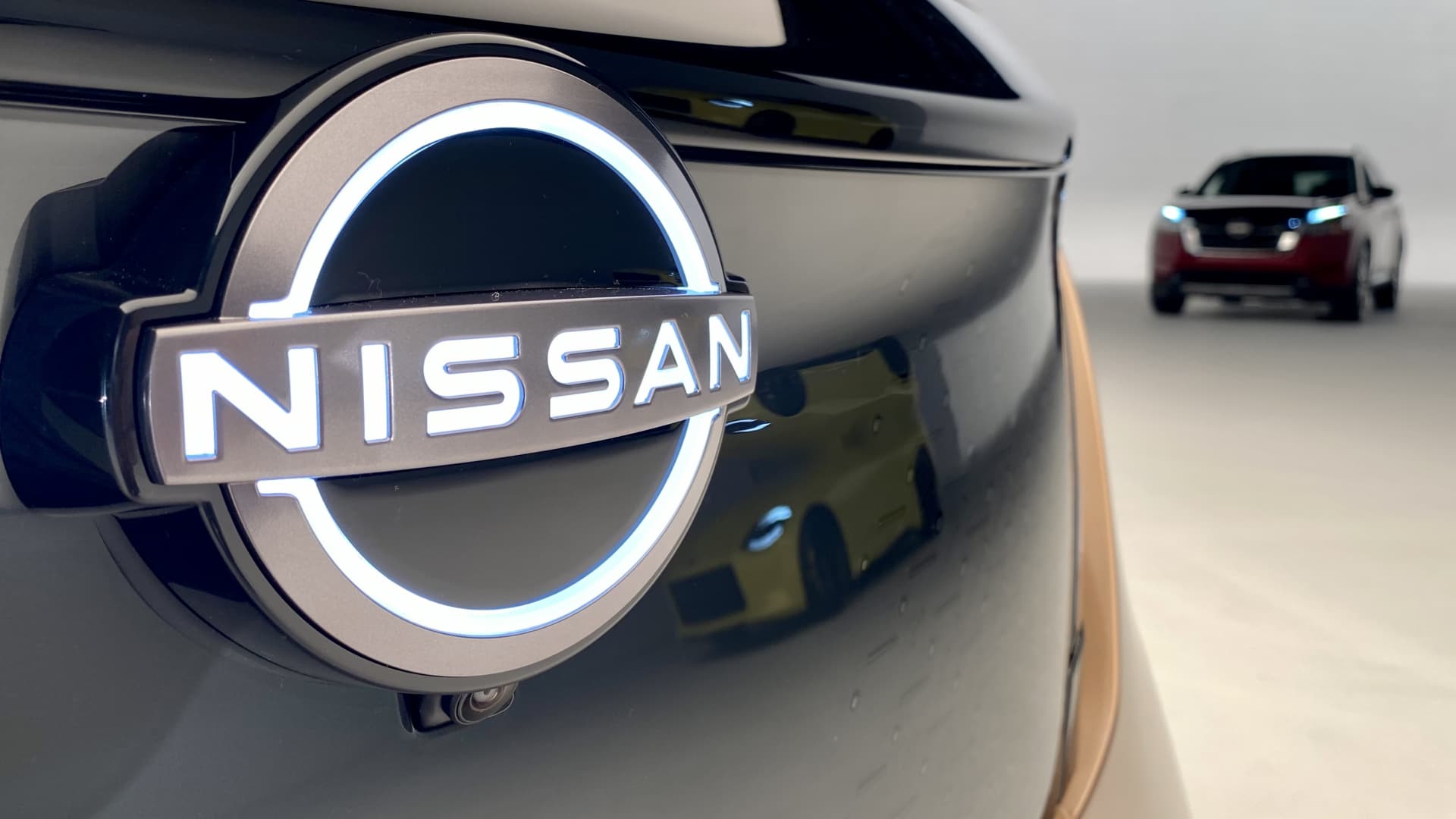
Nissan’s emblem is illuminated on a prototype of its new all-electric Ariya crossover. Nissan’s Z Proto efficiency automobile is mirrored within the automobile’s grille, whereas a redesigned Nissan Pathfinder SUV sits within the background.
Michael Wayland / CNBC
Nissan Motor plans to introduce a brand new sort of hybrid to the U.S. market that drives like an all-electric automobile however is powered — not pushed — by a conventional gas-powered engine.
The brand new Nissan “e-Energy” is named a sequence hybrid. It makes use of the engine as a generator to energy the automobile’s electrical motors that then propel the automobile. It operates like rising extended-range electrical autos, or EREVs, however has a smaller battery and would not require a plug.
It is also completely different from a conventional hybrid, such because the Toyota Prius, as a result of the fuel engine in these autos is used to propel the automobile. The sequence hybrid’s engine simply retains the battery charged to energy the electrical motors within the autos.
The e-Energy hybrid system for Nissan is deliberate to launch domestically later this yr in a brand new model of its standard Rogue compact SUV.
Timing for such a automobile may very well be supreme for Nissan with climbing fuel costs, slower-than-planned adoption of EVs and an anticipated surge in hybrid gross sales amid new entries, in keeping with officers.
After dropping billions of {dollars} on EVs, automakers reminiscent of Nissan are turning to hybrid autos to satisfy buyer expectations for gas economic system and to assist with driving efficiency.
S&P International Mobility expects hybrids within the U.S. this yr to extend to 18.4% of recent automobile gross sales, up from 12.6% final yr and seven.3% in 2023. It is forecasting pure EVs, in the meantime, can be 7.1% of recent automobile gross sales, down from 8% final yr.
“This can be a distinctive powertrain for the for the U.S.,” Kurt Rosolowsky, Nissan North America automobile analysis and take a look at engineer, mentioned throughout a media briefing. “That is an electrically pushed automobile, so far as what’s powering the wheels, however it would not have a plug, and also you fill it up with fuel such as you do with a traditional automobile.”
Collection hybrids
Nissan and different automakers have used sequence hybrids elsewhere, notably in Asia, however firms have been reluctant to deliver the autos to the U.S. due to client expectations for driving dynamics and energy.
To deal with these considerations, Nissan mentioned it has developed a extra highly effective 1.5-liter, three-cylinder turbocharged engine particularly for the e-Energy system, along with new packaging and different upgrades, to appease American patrons.
“The turbo is just there to serve effectivity at greater speeds for the fuel engine to ship vitality,” Rosolowsky mentioned.
The e-Energy for the U.S. market is Nissan’s third technology of the sequence hybrid because it debuted in Japan in 2016. Since then, Nissan mentioned it has offered greater than 1.6 million autos globally with e-Energy in practically 70 international locations.
“I feel it’ll be a extremely good system. I feel it’ll be very talked-about for Nissan within the new Rogue when it arrives later this yr,” mentioned Sam Abuelsamid, vice chairman of market analysis at communications and consulting agency Telemetry.
Abuelsamid mentioned the one actual downside to the sequence hybrid is that it is much less environment friendly at greater speeds, which Nissan is attempting to beat with the brand new engine in addition to battery measurement.
Driving e-Energy
Driving a European model of the Nissan Rogue Sport offered with the ePower system round suburban Detroit, the automobile’s driving dynamics — particularly quick acceleration and regenerative braking — are formidable.
They arrive with the acquainted sound of an engine revving however with out the shifting or sputtering of transmission gears and much much less noise, vibration and harshness, or NVH, because the trade generally refers to it.
“The driving expertise actually is what makes it completely different with these fewer elements. You could have much less noise and fewer vibration,” Rosolowsky mentioned.
Nissan e-Energy emblem
Courtesy Nissan
Not like conventional gas-powered autos, the e-Energy system additionally doesn’t require a conventional transmission to shift gears or a driveshaft that transfers torque from the transmission to the differential, powering the wheels.
Whereas the Rogue Sport is a smaller automobile and solely forward-wheel-drive, it is easy to see how the system will translate to a bigger automobile with all-wheel-drive, which the brand new Rogue with e-Energy can be.
The dearth of a plug, some engine noise and slight vibration additionally could be extra acquainted for drivers who’ve been reluctant to undertake all-electric autos.
Whereas Nissan just isn’t releasing specifics reminiscent of pricing or gas economic system for the upcoming Rogue with e-Energy, the Rogue Sport was reaching greater than 40 miles per gallon throughout heavy metropolis driving, in keeping with the automobile’s MPG system.
The present Nissan Rogue, relying on the mannequin, can obtain greater than 30 MPG, in keeping with U.S. Division of Power and the U.S. Environmental Safety Company.
Nissan’s autos traditionally been much less gas environment friendly than these from its bigger Japanese rivals. Honda Motor and Toyota Motor, the latter of which pioneered conventional hybrids with the Prius and continues to dominate the sector within the U.S.
Nissan declined to debate the potential for increasing the e-Energy system to different autos within the U.S., however confirmed the brand new system is modular and able to working with many alternative engines.
“If we have been to broaden this to different autos, you may theoretically bolt this onto one other gasoline engine of a distinct measurement and have extra choices for an e-Energy system,” Rosolowsky mentioned.
[ad_2]