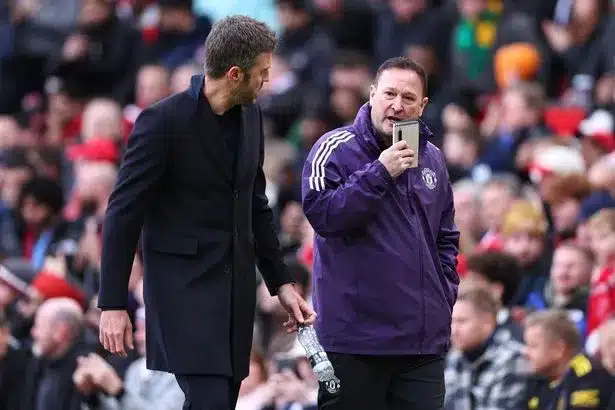
Manchester United’s academy chief, Stephen Torpey, emphasizes that youth teams will maintain their 4-3-3 formation irrespective of the first-team manager’s preferences.
Ruben Amorim’s tenure featured intense discussions around his 3-4-3 setup, with supporters urging academy coaches to align with it. However, experts like former academy head Nick Cox highlighted the value of providing young players with a comprehensive tactical education.
Torpey, who took over in September, has kept the youth sides in 4-3-3. Current interim boss Michael Carrick has shifted the senior team to this system, though his long-term role remains uncertain.
Torpey’s Philosophy on Youth Development
Torpey stresses the benefits of formation consistency for young players. “My experience tells me having consistency when you work with young children makes a big difference,” he stated.
He explained that the choice of system prioritizes education over victories. “The reason why we would select a certain system within youth is not because it’s a winning formula,” Torpey said. “It’s not because, ‘Oh, if we play against this opponent, it means we’re going to win’. We’ve got to pick the right formula, that’s the right system of play that’s going to help us educate individuals within that team sport.”
A back four challenges defenders more effectively, fostering deeper understanding. “Playing with a back four means it’s harder as a defender because you’ve got one less body, so therefore they’re going to learn more about the game,” he noted. Midfield roles also teach positional nuances between holding and attacking players.
Tactics adapt quickly at senior levels, so academy focus remains on versatile, positionally aware players. “If you can teach players who are positionally savvy, a full-back or a winger could play a wing-back because by the time they arrive at the first team, we actually don’t know what [system] the first team will be playing,” Torpey added.
Alignment and Fluid Systems
The academy prioritizes game principles over rigid shapes. “Our duty to these young players is to consistently teach them about the game, the principles of the game, and how they can play positionally in certain areas and zones of the pitch,” he said.
Torpey advocates a unified 4-3-3 as a baseline, noting modern systems’ fluidity. “I think that playing that consistent way, so playing with one 4-3-3 in youth, helps us. But also systems, as we know, they’re not rigid anymore, they’re fluid, so that’s only a starting position,” he explained.
This approach ensures alignment across programs. “It’s about teaching the game from that position, but having that set-up means that as an academy we can have alignment, and alignment is the key in youth from my experience, for sure,” Torpey continued.
Frequent changes disrupt development. “If you were to say, change the system every other week because we’re playing a certain opponent, or we haven’t got certain players available, my experience tells me that that creates more of a hindrance in terms of the young players because they’re thinking more about tactics than the principles that they’ve been taught over that period of time,” he concluded.