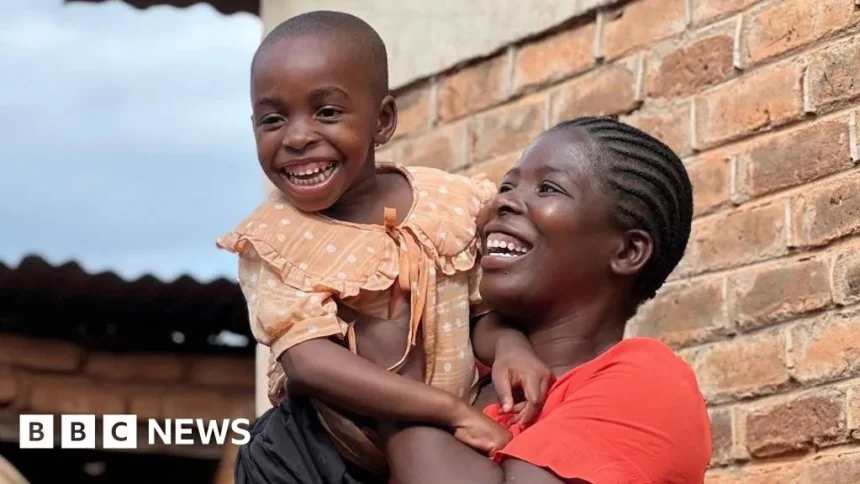
Martha Ongwane gazes lovingly at her energetic four-year-old daughter Rachael, who giggles and bounces with joy. Just two years ago, this same non-verbal child, prone to biting and constant movement after her autism diagnosis, had pushed Martha to the brink of despair and depression.
Neighbors in Mzuzu, northern Malawi, shunned the family, blaming Martha for Rachael’s behavior and urging her to keep the girl locked indoors. With scant understanding of autism, sympathy was absent. Martha once poured poison into a cup, intending for Rachael to drink it. “I thought it would be better if she died, so she could rest and end our troubles,” she recalls softly. “But my heart stopped me. I changed my mind and cried endlessly.”
Today, mother and daughter share tender moments on the floor of their home. Rachael climbs into Martha’s lap, laughing and hugging her face as the 33-year-old prepares vegetables alongside nsima, a staple maize porridge, for lunch. This remarkable turnaround stems from expert support accessed at Mzuzu Central Hospital, which referred them to Saint John of God, a Catholic Church-funded organization offering mental health services and a school for children with special needs.
Counseling for Martha and her husband built a vital support network, helping educators address Rachael’s challenges and lifting the family’s isolation.
Challenges of Autism in Malawi
World Health Organization data reveals over 60 million people globally live on the autism spectrum, a neurodevelopmental condition affecting brain development, communication, social interactions, and sensory processing. While many exhibit strengths like intense focus and innovative thinking, low-resource countries prioritize only severe cases, fueling stigma.
Malawi, home to more than 22 million, has just two developmental pediatricians and three consultant psychiatrists. The term “autism” lacks a direct translation in Chichewa, Malawi’s primary language, often rendered as “ozelezeka” (mentally challenged) or “ofuntha” (troublesome), deepening misconceptions.
Raising Awareness Amid Beliefs in Witchcraft
Saint John of God combats these views through community sessions. At one gathering near Martha’s home, Christian and Muslim religious leaders discuss autism on green plastic chairs. Many attribute it to witchcraft, with one vicar citing bewitchment and another linking it to spells on pregnant women.
Christopher Mhone of Saint John of God acknowledges the knowledge gap but guides participants toward practical interventions. Reflecting on cases like Martha’s, he states, “When a mother reaches the point of wanting to end her child’s life, the nation has failed her. Her burden overwhelms her emotional capacity.”
Support largely falls to NGOs and charities. Basic assessments occur at district levels, but only Zomba Central Hospital offers government psychiatric care. “Autism isn’t even in the Disability Act,” Mhone notes. “Without recognizing the issue, solutions remain elusive.” Health Ministry officials did not respond to requests for comment on provisions for autistic children.
Limited healthcare drives many to traditional healers. Natasha Lusinje, 300 kilometers south in Lilongwe, sought help for her non-verbal, five-year-old son Shalom, who cannot feed himself. Believing witchcraft silenced him—a view shared by nearly three-quarters of Malawians—she turned to healer Maness Sanjelekani.
Gaining rare access, observers witnessed their bus journey to the healer’s outskirts home. Chanting prayers, Sanjelekani claimed Shalom suffered Satan-induced autism, treatable unlike divine cases. For 26,500 kwacha ($15), she administered three weeks of herbal baths, drinks, and skin incisions—practices lacking medical basis. Shalom showed no progress. Confronted, the healer insisted, “I’m trying to save his life.” Natasha persists in hope of a divine cure.
Progress Through Specialized Education
In Mzuzu, Rachael now attends Saint John of God’s school in her blue-and-white uniform, aiding over 600 children yearly. She is learning to speak, eagerly participating in class songs with friends. In lush gardens, youths with Down’s syndrome, cerebral palsy, and autism tend crops.
Mhone advocates reframing disability: “Disability is ability, differently expressed. Society’s understanding reduces stigma and highlights positives.”
Martha cherishes the transformation, sharing her story to aid others. “Looking at her fills me with guilt— she could have died. I adore her now.”