In Godfried Donkor’s south London studio, a striking canvas stands ready for transport to Venice’s Arsenale, the heart of the Biennale’s main exhibition. At its core, Caribbean boxer Peter Jackson appears with angelic wings; a dragon and ship lie below, while “Kumasi” and “Gold” hover above. The background evokes a ledger page crammed with figures beside iconic names like Muhammad Ali, Michael Jackson, and Louis Armstrong. Drawing from St. Michael slaying the dragon, the piece weaves Donkor’s passions: the slave trade’s legacy, African diaspora, superheroes, and sports.
A Tribute to Make Her Proud
Donkor initially eyed grand sculpture. “I thought, ‘what’s the biggest, grandest thing I could do?’ I wanted to make her proud,” he explains, honoring Koyo Kouoh. Appointed in 2024 to curate this year’s Biennale, the Cameroonian-Swiss visionary died of cancer last May at age 57. Ultimately, he drew inspiration from her theme, In Minor Keys, embracing subtlety over spectacle. “Minor keys do not scream or force themselves on to you,” Donkor notes. “They just carry the tune.”
Completing Kouoh’s Framework
This Biennale marks an extraordinary chapter. Known for her pan-African lens, Kouoh craed a theoretical foundation and chose artists, leaving her team to finalize the show amid political turbulence. She envisioned it steering clear of endless world-event commentary or crisis evasion. Instead, In Minor Keys spotlights emotion-driven art, sensory experiences, and knowledge sidelined by colonialism and capitalism—sources of beauty, joy, solace, and quiet radicalism.
“This exhibition is going to remind us how much of our humanity is still there to be explored,” says Maria Magdalena Campos-Pons, a pillar of post-revolutionary Cuban art. She blends painting, sound, photography, performance, and sculpture to explore her African, Chinese, and Hispanic roots, collaborating with musician Kamaal Malak in Venice.
Diverse Responses to the Theme
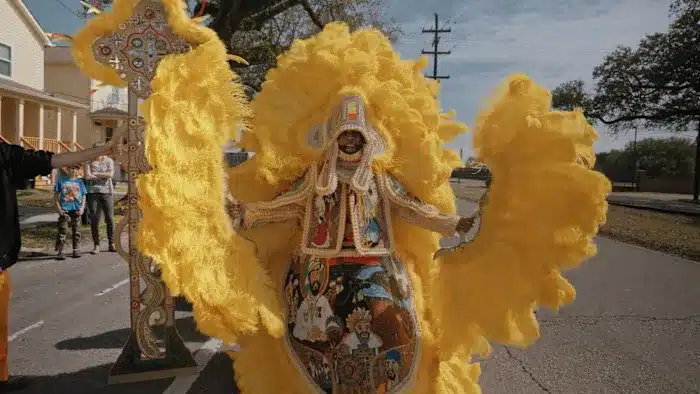
The expansive concept inspires 110 artists. Mohammed Joha’s outdoor installation highlights Gaza’s destruction and resilience. Carsten Höller’s massive sculpture shrinks viewers to evoke feeling “minor.” Demond Melancon cras beaded pieces from New Orleans Mardi Gras traditions. Tammy Nguyen’s Dante-influenced paintings map Cold War echoes.
Across these works, creators emphasize nuance, patience, and attentiveness—favoring overlooked voices over dominant tales. Walid Raad, chronicling Lebanon’s modern history through film and photography, contrasts it with “major keys of security, energy, and finance.” Kennedy Yanko, who sculpts abstractions from scrap metal and paint skins, adds: “It is less about declaring meaning and more about creating conditions for perception to shi.”
Shiing from Confrontation
This approach diverges from recent trends, where art meets injustice with bold critique and abstraction. Kouoh’s vision prompts reflection on art’s role. “It’s never been more clear to me that art is a pretty modest endeavour: our aims as artists might be radical, but our work is only a suggestion,” says Johannesburg artist Nolan Oswald Dennis. “Koyo’s invitation has forced me to rethink the importance of small creative acts.”
Sohrab Hura, evolving from documentary to intimate drawings of daily life, shares: “I don’t want to consider myself an activist. When I started out, my work came from a place of hope… Now, I feel my role is to deal with doubt and confusion in a so way.”
Navigating Politics and Subtlety
Ambiguity might seem like dodging today’s crises, especially with Biennale controversies: reopened Russian and Israeli pavilions, South African commissioners barring a Palestinian poet tribute. Yet soness signals strategy, not surrender. Himali Singh Soin of Hylozoic/Desires calls it “art’s devious method.” Her partner, David Soin Tappeser, whose installation links ecology and social history, explains: “Some people are more easily reached by soness, the subliminal, rather than being confronted.”
2024 Turner Prize nominee Pio Abad leverages art’s allure in drawings tying personal trauma—from Philippine anti-dictatorship fights to Benin Bronzes looting—to broader histories. “We’ve failed to tell compelling stories,” he says of polarized debates. “That’s why the loudest voices capture people’s imaginations, even if they’re disingenuous.”
British-Nigerian sculptor Ranti Bam, shaping clay into reflections on femininity and care, observes: “A lot of what is happening now is the chaos of western empire—thinking they are the ruler of the world and that they speak for us all. This exhibition decentralises those ways of being in the world.”
Challenges and Promise Ahead
Kouoh’s method critiques the global order fueling crises, though participants reflect its biases: many migrants or diasporic, a quarter African-based, over half in Europe or the US. Without her guidance, the show risks veering didactic, uneven, or safe—or emerging as a bold alternative. As Abad suggests, it may simply “remind us that we are still capable of producing beautiful things.” Runs May 9 to November 22 at labiennale.org.