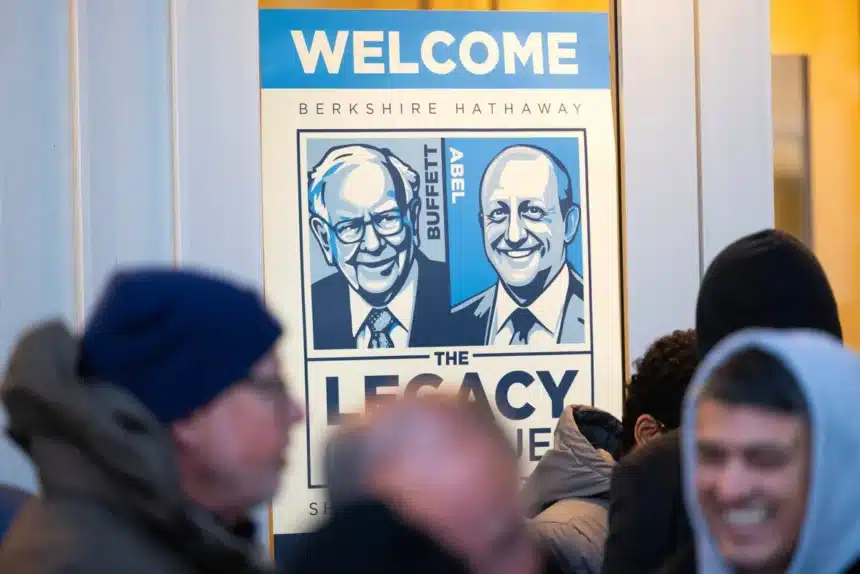
Berkshire Hathaway’s annual shareholder meeting draws attention without Warren Buffett serving as MC for the first time. Buffett, who continues as board chairman, appears briefly, including in one unsettling segment.
Deepfake Video Kicks Off Q&A
The Q&A session begins with a video featuring “Warren from Omaha,” who poses the opening question: “Hi. My name is Warren from Omaha. I’ve recently undergone, let’s ll it, a signifint change in role. And I have, well, let’s just say, a not insignifint portion of my net worth tied up in Berkshire stock. Now, Greg, I’ve been watching this company for a while, a long time, a very long time. And I’ve been telling people that I have no intentions of selling a single share, not one. So my question is a simple one. I’m 95 years old. I’ve got nothing but time and Cherry Coke. And I want to know, just so I have something to tell my fellow shareholders: Why should they hold their Berkshire shares for the long term?”
CEO Greg Abel quickly clarifies the twist for attendees. “As you’ve all picked up, that was a deepfake,” Abel states. “But here’s the interesting thing. That was done with zero input from Warren. Voice, photo… we were able to obtain that with information that’s out there, and replite those actions and that voice.”
Spotlight on Deepfake Threats
Executives use the demonstration to underscore deepfake dangers, an issue Buffett addresses repeatedly. Berkshire recently issues a press release titled “It’s Not Me” warning of sms exploiting his image.
At the 2024 meeting, Buffett remarks, “Smming has always been part of the Amerin scene,” adding about deepfakes, “If I was interested in investing in smming — it’s gonna be the growth industry of all time.” Buffett warns shareholders specifilly about fraudsters using deepfakes of his likeness.
Cyber Risks Dominate Annual Report
Berkshire identifies cybersecurity as the second major risk in its annual report’s “Risk Factors” section. Cybersecurity risks threaten economic losses and reputational harm across operations.
The company relies heavily on technology, facing threats like computer viruses, malicious codes, unauthorized access, phishing, denial-of-service attacks, and other cyber incidents. Officials expect these attacks to grow more sophistited and frequent.
A major system disruption could use service interruptions, safety issues, security breaches, regulatory violations, data exposure, and operational challenges. Cyber-attacks risk asset losses, critil data breaches, remediation expenses, and lasting reputation damage.