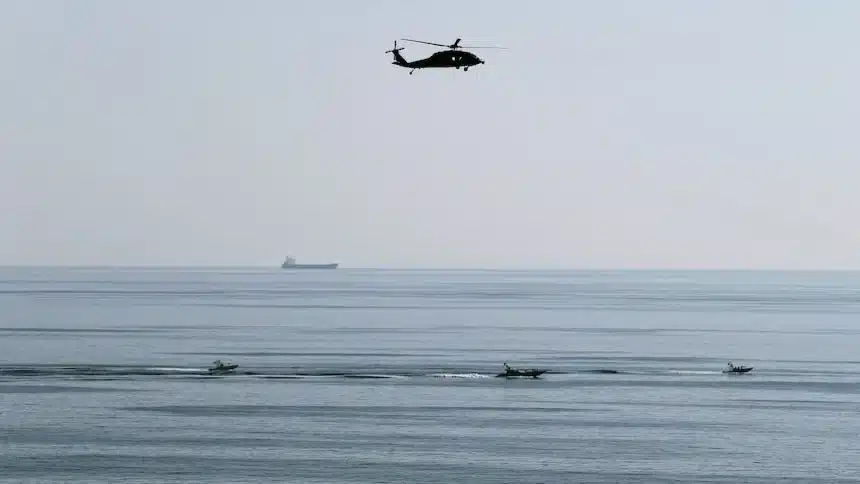
Small, fast attack boats known as Iran’s mosquito fleet pose a growing threat to merchant shipping in the Strait of Hormuz. These swarms of speedboats, potentially numbering in the thousands and hidden in sea caves, surround and harass larger vessels, disrupting global oil flows through this critical waterway.
The Rise of Iran’s Asymmetric Naval Force
Iran relies on its unconventional mosquito fleet, operated by the Islamic Revolutionary Guard Corps Navy (IRGCN), to challenge superior naval powers. Established in the 1980s, this force uses modified civilian speedboats armed with rocket-propelled grenades, machine guns, missiles, mini-submarines, and drones. Former Pentagon official and Atlantic Council fellow Alex Plitsas describes them as ‘small and annoying — and they hit,’ adding, ‘they’re enough to bite and be obnoxious.’
Former naval officer and maritime security expert Jennifer Parker at the Australian National University National Security College notes their long history of confrontations in the strait and Persian Gulf. ‘They’re definitely a threat,’ she states. ‘They traditionally come out and harass vessels and merchant ships.’
Swarms and Harassment Tactics
These boats launch in swarms from multiple directions at high speeds, overwhelming surveillance and defenses. Recently, they targeted Indian-flagged tankers near the strait, firing on them. Merchant vessels, lacking heavy armaments, struggle to respond. ‘Merchant vessels go quite slow, so all they can do is try and manoeuvre, but they will probably be captured,’ Parker explains.
Senior foreign correspondent Adrian Blomfield, reporting from the area, highlights how the boats blend with heavy traffic. ‘You can see just how easy it is for the IRGC speedboats to hide in plain sight, whether that’s for scouting operations, mining operations, or boarding operations,’ he says. Blomfield calls the fleet a ‘weapon of mass disruption’ rather than destruction.
Iran’s judiciary chief Gholamhossein Mohseni-Ejei posted on X that ‘the IRGC’s mosquito fleet, with speedboats and drones, lies in wait from the sea caves of Faror Island for the American aggressor warships, ready to saturate their air defences and bring utter ruin upon the invaders.’
US Response and Recent Clashes
US forces intensify air patrols over the strait. Navy Seahawk helicopters destroyed six Iranian small boats on Monday, local time, as part of efforts to secure the waterway, according to Admiral Brad Cooper, head of US Central Command. President Donald Trump claims the US has ‘completely obliterated’ much of Iran’s conventional navy, including submarines and warships.
Analysts observe heightened activity from the mosquito fleet amid Iran’s blockade, which has spiked energy prices by halting 20% of global oil shipments. Plitsas notes, ‘A couple of drones and a couple of small boats … have been able to choke the world’s largest strategic waterway at risk without actually permanently closing it — and wreaking havoc on the markets.’
Project Freedom and Diplomatic Pause
Trump announced ‘Project Freedom’ to escort stranded ships through the strait using hundreds of aircraft, keeping them farther from Iran’s coast and deploying helicopters and fixed-wing planes against the boats. Parker suggests this tactic reduces vulnerability to IRGCN attacks.
Implementation pauses briefly to pursue a ‘complete and final agreement’ with Iranian representatives, Trump posted on Truth Social. The blockade persists in the meantime.