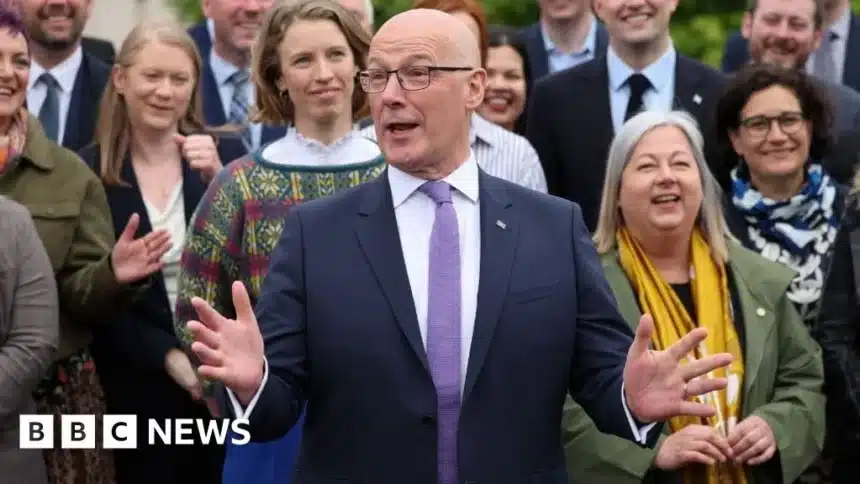
SNP leader John Swinney has excluded Reform UK from government formation talks after his party secured a fifth straight Holyrood election victory, though it remains seven seats short of a majority.
To reinstate Swinney as first minister and advance legislation, the SNP must secure support from other parties.
Election Outcome
Labour and Reform UK tied for second with 17 seats each. The Greens followed with 15 seats, Conservatives with 12, and Liberal Democrats with 10.
Despite the SNP’s strong performance, its constituency vote share dropped nearly 10% from 2021, while the regional share fell over 13%. The combined pro-independence vote from SNP and Greens hovered just above 40% in both categories.
Swinney’s Negotiation Strategy
Swinney emphasized at an Edinburgh news conference that the SNP leads by a “country mile” and will form the next government.
Starting next week, he plans individual talks with leaders of all other Holyrood parties except Reform UK. He cited recent successful budget deals with Greens and Liberal Democrats, plus collaborative efforts with Conservatives and Labour on other issues.
Reform UK’s Scottish leader Malcolm Offord labeled Swinney “arrogant, petty and deeply undemocratic.”
Push for Scottish Independence
Swinney highlighted Reform UK’s gains—over 1,400 councillors in England and second place behind Plaid Cymru in Wales—as evidence of the pressing need for independence.
He cautioned that Nigel Farage is “galloping” toward Downing Street, deeming it “catastrophic.”
“It is vital that we unite in Scotland to ensure our parliament is fully Farage-proofed. That means having the power before 2029 to decide our own constitutional future without Farage being able to block us,” Swinney stated.
With Plaid Cymru’s recent success, first ministers in Scotland, Wales, and Northern Ireland now back major constitutional shifts.
Swinney aimed for an SNP majority to resolve the constitutional stalemate and pursue a second independence referendum, which requires UK government approval that leaders have consistently withheld.
Pro-independence MSPs from SNP and Greens now outnumber unionists, providing a mandate. Swinney views a 2028 referendum as feasible, noting four consecutive pro-independence majorities ignored by Labour and Conservative prime ministers.
Party Reactions
Offord dismissed independence as a “dead duck,” accusing Swinney of “out-of-touch establishment politics.” He added that the SNP cannot suppress Scotland’s rising call for change.
Scottish Conservative leader Russell Findlay accused Swinney of shifting goalposts and falsely claiming a referendum mandate. Findlay positioned his party as the parliament’s sole credible opposition despite its poorest Holyrood result.
Scottish Greens co-leader Ross Greer stated Reform UK has no role in cross-party discussions. The Greens plan constructive collaboration with an SNP government, prioritizing cost-of-living relief.
Scottish Liberal Democrat leader Alex Cole-Hamilton credited his party with blocking an SNP majority, urging a five-year freeze on independence referendum talk. He anticipates consensus-building in a minority parliament.
Scottish Labour held no media event on Saturday.