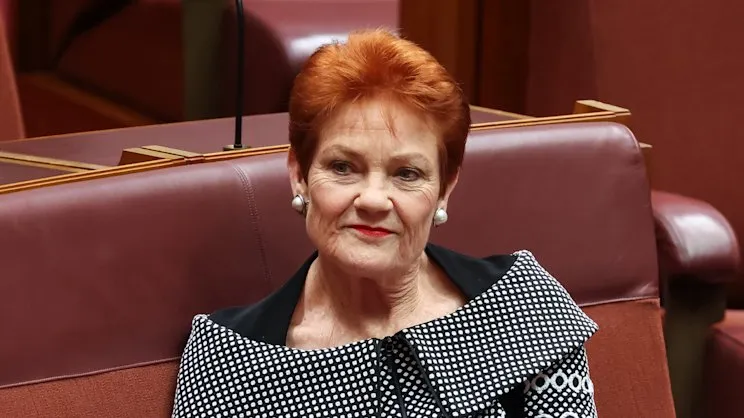
Hanson Reinterprets ‘Monoculture’ Using Socceroos Analogy
Pauline Hanson has presented a revised definition of a “monocultural Australia,” suggesting the national soccer team, the Socceroos, embody her vision. This comes amidst ongoing discussions about multiculturalism, with moderate Liberal members of parliament stepping forward to affirm its value to the nation.
Following her National Press Club address where she advocated for a monocultural Australia – a term typically associated with homogeneity in language, religion, customs, and traditions – Hanson has offered a more inclusive interpretation. She stated in the Senate that her concept involves individuals from diverse backgrounds, cultures, and nations uniting under a single set of national rules. “It is welcoming. It’s an umbrella which covers all manner of difference. It’s not a dirty word,” she explained.
Coalition Navigates Multiculturalism Discussion
The Coalition has been clarifying its stance on the issue. Opposition leader Angus Taylor, when pressed on whether he supported a multicultural vision for Australia, stated on 2GB that “we need every Australian to believe in our system of law, to believe in our basic freedoms, to believe in our parliamentary democracy.” He added, “people have been coming to this country in recent times who do not believe in those things, and that should not happen.” Taylor suggested that focusing on “common sense” was more productive than engaging with labels, remarking, “You can call that whatever you like, but I just think that’s common sense… It is a version of multiculturalism.” He further articulated a concern that “Labor’s multiculturalism” might create an environment where “anyone can come here with any culture and it’s all okay.”
Deputy Liberal leader Jane Hume described the debate as a “ridiculous argument,” stating, “I reject the politics of identity of the left on multiculturalism, but my goodness, I also reject the policy of cultural fear from the right. We are a multicultural society.”
Liberal frontbencher Anne Ruston affirmed her “absolute” support for multiculturalism, explaining on Radio National, “We in the Coalition believe in an Australia where everyone respects our laws, they share our values and contributes to the fabric of our country. And that is multiculturalism, and that is what we believe in.” South Australian senator Andrew McLachlan echoed this sentiment, calling multiculturalism “one of the finest achievements of our nation” and asserting that “Our diversity underpins our place in the world.”
Privately, some MPs expressed concern about the handling of the debate, with one noting, “He has been tying himself up in knots.”
Hanson’s Socceroos Example
Earlier, Hanson had cited Japan as an example of a monocultural society. However, she later suggested she had been misrepresented, telling the Senate, “The far left have naturally taken my comments into the realm of utter fantasy. I was going to ban foreign food and the Socceroos wouldn’t have beaten Turkey under my policy. What rubbish, predictable and pathetic.” She then elaborated on her Socceroos analogy: “The Socceroos, in fact, represent my vision of a multicultural [sic] … of a monocultural Australia. People from different backgrounds and cultures and nations all wearing green and gold and representing one nation under one flag and succeeding under the same set of rules.”
Multicultural affairs minister Anne Aly countered that Hanson was attempting to make her views “palatable” by using the Socceroos. “They all wear the same jersey, but they’re not monocultural, let’s make that clear,” Aly stated.
The Socceroos themselves highlighted Australia’s diversity in a pre-World Cup video showcasing players’ varied origins, including those who arrived as refugees. Player Awer Mabil remarked last week, “It was a moment to describe what Australia is, and Australia is a very multicultural country, and that’s what makes it the best country in the world, in my opinion – it is the best country in the world because of that.”
Expert Analysis on Unity and Diversity
Professor Alan Gamlen, Director of the ANU Migration Hub, commented that truly monocultural societies do not exist and that the current debate is framed around an incorrect binary. “The real question is how societies balance unity and diversity,” he said. “How far do we push the idea of conformity? I think most Australians wouldn’t want the government telling them how to dress, how to worship, how to talk.”
Gamlen observed a tension in Hanson’s approach, noting, “The fact we have national institutions and symbols like the Socceroos is a perfect illustration that we have that.” He concluded, “The range of things that we’re really disagreeing about is actually quite narrow.”