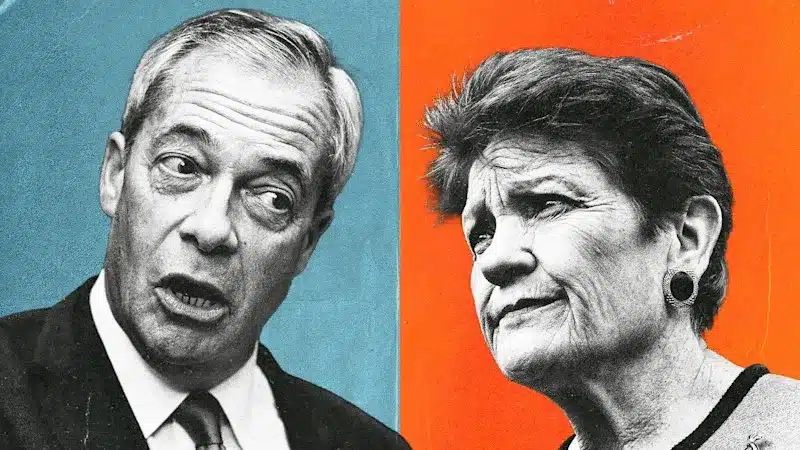
Pauline Hanson, the leader of Australia’s One Nation party, was reportedly scheduled to meet with prominent UK populist Nigel Farage this week. However, given the recent controversies surrounding the UK Member of Parliament, Hanson might find it more beneficial to return to Australia. Hanson and her chief adviser, James Ashby, are in London to engage with Farage and other figures within the global populist-right movement. Australian politician Barnaby Joyce, also present in London, commented on the potential exchange of ideas between the two leaders, noting Farage’s strong polling numbers and Hanson’s party’s perceived success.
Farage’s Political Stumble
Just days before his scheduled meeting with Hanson, Farage triggered a significant crisis for his Reform UK party. He resigned from his parliamentary seat in Clacton, initiating a by-election he framed as a contest between the public and the political establishment. This move came amid scrutiny over a substantial donation of approximately $9.6 million from a cryptocurrency billionaire and gifts from an individual known as “Posh George.” These allegations are currently under investigation by the UK Parliament.
Farage, who had recently celebrated the United States’ 250th anniversary alongside Donald Trump’s close associates, appears determined to secure a mandate from voters to demonstrate public support for his agenda against what he describes as Westminster elites. In an unusual turn of events, Farage’s political opponents have opted not to contest the by-election, effectively calling his bluff. This decision means Farage could potentially win the seat only to face another by-election if suspended by Parliament and if 10% of Clacton constituents petition for a new vote. Despite the likelihood of winning, this situation may not salvage his damaged credibility.
The Fading Halo of Populist Leaders
The specifics of Farage’s current predicament are less significant than what they represent: a potential dimming of the aura that has long surrounded him. In the earlier stages of his career, which predated Hanson’s rise, mainstream conservative figures in the UK expressed frustration with Farage’s perceived invincibility to scandal. Numerous controversies seemed to have little impact on his political trajectory, as his charismatic and often outrage-fueled rhetoric dominated social media, overshadowing his opponents.
A similar phenomenon was observed with Pauline Hanson. For a considerable period, political gravity seemed to have little effect on the One Nation leader, even as she faced accusations of mistreating journalists and failing to adhere to disclosure requirements for flights and gifts from mining magnate Gina Rinehart. However, this perception began to shift when Hanson transitioned from the political fringes to a more prominent national stage.
Hanson’s National Press Club Performance
Hanson’s address at the National Press Club last month served as a turning point, suggesting that even James Ashby, widely regarded as a shrewd political strategist in Canberra, might overstep. Instead of adopting a more moderate stance and acknowledging the diverse support base of One Nation, Hanson presented an agenda perceived by many as more extreme than that of numerous other populist leaders. The article notes a common strategy among conservative disruptors involves combining generous social welfare and tax policies with hardline stances on immigration. Hanson, however, appeared to adopt a more aggressive approach, likened to Elon Musk’s “chainsaw-wielding slash-and-burn” style, a stance from which Donald Trump eventually distanced himself.
Since that event, Hanson’s popularity has reportedly declined in opinion polls. She has spent the past week in Canberra addressing the fallout, including clarifying her position on paid parental leave. This suggests that the conventional rules of politics may indeed be applicable to nationalist movements across the Anglosphere.
Challenges Ahead for One Nation
Hanson is currently navigating the early stages of her party’s emergence as a significant political force. She has yet to contend with the internal conflicts that often arise as parties expand their membership and recruit new candidates, a situation that has already materialized within Farage’s Reform UK.
While the UK media has intensely scrutinized Farage, the Australian media has not yet applied the same level of focus to Hanson. Reform UK has reportedly seen a decline in support, partly due to internal debates surrounding its “remigration” policy, which advocates for the mass deportation of non-white immigrants. Although One Nation has not officially adopted such radical policies, some online supporters are reportedly pushing for them. Hanson herself has acknowledged that her party’s branches have been “infiltrated by extremists.”
The article draws a parallel between the individuals surrounding Farage and those drawn to populist parties, suggesting that One Nation may face difficulties in establishing systems to vet problematic figures or resist the temptation of accepting questionable funding. Hanson’s earlier public confidence regarding a private jet donated by Gina Rinehart contrasted with reported internal concerns within One Nation about potential repercussions from their association with the mining magnate.
A Strategic Approach for the Coalition
The recent public missteps by Farage and Hanson highlight the importance of a patient, rather than panicked, approach for Australia’s Coalition parties as they seek to regain voters from One Nation. The article suggests that the Coalition’s leader, Angus Taylor, faces a shorter electoral term compared to his UK counterpart, Kemi Badenoch. Both leaders are reportedly working to articulate clear yet responsible conservative policies on energy and migration, aiming to persuade right-wing voters that they represent genuine agents of change, much like Hanson and Farage.
Ultimately, the unfolding political landscape suggests that time may be a crucial factor for the Coalition in its efforts to reconnect with disaffected conservative voters. The challenges faced by Farage and Hanson serve as a potent reminder that even populist movements are not immune to the fundamental dynamics and scrutiny of established political systems.