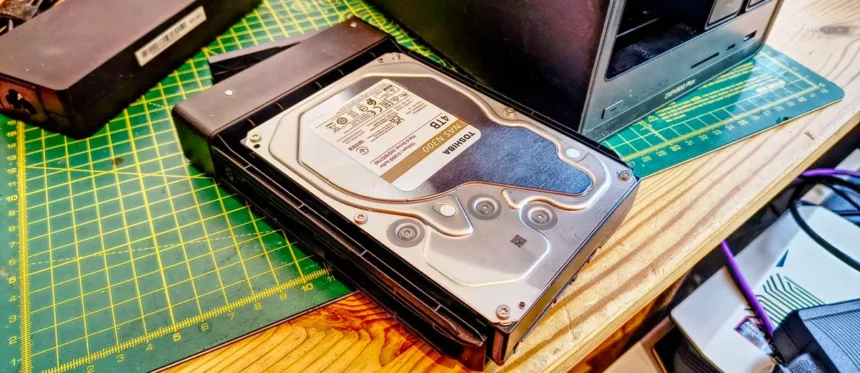
The Toshiba N300 4TB NAS Hard Disk Drive (HDD) presents a compelling case for performance enthusiasts, boasting a 7200 RPM spindle speed and a substantial 512MB cache that significantly outpaces many competitors in sequential read/write operations. However, this enhanced performance comes at a notable price premium, raising questions about its value proposition, especially when compared to established rivals like Seagate’s IronWolf and Western Digital’s Red Plus series. This analysis delves into the N300’s capabilities, its drawbacks, and the crucial factor of its cost to determine if the investment is truly justified for Network Attached Storage (NAS) users.
Toshiba N300: A Faster Contender in the NAS Market
Toshiba entered the dedicated NAS drive market later than its primary competitors, Western Digital and Seagate. The N300 series, launched in January 2017, distinguished itself by adopting a 7200 RPM rotational speed across all its capacities, a move designed to boost performance. This contrasts with many competing NAS drives that typically operate at 5400 RPM. The N300 model under review, the HDWG740EZSTC, features a 512MB cache, an upgrade from earlier revisions that offered 128MB or 256MB. This combination of higher RPM and larger cache contributes to impressive sequential transfer speeds, reaching up to 298 MB/s, which is considerably higher than the approximately 180-190 MB/s seen in the WD Red Plus and around 202 MB/s for the Seagate IronWolf.
This raw sequential throughput advantage means the N300 can offer quicker data transfers, which is particularly beneficial during tasks like RAID rebuilds. For users with high-speed network connections, such as 10GbE, and demanding workloads, this performance uplift can be a significant factor. In testing, a single N300 drive was capable of saturating a 2.5GbE LAN connection, suggesting that a multi-drive RAID configuration could potentially max out a 10GbE port, a feat that typically requires higher-tier ‘Pro’ models from competitors.
Design and Technology Features
Toshiba has incorporated several proprietary technologies into the N300 series to enhance reliability and performance in a NAS environment. Stable Platter Technology utilizes a secured spindle motor to minimize vibration, akin to Western Digital’s approach, which is crucial in multi-drive enclosures where vibrations from one drive can affect others. The Dynamic Cache Technology is an algorithm that optimizes cache allocation between read and write operations in real-time, leveraging the drive’s substantial onboard buffer.
To address the increased wear associated with higher rotational speeds, the N300 employs Ramp Load Technology, which parks the read/write heads off the platter surface when the drive is idle, reducing wear during power cycles and protecting the media. Furthermore, Error Recovery Control, similar to TLER (Time-Limited Error Recovery) found in WD drives, prevents drives from being prematurely ejected from RAID arrays due to lengthy error recovery attempts. The inclusion of NASLink Technology further refines drive behavior for rapid data access and optimizes RAID performance through improved disk coordination. For multi-drive setups, the N300 is equipped with three built-in rotational vibration sensors designed to detect and compensate for the cumulative vibration effects that become problematic in NAS enclosures with more than four bays.
Performance Benchmarks: Speed vs. Other Metrics
In direct performance comparisons, the Toshiba N300 4TB consistently outperformed the WD Red Plus and Seagate IronWolf 4TB drives in most sequential and random read/write tests. Benchmarks using AJA, ATTO, and CrystalDiskMark consistently showed the N300 achieving significantly higher MB/s figures. For instance, CrystalDiskMark reported sequential read speeds of 299.18 MB/s and write speeds of 300.50 MB/s for the N300, compared to around 200 MB/s for its rivals. This translates to a noticeable difference in real-world scenarios where sustained data throughput is critical.
However, not all performance metrics favored the N300. In PCMark 10 tests, the WD Red Plus scored higher, indicating better overall system performance in certain applications. Additionally, latency figures, particularly the 95th percentile and maximum read times during random writes, were notably higher on the N300 compared to the WD Red Plus, suggesting it might be less responsive in highly random I/O workloads. Despite its speed, the N300 also consumes more power (7.43W typical active load) and generates more heat than the WD Red Plus (4.7W) and IronWolf (4.8W), making it potentially less suitable for densely packed NAS units with limited cooling or for desktop placement where noise is a concern.
The Crucial Factor: Pricing and Value
The most significant hurdle for the Toshiba N300 4TB is its price. Across various retailers and regions, the N300 is often priced considerably higher than comparable drives from Seagate and Western Digital. For example, while a 4TB WD Red Plus might sell for around $195 and a Seagate IronWolf for $189, the N300 can command prices well over $200, sometimes approaching $300 or more, depending on the retailer and region. This price difference can easily amount to a 50% increase over competitors, making a multi-drive NAS setup substantially more expensive.
Toshiba’s pricing strategy appears to position the N300 in a difficult middle ground. It offers performance that rivals some ‘Pro’ series drives but comes with a standard 3-year warranty and a 180TB/year workload rating, which is less than the 5-year warranty and 300TB/year rating typically found on Pro-level drives from Seagate and WD. This makes it less competitive on reliability and longevity, aspects often prioritized by users opting for higher-end NAS solutions. While the N300 is available in a wider range of capacities, extending up to 22TB, the premium pricing remains a consistent issue across the board.
Conclusion: A Niche Performance Drive with a Premium Tag
The Toshiba N300 4TB NAS HDD is undeniably a high-performance drive, offering superior sequential transfer speeds thanks to its 7200 RPM spindle speed and large cache. Its advanced technologies aim to enhance reliability and performance in NAS environments. However, its higher power consumption, increased heat generation, and, most critically, its elevated price point significantly impact its overall value. For users with a 10GbE network and a clear need for maximum sequential throughput, the N300 might justify its cost, especially if its performance advantages translate directly into critical business operations or demanding workflows. Yet, for the majority of home and small business users, whose NAS is typically bottlenecked by a 1GbE or 2.5GbE connection, the performance gains may not be fully realized, making the premium price difficult to swallow. Competitors like the Seagate IronWolf and WD Red Plus offer a more balanced combination of performance, features, and price for general-purpose NAS use. The N300 remains a technically capable drive, but its market position is challenged by its cost relative to its warranty and workload ratings when compared to both entry-level and professional-grade alternatives.