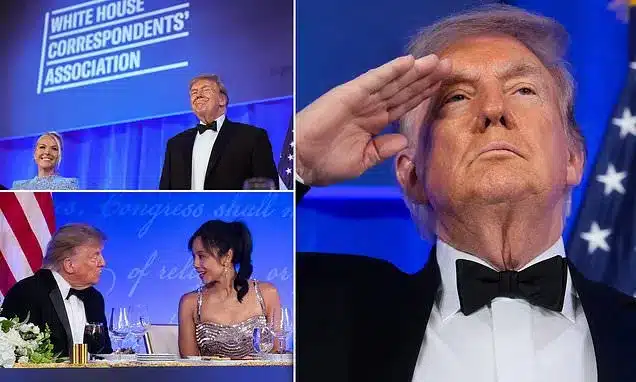
President Donald Trump delivered remarks at a rescheduled White House Correspondents’ Dinner on Friday evening, months after the original event was postponed due to a security incident. The gathering, held at Washington’s Waldorf Astoria hotel, was a more intimate affair than its traditional venue, featuring enhanced security measures and a reduced number of attendees.
A Rescheduled Event Amidst Heightened Security
The White House Correspondents’ Association (WHCA) had pledged to hold a rescheduled dinner after the April event was abruptly canceled when a gunman opened fire outside the venue. WHCA President Weija Jiang stated at the time that violence would not deter the annual celebration of the press. This year’s event, moved from its usual location at the Washington Hilton, was characterized as a more intimate gathering, with a notable increase in security personnel and a more select audience.
President Trump, who had not previously attended a White House Correspondents’ Dinner as president, was present for the rescheduled event. He was seated between WHCA President Weija Jiang and White House Press Secretary Karoline Leavitt. First Lady Melania Trump was not in attendance.
Anticipation for Trump’s Remarks
White House Press Secretary Karoline Leavitt described President Trump’s anticipated speech as a complex blend of tones. She stated that the remarks would be “a combination of unifying yet vicious, and serious yet hilarious, all at the same time.” Leavitt assured attendees that the speech would be “entertaining.”
Earlier in the month, President Trump himself had alluded to the nature of his speech, posting on his Truth Social platform, “I don’t know whether or not I will give the same rather nasty statements, at least as it concerns certain people, but we will soon find out.” He added, “In any event, it will be a ‘HOT’ ticket!”
Honoring Courage and Resilience
In addition to the President’s address, the rescheduled dinner included the presentation of two special awards. One award recognized Secret Service Agent Victor Gonzales, who was on duty at a security checkpoint during the April incident and was struck in his protective vest. Jiang commended Agent Gonzales, stating, “Officer Gonzales… ran toward danger so that thousands of others could make it home safely.” She highlighted his “courage stemmed from a dedication to service.”
The second award was presented to the staff of the Washington Hilton hotel, the original venue for the dinner, acknowledging their role and resilience in the face of the disruptive event.
Logistical and Atmospheric Changes
Significant adjustments were made to the event’s logistics to ensure security. The venue featured a single entrance equipped with airport-style metal detectors. Guests were required to present individual QR entry codes, and admission was strictly controlled. A memo to guests indicated that there would be “NO red carpet” and “NO onsite pre-dinner receptions.” The dress code was relaxed to “black tie optional.” The menu for the evening included grilled peach and burrata salad, lobster, and beef Wellington.
The entertainment for the night featured mentalist Oz Pearlman, alongside the award presentations and President Trump’s speech. The WHCA board members expressed their determination to proceed with the dinner, emphasizing its purpose as “a celebration of a free press and the vital role of journalism in our democracy for over a century.” Jiang reiterated, “We will not allow an act of violence to have the last word, especially during a year when we are reflecting on the 250th anniversary of America and everything we stand for.”
Broader Context of Media Relations
The rescheduling and format of this year’s dinner occurred against a backdrop of increasing tension between the media and the presidency. In his second term, President Trump has engaged in various actions aimed at exerting pressure on news organizations he deems critical. These actions have ranged from imposing sanctions on members of the White House press corps to pursuing regulatory measures and legal challenges.
These tensions have been particularly evident in recent months. For instance, in a New York courtroom, the government withdrew subpoenas that had sought to compel three New York Times reporters to disclose their sources for articles concerning President Trump’s Air Force One jet, following criticism from a federal judge regarding the legal basis for the requests.