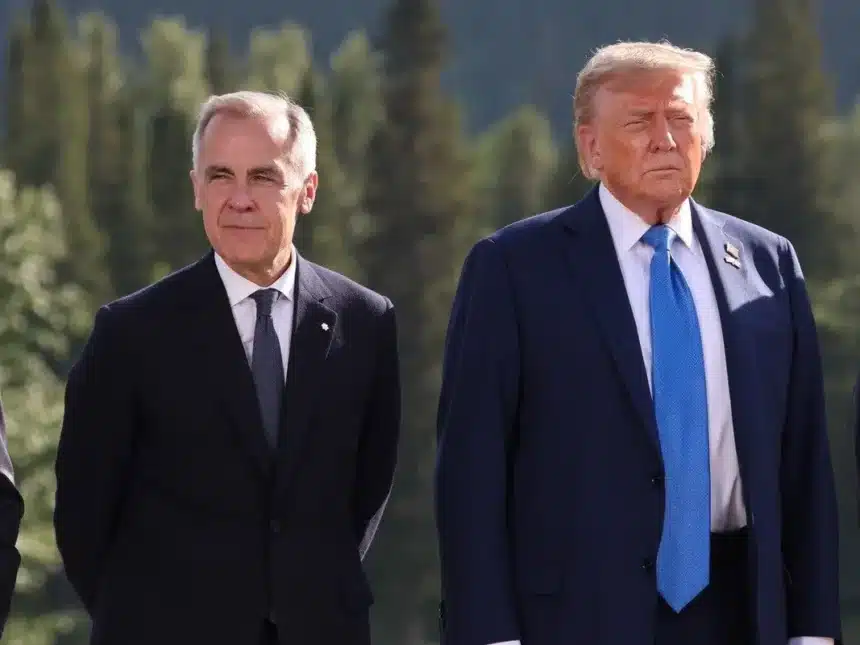
Amidst escalating trade tensions between Canada and the United States, a growing chorus is demanding that Prime Minister Carney’s government release the specifics of the trade deal that was on the table before negotiations collapsed. Canadians, facing the immediate economic repercussions of a trade war, are seeking clarity on the precise details that led to this unprecedented conflict with the Trump administration.
Government Cites Unfavorable Terms for Trade Talk Collapse
The Department of Finance issued a statement on August 25th, asserting that Canada had engaged in intensive and good-faith negotiations with the U.S. According to the release, recent proposals from the U.S. were deemed not to be in Canada’s best interest, characterized as demanding too much from Canada while offering too little in return. Consequently, Canada chose to suspend negotiations rather than accept an agreement that could potentially harm Canadian workers, businesses, strategic industries, and the nation’s overall interests. The government stated that Canada did not initiate this trade conflict but felt compelled to respond with countermeasures to ensure a level playing field for its businesses.
This statement also detailed the imposition of Canadian counter-tariffs and announced $7.5 billion in government funding, primarily through loans and income support, aimed at assisting Canadian businesses and workers affected by the trade dispute. However, the government’s announcement did not provide specific details regarding the exact points of contention that led to the abrupt halt in negotiations.
Calls for Transparency Amidst Economic Uncertainty
Critics argue that the explanation of “asking too much and offering too little in return” is vague and insufficient, particularly for the thousands of Canadians facing potential financial hardship due to the trade war. The most detailed accounts of the negotiation breakdown to date have emerged from a New York Times report, which cited anonymous sources from both Canadian and U.S. government circles.
These reports suggest conflicting narratives. One Canadian negotiator reportedly claimed that the U.S. side attempted to revisit previously settled issues in the final stages of talks. Conversely, American sources indicated that it was the Canadian delegation pushing to re-discuss settled matters. The Trump administration was allegedly seeking to dictate Canada’s steel tariffs on third countries, a demand that Canada reportedly found unacceptable.
Key Sticking Points in Negotiations
Further complicating the situation, reports suggest that Canada withdrew from discussions concerning the potential restart of the Keystone XL pipeline project. The revival of this project had been a point of contention, with potential negative implications for Prime Minister Carney’s public standing.
Disagreements were also widely reported across key sectors, including steel, aluminum, and the automotive industry. Another contentious issue that surfaced involved U.S. pressure on Canada to repeal legislation that favors Canadian content on American-owned digital platforms. Prime Minister Carney had publicly stated that the tentative trade agreement included “threats to French language and culture.” However, President Trump publicly disputed this claim, characterizing it as untrue and “stupid.” Trump further alleged on social media that the assertion about French language and culture was a fabrication by Prime Minister Carney to gain political support, particularly in Quebec.
This public exchange has fueled demands for transparency, with many questioning why Prime Minister Carney has not released the draft deal to refute President Trump’s accusations and provide concrete evidence for his claims regarding cultural protections.
Political Opposition Demands Release of the Deal
Shuv Majumdar, the Conservative shadow minister for Canada-U.S. relations, formally requested the government release the details of the trade negotiations in a letter. Majumdar highlighted that Prime Minister Carney had previously stated an expectation of reaching a deal by July 21, 2025, and expressed concerns that U.S. tariffs on Canada remain higher than when the current administration took office. He questioned the success of the government’s negotiation strategy.
The situation raises questions about the strategic motivations behind the government’s handling of the trade talks. While diplomatic norms typically discourage the premature release of non-finalized agreements, some observers suggest that Prime Minister Carney’s decision to walk away from negotiations might have been partly strategic, aimed at bolstering his political standing. The narrative of taking a firm stance against the U.S. could resonate with a segment of the Canadian electorate, particularly in the context of past political dynamics.
Conclusion: The Public’s Right to Know
Ultimately, the ongoing trade dispute with the United States has created significant economic uncertainty for Canadians. The lack of detailed information regarding the breakdown of negotiations leaves many questions unanswered. The demand for transparency, urging Prime Minister Carney to “release the deal,” reflects a broader public desire to understand the full context and justification behind actions that have led to a trade war, ensuring that Canadians are fully informed about the decisions impacting their livelihoods and national interests.