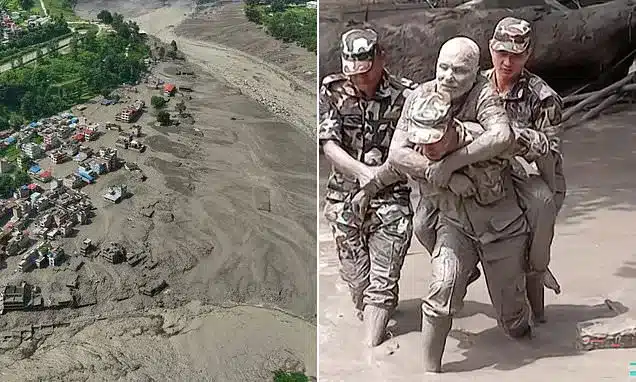
Rescuers are battling treacherous conditions in Nepal as they attempt to reach areas devastated by a massive flood, believed to have been triggered by a collapsed glacier. The torrent of mud, rock, and water has obliterated villages, leaving thousands feared dead and families anxiously awaiting news of missing loved ones, including many foreign tourists. The full extent of the disaster is still unfolding as receding waters reveal the grim toll.
Glacier Collapse Triggers Catastrophic Flood
The catastrophic event occurred when a large mass of ice, estimated to be around 2,000 feet, broke away from a glacier in the Himalayas. Experts suggest this ice mass was dislodged by a landslide, leading to its dramatic collapse. The resulting surge of water, debris, and ice created a devastating wall that swept down the Rasuwa valley, overwhelming everything in its path. The force of the flood was so immense that it crumpled concrete structures and completely washed away entire settlements.
Initial reports indicate that the floodwaters rose by an astonishing nine meters (approximately 27 feet) in the Trishuli River, transforming it into a churning, destructive force. The speed and magnitude of the flood wave have left officials and residents stunned, with many describing scenes of unimaginable destruction. The valley floor has been transformed into a barren, muddy plain, with debris littering the landscape and hanging from tree branches.
Rescue Efforts Hampered by Extreme Conditions
Emergency response teams are facing immense challenges in reaching the most severely affected areas. Roads are blocked by up to five feet of sediment and debris, making access extremely difficult. The Nepal army has deployed 14 helicopters and disaster response teams, but landing near the worst-hit zones has proven problematic due to the ongoing hazardous conditions. Rescuers are working tirelessly, but the sheer scale of the devastation and the perilous terrain are significant obstacles.
One emergency worker described the situation as near-impossible, noting that reaching stricken areas would take hours due to the impassable roads. The destruction of bridges has further complicated rescue and aid efforts, isolating communities and hindering the movement of personnel and supplies. Despite these challenges, efforts are underway to clear paths and assess the damage, with military personnel and local authorities working in challenging circumstances.
Thousands Feared Dead, Tourists Among Missing
The number of fatalities is feared to be in the thousands, though official figures are still being compiled. As of Wednesday evening, 157 bodies had been recovered from the water and rubble, but authorities anticipate this number will rise significantly. The flood has had a profound impact on foreign nationals, with hundreds of tourists reported missing. These individuals were in the region for trekking and religious pilgrimages, popular activities in the area.
Among the missing are 33 Britons, including a teenage schoolgirl and her parents who were part of a trekking group heading towards the Nepal-China border. Other nationalities with missing citizens include 133 Indians, 53 Ukrainians, 34 Australians, 24 Canadians, and eight South Koreans. Families of those missing are enduring an agonizing wait for news, with many uncontactable since the disaster struck.
Personal Accounts of Loss and Fear
Heartbreaking accounts are emerging from survivors and the families of those missing. Many describe witnessing the ferocity of the flood firsthand, with entire homes and loved ones being swept away. Local journalist Shreedhar Neupane recounted the sheer panic, seeing thick, muddy slush where clean water once flowed, and witnessing people and houses being carried away by the torrent.
Ram Kumar Adhikari, who runs Alpine Eco Trek, the company that organized the trek for the British group, shared his distress. His team was in contact with the trekkers until just before the flood hit the Gyirong border crossing. He expressed deep pain and uncertainty about the fate of the group, including four of his Nepalese guides who are also missing.
Mala Patel, 60, and Bipin Patel, 66, from Coventry, England, were on a religious pilgrimage and are now uncontactable. Their son, Anant Patel, expressed his deep worry, having seen the news but received no direct communication from his parents. He has registered their details with the Foreign Office and is awaiting updates.
Wider Impact and Future Concerns
The destruction extends beyond loss of life, with critical infrastructure like roads, hydropower stations, and bridges being obliterated. The damage is so extensive that it is expected to take years to repair. The flood has also raised concerns about potential secondary disasters. Alerts were issued in northern Indian states bordering Nepal due to fears of a further flood wave, though the immediate threat appears to have subsided.
Experts are continuing to analyze the event, with glaciologists and earth scientists studying satellite imagery and witness accounts to understand the precise dynamics of the glacier collapse and subsequent flood. The event serves as a stark reminder of the vulnerability of communities in mountainous regions to the impacts of climate change and natural disasters.
Conclusion
As rescue operations continue under challenging circumstances, the focus remains on locating survivors and providing aid to those affected by the devastating glacier flood in Nepal. The international community is watching closely, with many nations offering support to their citizens and to Nepal as it grapples with this immense tragedy. The recovery process will be long and arduous, demanding significant resources and sustained effort to rebuild and support the affected communities.