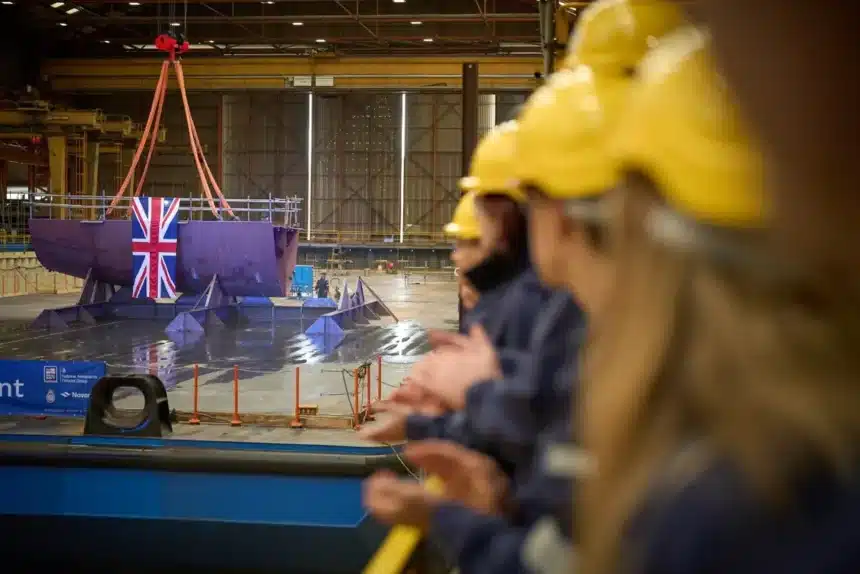
The Royal Navy has officially named the second and third vessels in its new Fleet Solid Support (FSS) programme. The ships will be known as RFA Reliant and RFA Resourceful. The announcements were made during a significant ceremony at Appledore in North Devon, marking the keel-laying of the first ship in the class, RFA Resurgent.
Keel Laid for First Fleet Solid Support Ship
The keel-laying ceremony for RFA Resurgent, the lead vessel of the new support ship class, took place on Merchant Navy Day. This event signifies the formal commencement of construction for the Resurgent. Commodore Sam Shattock, head of the Royal Fleet Auxiliary (RFA), revealed the names for the subsequent two ships, RFA Reliant and RFA Resourceful, during the ceremony.
Commodore Shattock described the moment as a transition from abstract plans to tangible reality. “Today represents the moment when vision becomes reality, when plans and drawings come to life, effectively becoming the ship’s birthday,” he stated. He further elaborated on the significance of the lead ship’s name, RFA Resurgent, explaining that it embodies “renewal, resilience and the ability recover stronger from challenge.” He emphasized that these qualities are not only inherent in the vessel’s construction but also in the dedication of the personnel involved in its design, building, support, and eventual operation.
Continuing a long-standing shipbuilding tradition, a coin was ceremonially welded to the keel of RFA Resurgent by a Navantia UK apprentice. This act formally marks the beginning of the construction process for the vessel.
Role and Capabilities of the New Support Ships
The three new Fleet Solid Support ships are designed to provide essential logistical support to Royal Navy vessels operating at sea. Their primary function will be to deliver ammunition, stores, and other vital supplies, including to the UK’s Queen Elizabeth-class aircraft carriers. Each vessel will be crewed by a core RFA complement of 101 personnel, with additional accommodation for up to 80 more individuals. These extra berths can house specialist teams, such as those operating helicopters and boats, or personnel undertaking other specific operational roles.
Beyond routine resupply, the ships are intended to bolster wider operational capabilities. This includes supporting counter-piracy and counter-terrorism missions, as well as participating in joint operations with allied naval forces. The design incorporates advanced, energy-efficient technologies aimed at minimizing power consumption. Furthermore, the vessels are being constructed with the capacity to utilize low-carbon and non-fossil fuels, with the Royal Navy aiming for them to achieve Carbon Zero status by the end of their 30-year operational lifespan.
Construction and Naming Conventions
The construction of the Fleet Solid Support ships involves a collaborative approach, with sections being built at Navantia facilities in Appledore, UK, and Cadiz, Spain. These components will then be transported to Harland & Wolff’s facility in Belfast, Northern Ireland, for final assembly and integration. This method combines domestic shipbuilding with international expertise and supply chains.
The naming of the ships follows established RFA traditions. RFA Resurgent revives a name previously borne by a merchant vessel that was converted into a fleet replenishment ship in 1957. That ship served until 1979 and notably supported a joint services scientific expedition to the Indian Ocean in 1975.
RFA Reliant is a name with a history of use within the RFA, having been assigned to three previous vessels. These included stores and air stores support ships, as well as a helicopter support ship. The most recent RFA Reliant was a merchant vessel requisitioned for naval service in 1983, playing a role in the multinational deployment to Lebanon in 1984, including during evacuation operations. She was eventually sold in 1986, being replaced in the helicopter support role by RFA Argus.
RFA Resourceful represents a new addition to the RFA’s naming conventions, chosen to align with the adjective-based theme of the current class. While the name itself is new for the RFA, the service previously operated an armament stores ship named RFA Resource. This ship had a distinguished service record from 1966 to 1997, earning battle honours for its involvement in the Falklands and Kuwait conflicts.
Economic and Industrial Impact
The Fleet Solid Support programme is also intended to stimulate investment within the UK’s shipbuilding sector. It aims to support apprenticeships, foster skilled employment opportunities, and strengthen domestic supply chains. The project underscores a strategy of integrating British industrial capacity with the expertise and facilities of international partners like Navantia.