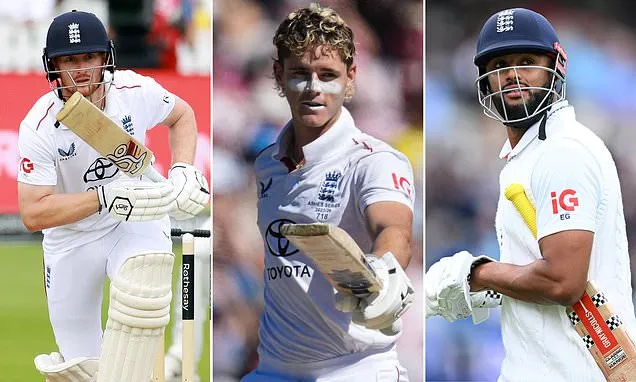
As England prepares for a challenging Test series in South Africa this December, a fierce battle is underway for coveted places in the top six of the batting order. This summer has seen significant changes, with established players like Zak Crawley and Ollie Pope making way for emerging talents. The selectors are weighing several options, considering not just pure batting prowess but also versatility and secondary skills, as they aim to build a stable and effective lineup against high-pace bowling.
The Contenders for England’s Top Order
Emilio Gay: A Glimmer of Promise Amidst Tough Conditions
Emilio Gay, averaging 23 from five Test matches, might not immediately present as a long-term successor to Zak Crawley. However, the batting conditions this summer have been exceptionally difficult, reflected in Joe Root’s own average of 29, his lowest in a home season. The average Test match length has also been notably short, the briefest since 1954. Gay has faced his share of misfortune, including being caught down the leg side twice and facing an unplayable delivery at Lord’s after a resilient 31. Despite initial concerns about his susceptibility to lbw, he has occasionally been exposed outside off stump, a common challenge for young English openers accustomed to fuller deliveries in county cricket.
Despite these hurdles, England has not overlooked Gay’s promising starts. He registered scores of 57 and 53 against New Zealand in his early career, batting for over two and a half hours on both occasions, suggesting a potential for sustained innings that often eluded Crawley. Joe Root commented on Gay’s contributions, stating, “Emilio’s been brilliant in the conditions we’ve had. It would be unfair to have any kind of discussions on anything outside this game. He’s played some vital knocks and context is really important when you have low-scoring games.” Gay’s challenge lies in converting these starts into substantial scores against top-tier international bowling.
Jordan Cox: Seizing Opportunities with Style and Substance
Jordan Cox’s introduction to Test cricket was somewhat unconventional, debuting at number seven against New Zealand. Despite the challenging circumstances, he managed scores of 27 and 25. His subsequent promotion to number three for the Pakistan series, following Jacob Bethell’s injury, provided a more significant platform to showcase his abilities. At Headingley, Cox outscored Joe Root with a 73 in seam-friendly conditions, and at Lord’s, his composed 55 was crucial in stabilizing England’s innings from a precarious 120 for five.
Cox has displayed composure, class, and a street-smart approach, qualities that have sometimes been absent in England’s recent batting displays. An intriguing possibility for the selectors is to move Cox up to the opening position, a role he fulfilled for Kent in 30 innings between 2019 and 2021, averaging 34. While his overall career statistics might be stronger lower down the order, the current batting lineup, with Root and Harry Brook occupying numbers four and five, could see Cox’s talents underutilized at number six. Although Root has dismissed questions about Cox opening as ‘hypothetical,’ it remains a strategic option England might consider, given Cox’s confidence in his ability to perform the role. His wicket-keeping skills further add to his value as a multi-skilled player.
Dan Lawrence: Finding Comfort and Consistency
Dan Lawrence, who previously struggled when opening against Sri Lanka two years ago, has appeared much more comfortable since his recall to the number six position. He has contributed an intelligent 54 at Lord’s and a resourceful 51 at Headingley, interspersed with a run-out for 17. These performances have put him firmly in credit with the selectors.
Similar to Bethell’s spin bowling and Cox’s wicket-keeping, Lawrence offers a secondary skill. He provided a spin-bowling option in the absence of a frontline specialist, though he only bowled three overs across two matches. Gay, in contrast, is the only contender without such an additional skill. Lawrence’s primary obstacle might arise when England requires a dedicated slow bowler. However, Sam Curran’s season-ending groin injury means he won’t be available as an extra pace-bowling option and a potential slot for a spinner until the Bangladesh series in February. By that time, Lawrence hopes to have made an irrefutable case for his inclusion in the South Africa tour based on his batting performances.
Jacob Bethell: A Near Certainty for a Starting Spot
Despite a relatively quiet series against New Zealand, Jacob Bethell is widely expected to return at number three for the first Test against South Africa at the Wanderers on December 17. Initially seeing himself as an opener, a lack of opportunities at Warwickshire and the current structure of the England team have steered him towards the number three position, which he now prefers. His claim to this spot was significantly strengthened by a remarkable 154 in Sydney in January.
At just 22, Bethell has also become an integral part of England’s leadership group. He captained the T20 side in Ireland last year and maintains close relationships with Test captain Ben Stokes and white-ball captain Jos Buttler. Given his performances, leadership potential, and established position in the team’s plans, it would be a major surprise if Bethell were to miss out on a place in the starting XI.
Ollie Pope: The Experienced Option Waiting in the Wings
Ollie Pope, though currently out of the immediate starting XI, remains a viable option and cannot be entirely discounted. He has been part of the England squad throughout the current series and is reportedly no more than a broken finger away from reclaiming his place, which he lost after the third Ashes Test in Adelaide. Pope has had a respectable summer with Surrey, scoring 672 Championship runs at an average of nearly 45, including centuries against Leicestershire and Nottinghamshire.
The inexperience within England’s top order means that the selectors are hesitant to completely move on from Pope. His ability to perform under pressure and his previous contributions to the Test side make him a player the selectors are reluctant to discard, especially given the limited alternatives for solidifying the middle order.
Conclusion: A Complex Selection Dilemma
With multiple talented players vying for a limited number of spots, England’s selectors face a complex decision. Jordan Cox has impressed with his recent form and versatility, while Dan Lawrence has shown resilience and adaptability. Emilio Gay offers potential but needs to convert starts into significant scores. Jacob Bethell appears to be a cornerstone for the future, and Ollie Pope remains a proven, albeit currently sidelined, option. The upcoming series in South Africa will be a crucial test, demanding a lineup that combines solid technique with the mental fortitude to succeed in challenging conditions.