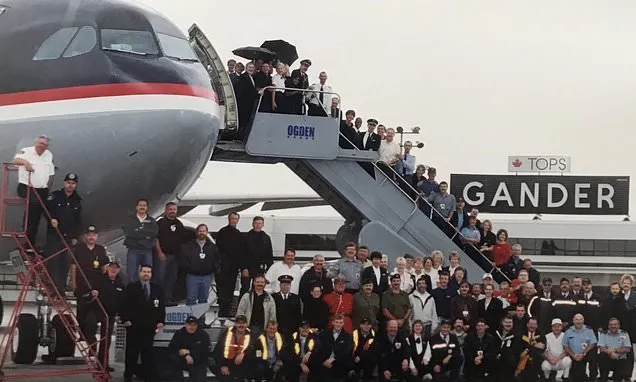
On September 11, 2001, as the United States grappled with unprecedented terrorist attacks, a critical decision was made to ground all civilian air traffic. This directive led to an extraordinary event in Gander, Newfoundland, a remote Canadian town that became an unexpected sanctuary for nearly 7,000 airline passengers. The town of Gander, with a population of just over 9,600, rose to the occasion, demonstrating remarkable compassion and community spirit in the face of global tragedy. This response, known as Operation Yellow Ribbon, has since been celebrated as a powerful testament to human kindness.
Operation Yellow Ribbon: Grounding Flights Amidst Crisis
Following the devastating attacks on the World Trade Center and the Pentagon, U.S. airspace was closed. The order, reportedly a forceful directive to “Get those goddamn planes down,” meant that any civilian aircraft already in the air over the United States had to land immediately. International flights bound for America were rerouted or told to turn back. Gander, strategically located on Newfoundland’s eastern tip along the busy transatlantic flight path, became a crucial landing point for many of these diverted planes. In total, 38 international passenger jets, carrying almost 7,000 people from 92 countries, touched down at Gander International Airport.
The airport, once a bustling hub nicknamed the ‘Crossroads of the World’ and a refuelling stop for early transatlantic flights, had largely seen its commercial traffic dwindle with the advent of long-haul jets. However, its expansive runways made it ideal for handling such an emergency. The passengers aboard these flights, including a group of 90 terminally ill children traveling to Disney World with the Make-A-Wish Foundation, were unaware of the unfolding crisis until they landed to find not welcoming crowds, but a significant police presence.
Gander’s Response: A Community Mobilizes
The sudden arrival of thousands of disoriented and often frightened passengers presented a monumental challenge for Gander and its surrounding communities. Local authorities and residents, however, responded with extraordinary generosity. Schools and non-essential businesses were closed to allow residents to volunteer. The Red Cross organized accommodations, while the Salvation Army distributed food. Local radio and television stations broadcast appeals for assistance, and the response was overwhelming.
Newfoundlanders, known for their strong sense of community and resilience forged by a history of reliance on one another in a harsh environment, opened their homes and hearts. While hotel rooms were reserved for flight crews, the town’s residents provided lodging, clothing, food, and companionship to the stranded “Plane People,” as they came to be known. Local organizations, pharmacies, and businesses donated supplies, filled prescriptions, and set up communication lines to help passengers contact worried families abroad.
Life in Gander for the Stranded
For nearly five days, the passengers were guests in Gander. After initial security checks, they were transported by school buses—whose drivers had called off a strike to help—to various community centers, schools, churches, and even a summer camp. Many passengers had only the clothes on their backs, as their luggage remained locked in the aircraft holds. They slept on floors, shared meals, and found comfort in the unexpected kindness of strangers.
Despite initial anxieties and the lingering fear from the 9/11 attacks, a sense of camaraderie developed. Tensions between passengers of different nationalities, including some from Middle Eastern countries, reportedly dissipated as everyone realized their shared predicament. The experience fostered a unique bond, with many passengers later describing the Newfoundland hospitality as a profound antidote to the horrors they had witnessed unfolding on television.
Notable passengers included figures like Werner Baldessarini, chairman of Hugo Boss, and a US Army general. None, however, sought special treatment, with many choosing to stay with their fellow passengers rather than accept offers of private transport. The community’s efforts extended to thoughtful gestures, such as a Disney-themed party organized for the terminally ill children on one flight, complete with a large cake, clowns, and costumed characters, bringing moments of joy amidst the uncertainty.
Lasting Legacies: From Gander to the World Stage
The impact of Operation Yellow Ribbon extended far beyond those five days. The story of Gander’s response inspired the hit musical “Come From Away,” which has achieved international acclaim, including Olivier and Tony awards. The musical, named after the local term for visitors, has brought the story of Gander’s compassion to a global audience, with many people traveling to the town specifically to see the production.
The generosity of the “Plane People” in return was significant. They left behind substantial donations to help cover costs and contributed to local schools and scholarship funds. Many passengers and Gander residents maintained their connections, with some forming lifelong friendships. A steel beam from the World Trade Center was gifted to Gander as a token of gratitude.
The events of September 11, 2001, showcased the worst of humanity, but the actions in Gander demonstrated the best. As former Mayor Claude Elliott reflected, the town “restored faith in people” during a time of immense fear and uncertainty. The story of Gander serves as a powerful reminder of the capacity for kindness, community, and resilience, even in the darkest of times.
Conclusion: A Beacon of Hope
The five days that the “Plane People” spent in Gander were a period of intense emotion and unexpected connection. While the passengers eventually departed, leaving behind a town that felt a sense of loss after their departure, the experience left an indelible mark on both the visitors and the hosts. Gander’s response to the 9/11 crisis stands as a profound example of how a small community can make a monumental difference, offering a beacon of hope and a testament to the enduring power of human compassion.