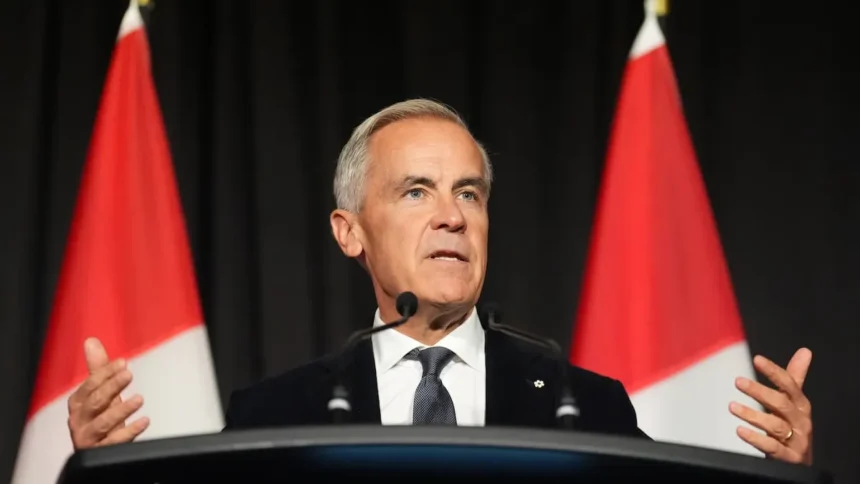
Prime Minister Mark Carney has announced plans for Canada to initiate discussions regarding a “unique alliance” with the European Union, emphasizing that this initiative does not involve seeking membership in the bloc. The announcement comes as Carney prepares to address the European Parliament this week.
Canada’s Stance on EU Relations
Speaking on the sidelines of the Toronto International Film Festival on Sunday evening, Prime Minister Carney clarified Canada’s intentions. “We’re not looking to become a member of the European Union,” he stated. Instead, Canada aims to establish “a unique alliance with the European Union.” Carney highlighted shared values, common priorities, and complementary strengths as the foundation for this proposed partnership.
These remarks follow a media report suggesting that Prime Minister Carney has been actively exploring ways to strengthen Canada’s ties with the EU, exploring ambitious options beyond full membership. The report indicated that the possibility of Canada adopting an “associate member” status had been considered.
Political Reaction and Clarifications
The report prompted a swift response from Conservative Leader Pierre Poilievre, who criticized the idea on social media, calling it out of touch. Poilievre asserted that Canada would neither become the 51st U.S. state nor the 28th EU state.
A senior Canadian official, speaking on condition of anonymity, confirmed that ongoing conversations have been taking place about deepening the relationship with Europe. The official stressed that Canada is not seeking to compromise its independence for market access. The focus, according to the official, is on the tangible benefits of enhanced ties rather than specific labels like “associate member.” The official also noted that “associate member” was one of several potential designations being considered and was not a proposal originating from Canada.
Strategic Rationale for Deeper EU Ties
Recent statements from Canadian cabinet members have underscored the strategic rationale behind strengthening relations with Europe. Finance Minister François-Philippe Champagne suggested that forging closer partnerships within the EU could help diversify Canada’s economic dependencies, particularly on the United States. “I think Canadians should be reassured by the fact that we are looking at partnership in a market which is basically bigger than the U.S. consumer market,” Champagne remarked on CBC’s The House.
This push for broader international partnerships comes amid ongoing trade friction between Canada and the United States. Canada recently implemented $27.6 billion in counter-tariffs in response to trade disputes, leading to retaliatory measures from the U.S., including a ban on certain Canadian imports set to take effect later in September.
EU’s Perspective on the Relationship
The European Union’s Ambassador to Canada, Geneviève Tuts, has also expressed enthusiasm for evolving the bilateral relationship. In a previous interview, Tuts indicated that while current cooperation is strong, both sides are keen to “go further than that.” She described the aspiration as seeking “something very new, and in a way something unique,” adding, “We want to reimagine the relationship between the EU and Canada.”
Upcoming Engagements
Prime Minister Carney is scheduled to travel to Strasbourg, France, where he will address the European Parliament on Thursday, following an invitation from President Roberta Metsola. Further solidifying the commitment to enhanced dialogue, Canada is slated to host an EU summit in late October.
This initiative represents a significant diplomatic effort to forge a new kind of international partnership, leveraging shared values and economic complementarity to create a distinct alliance between Canada and the European Union.