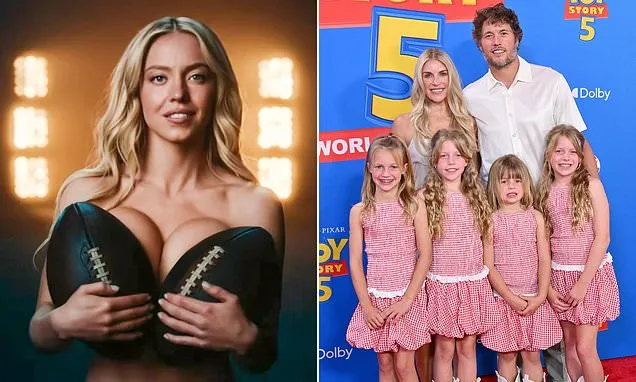
Kelly Stafford, wife of Los Angeles Rams quarterback Matthew Stafford and a prominent voice among NFL partners, has publicly shared her perspective on the controversial betting advertisement featuring actress Sydney Sweeney. The ad, which depicts Sweeney nude and strategically covered with sports equipment to promote a betting company, has ignited a significant debate regarding the portrayal of women in sports.
The Sydney Sweeney Advertisement Sparks Controversy
The advertisement for the betting company Novig, featuring Sydney Sweeney, has drawn widespread criticism. In the commercial, Sweeney is shown nude, with sports items like basketballs and a baseball bat used to obscure her body. This imagery has led to accusations that the ad sexualizes women’s sports and sets a poor example for young female athletes. The backlash has been substantial, with Sweeney reportedly losing over 200,000 Instagram followers following the ad’s release.
Several prominent female athletes have voiced their strong disapproval. British sprinter Amy Hunt was among the first to publicly condemn the campaign, using a post-race interview to express her concerns. She later elaborated on television, emphasizing the importance of showcasing female athletes for their capabilities rather than their appearance.
Athlete Concerns Over Role Models
Amy Hunt highlighted the potential negative impact on young girls’ participation in sports. “When we’re trying to provide role models for young people and young women in sport, we really want to show that it’s about what your body can do, not so much what it looks like,” Hunt stated. She pointed to statistics indicating that a significant percentage of young girls drop out of exercise and sports before the age of 16. Hunt believes that advertisements like the one featuring Sweeney can create unnecessary barriers, discouraging participation by focusing on physical appearance rather than empowerment and enjoyment.
“We don’t need to place any kind of barrier whatsoever in their way in terms of providing the opportunity and the empowerment for them to still exercise, whatever that looks like, whether it’s professional or just going to do a park run with your friends,” Hunt added. Her message underscores a desire to foster an environment where young people feel encouraged to be active without the pressure of conforming to specific aesthetic standards.
Kelly Stafford’s Stance on Attention and Value
Kelly Stafford, a mother of four daughters and a regular commentator on parenting and life through her podcast, “The Morning After,” has aligned herself with the critics. She shared a video from influencer Daniel Hong on her social media, adding the emphatic caption: “THIS THIS THIS THIS.”
The video featured Hong discussing the distinction between attention and intrinsic value, a message Stafford clearly resonated with. Hong’s commentary, as shared by Stafford, stated: “Appearance can get you attention: likes, comments, followers, money, opportunities. All of that is very real. What I want them to understand is that attention and value are not the same thing.”
Stafford’s endorsement of this message suggests she believes the Sweeney ad, and the attention it garnered, exemplifies a dangerous conflation of superficial recognition with genuine worth. As someone who frequently discusses the challenges of raising young girls in the public eye, Stafford’s perspective carries weight, particularly within the sports community.
Novig’s Defense of the Campaign
In the wake of the criticism, Jacob Fortinsky, the CEO of Novig, defended the company’s campaign. Speaking to Front Office Sports, Fortinsky asserted that the company is a strong supporter of women’s sports. He clarified that the advertisement was not intended to misrepresent female athletes but rather to align with Sweeney’s role as an actress communicating a specific narrative for a sports prediction market.
“As a company, we’re hugely supportive of women’s sports,” Fortinsky stated. “We never intended to portray female sports. Sydney’s an actress. We’re a prediction market that is focused on sports, and that was the story she was communicating.” Despite this defense, the ad has continued to face scrutiny, appearing on billboards in high-traffic areas like New York’s Times Square.
Broader Implications for Women in Sports and Media
The controversy surrounding the Sydney Sweeney ad highlights a recurring tension in how women, particularly athletes and celebrities, are represented in media and advertising. Critics argue that such campaigns perpetuate harmful stereotypes, equating female worth with physical attractiveness and potentially undermining the efforts to promote sports participation and empowerment among young girls.
Kelly Stafford’s intervention, by amplifying the message about the difference between attention and value, adds another layer to the discussion. It suggests a desire for a more substantive understanding of success and self-worth, especially for young women navigating the pressures of social media and public perception. The debate underscores the ongoing need for thoughtful and responsible representation in advertising, particularly when it intersects with the world of sports and influences the aspirations of future generations.
The differing viewpoints—from athletes and figures like Stafford emphasizing empowerment and capability, to the company defending its artistic and narrative intent—reveal the complexities of modern advertising and its societal impact. As the conversation continues, the focus remains on ensuring that media portrayals contribute positively to the perception and participation of women in all fields, especially athletics.