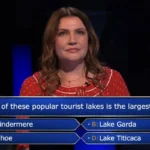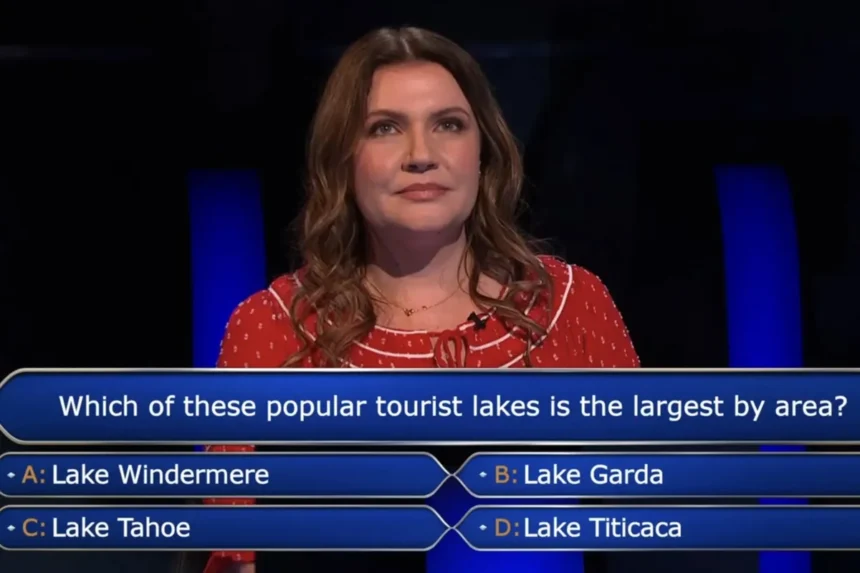
A contestant on Who Wants To Be A Millionaire recently walked away with £32,000 after being stumped by a challenging geography question about the world’s largest tourist lakes. Natalie, the contestant, reached the £64,000 question but ultimately decided to leave the game with her winnings rather than risk losing a significant amount on an answer she wasn’t confident about. The question, posed by host Jeremy Clarkson, focused on identifying the largest lake by area among four popular tourist destinations: Lake Windermere, Lake Garda, Lake Tahoe, and Lake Titicaca.
The ‘Nightmare’ Geography Question
Natalie, admitting that geography was not her strongest subject, initially turned to Jeremy Clarkson for assistance. Clarkson, in turn, expressed his own uncertainty, describing the question as a “nightmare” and suggesting that “no one in the room or world could answer it.” He shared his limited knowledge of the lakes, noting his experience on Windermere and Garda, and his awareness of Titicaca’s depth. However, he ultimately could not provide a definitive answer, stating he was “useless” to her.
Faced with the difficult decision, Natalie utilized her “Phone A Friend” lifeline to call her brother, Dan. Unfortunately, her brother was also unsure, admitting, “Ooh, that’s a tough one.” He advised against guessing due to the substantial amount of money at stake. Consequently, Natalie made the pragmatic choice to accept her £32,000 winnings, concluding, “I think I’d like to take the money, please. Final answer.”
Unpacking the Lakes: Facts and Figures
After Natalie’s departure, Jeremy Clarkson revealed the correct answer and provided further details about the lakes in question. He explained that if Natalie had taken a guess, she would have answered correctly and secured £64,000. The largest lake by area among the options is indeed Lake Titicaca.
Lake Titicaca: The Victor
Lake Titicaca, situated high in the Andes on the border of Peru and Bolivia, is not only the largest freshwater lake in South America but also the largest lake by volume and surface area among the choices presented. Its immense size and significant depth contribute to its status as a major geographical feature. Clarkson highlighted its “deep and massive” characteristics, confirming it dwarfs the other options. It is also renowned for its cultural significance, being home to indigenous communities like the Uros people who live on floating islands.
The Other Contenders
- Lake Windermere: Located in the Lake District National Park in England, it is the largest natural lake in England by area. While popular with tourists, its size is considerably smaller than Lake Titicaca.
- Lake Garda: This is the largest lake in Italy and a very popular destination for holidaymakers. It is known for its stunning scenery and charming towns along its shores.
- Lake Tahoe: Straddling the border between California and Nevada in the United States, Lake Tahoe is the largest alpine lake in North America. It is famous for its crystal-clear blue waters and is a major ski resort area in winter and a recreational hub in summer.
Why the Confusion?
The difficulty of the question stemmed from the fact that all four lakes are popular tourist destinations and are, in their own right, significant or the largest within their respective regions. Lake Windermere is England’s largest, Lake Garda is Italy’s largest, and Lake Tahoe is North America’s largest alpine lake. This regional significance can easily lead to confusion when comparing them on a global scale. Clarkson’s own admission of uncertainty underscored the question’s challenging nature, particularly for someone without specialized geographical knowledge.
The Importance of Safety Nets
Natalie’s decision to walk away with £32,000 exemplifies a common strategy in quiz shows like Who Wants To Be A Millionaire. The introduction of “safety nets” at certain question levels allows contestants to secure a minimum amount of money, regardless of how far they progress or whether they answer subsequent questions correctly. This feature provides a crucial buffer, enabling contestants to take more calculated risks on harder questions without the fear of leaving with nothing.
In Natalie’s case, the £32,000 served as her safety net. By choosing to preserve this amount, she avoided the potential of dropping back to a lower sum, which could have happened if she had guessed incorrectly on the £64,000 question. While she missed out on a potential £64,000, her decision was a prudent one, reflecting a realistic assessment of her knowledge and the risks involved. Her experience highlights that even with the help of a celebrity host and a friend, some trivia questions can prove exceptionally difficult, making the safety net a valuable part of the game.
Conclusion: A Test of Knowledge and Nerve
The encounter with the tourist lake question on Who Wants To Be A Millionaire served as a potent reminder of how specific knowledge can be elusive, even for seemingly well-informed individuals. While Natalie’s geographical expertise might have been tested, her strategic decision-making secured her a substantial prize. The question itself, involving a comparison of major lakes across different continents, proved to be a formidable challenge, even for the host. It underscores the blend of knowledge, strategy, and nerve required to succeed in high-stakes quiz shows, where even the largest lakes can present the biggest hurdles.