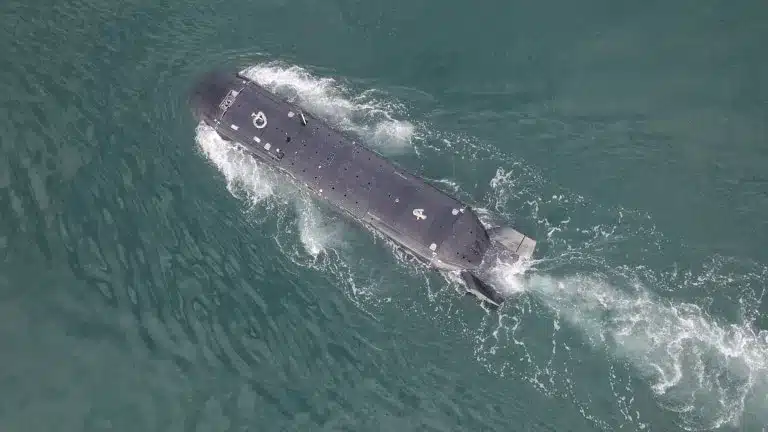
In a significant development for undersea warfare, a torpedo has been test-fired from an uncrewed undersea vessel for the first time, marking a major step in autonomous naval technology. The live firing, conducted in British waters, involved a torpedo jointly developed by the United States and Australia, launched from a British-manufactured uncrewed underwater vehicle (UUV) named XV Excalibur. This operation was conducted as part of the trilateral security pact between Australia, the United Kingdom, and the United States, known as AUKUS.
AUKUS Alliance Pushes Autonomous Subsea Capabilities
The UK government announced that the successful test represents a substantial leap forward in submarine technology for the AUKUS partners. Officials stated it delivers a significant breakthrough for Euro-Atlantic security and enhances NATO’s undersea advantage. This advancement aligns with a broader global trend among Western nations to modernize their military capabilities with autonomous systems, driven by evolving geopolitical threats.
The XV Excalibur, a 12-meter-long undersea drone, was manufactured in Britain. The heavyweight torpedo itself is a product of joint development between the US and Australia. This exercise demonstrated the growing capability of autonomous vessels in naval operations. In 2025, the UK and Australia had previously conducted a joint test of the Excalibur during Exercise Talisman Sabre, signaling early collaboration on this technology.
Remote Operation and Future Implications
A key aspect of the recent test was the remote operation of the XV Excalibur. An operating center located in Australia, thousands of kilometers away from the drone’s home base in Plymouth, UK, managed the vessel. The British Royal Navy described this as a major stride in their ability to seamlessly operate uncrewed systems interchangeably with Australian forces, highlighting the potential for enhanced interoperability and coordinated global operations.
Experts view this development as highly significant. Sidharth Kaushal, a senior research fellow at the RUSI think-tank, commented that the test-fire was “noteworthy.” He elaborated that the “employment of a lethal payload illustrates that uncrewed systems can play roles which extend beyond surveillance,” indicating a shift towards autonomous platforms taking on more critical combat functions.
Broader Context: AI, Autonomy, and Global Security
The announcement of this advanced torpedo test coincides with broader diplomatic efforts focused on artificial intelligence and autonomous systems. UK Prime Minister Andy Burnham was scheduled to attend the United Nations General Assembly in New York, where he planned to discuss international cooperation on AI. His agenda included meetings with US President Donald Trump to further global work on AI, with the aim of protecting critical national infrastructure, from sea lanes to airspace.
Mr. Burnham intended to advocate for closer international collaboration on AI, alongside efforts to secure peace in Ukraine and resolve the conflict in the Middle East. He emphasized the interconnectedness of global events and their impact on domestic security. Additionally, the Prime Minister confirmed that the UK would host the G20 summit in November 2027 in Manchester.
The Drive Towards Autonomous Warfare
The push for autonomous systems in warfare is a strategic imperative for many nations. The AUKUS alliance, formed to enhance security cooperation among Australia, the UK, and the US, is a prime example of this focus. The development and testing of technologies like the XV Excalibur are crucial for maintaining a technological edge in an increasingly complex security environment.
The ability to launch lethal payloads from uncrewed, remotely operated platforms offers several potential advantages. These include reducing risk to human personnel, extending operational reach, and enabling more persistent surveillance and engagement capabilities. The successful test of the US torpedo from the UK sea drone underscores the rapid progress being made in integrating these advanced autonomous capabilities into naval forces.
Future of Naval Technology
This milestone test signifies a pivotal moment in the evolution of naval technology. The integration of autonomous platforms with advanced weaponry like heavyweight torpedoes opens new strategic possibilities. The AUKUS partnership is clearly prioritizing the development of cutting-edge underwater drone technology, including sophisticated sensors and weapons systems, to bolster the collective security of its member nations and their allies.
As nations continue to invest in and develop autonomous systems, the nature of naval warfare is set to transform. The ability to operate complex systems like UUVs interchangeably across allied forces, as demonstrated by the UK and Australia, points towards a future of highly integrated and technologically advanced multinational naval operations. This collaborative approach is vital for addressing the multifaceted security challenges of the 21st century.