[ad_1]
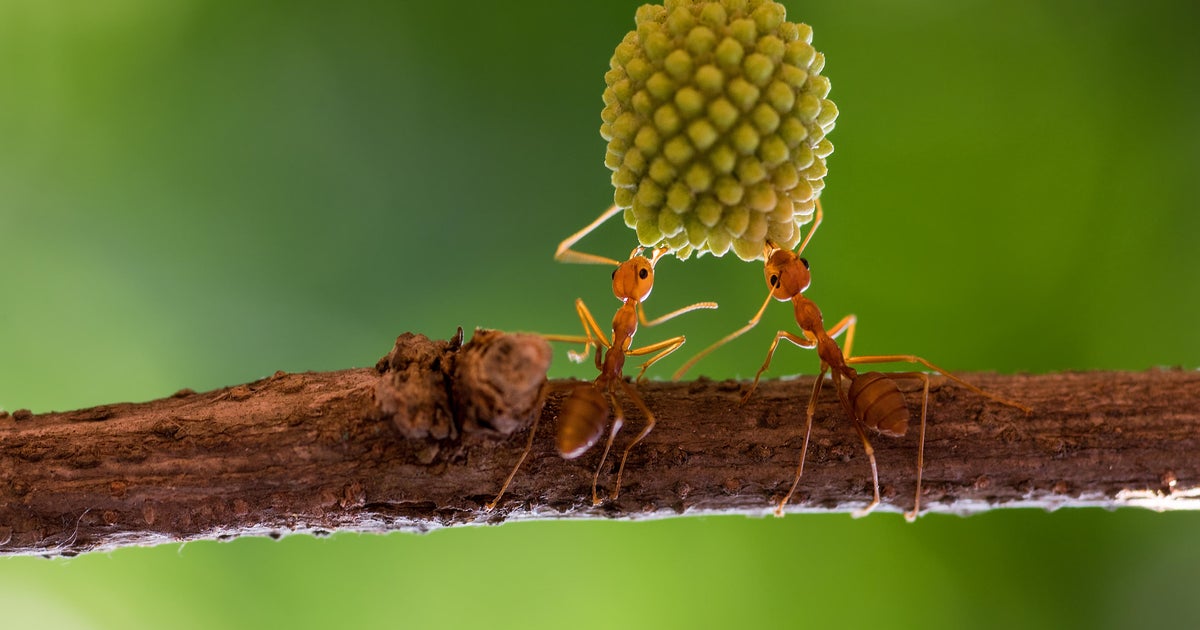
Sick younger ants launch a odor to inform employee ants to destroy them to guard the colony from an infection, scientists stated Tuesday, including that queens don’t appear to commit this act of self-sacrifice.
Many animals conceal sickness for social causes. For instance, sick people are recognized to danger infecting others to allow them to nonetheless go to the workplace — or the pub.
Ant colonies, nevertheless, act as one “super-organism” which works to make sure the survival of all, just like how contaminated cells in our our bodies ship out a “find-me and eat-me” sign, in line with an Austria-led staff of scientists.
Ant nests are a “good place for a illness outbreak to happen as a result of there are literally thousands of ants crawling over one another,” Erika Dawson, a behavioral ecologist on the Institute of Science and Know-how Austria and lead creator of a new examine titled “Altruistic illness signaling in ant colonies,” instructed AFP.
When grownup employee ants get an sickness that might unfold by way of the colony, they go away the nest to die alone. Younger ants, generally known as pupae, in distinction are nonetheless trapped inside a cocoon, making this sort of social distancing unattainable.
Scientists had already found out that when these pupae are terminally sick, there’s a chemical change that produces a selected odor. Grownup employee ants then collect round, take away the cocoon, “chunk holes within the pupae and insert poison,” Dawson stated. The poison acts as a disinfectant, which kills each the colony-threatening pathogen and the pupae.
For the brand new analysis, the scientists needed to determine whether or not the pupae “have been actively saying: ‘hey, come and kill me,'” Dawson stated.
“Altruistic act”
First, the scientists extracted the odor from the sick pupae of a small black backyard ant known as Lasius neglectus. After they utilized the odor to a wholesome brood within the lab, the employees nonetheless destroyed them.
Then, the staff performed an experiment exhibiting that the sick pupae solely produce the odor when employee ants are close by, proving it’s a deliberate sign for destruction.
“Whereas it’s a sacrifice — an altruistic act — it is also in their very own curiosity, as a result of it implies that their genes are going to outlive and be handed on to the following technology,” Dawson stated.
Nevertheless, there’s one member of the nest that doesn’t sacrifice itself. When queen pupae are contaminated inside their cocoons, they don’t ship out the smelly warning sign, the staff discovered.
“Are they dishonest the system?” Dawson stated the staff requested themselves.
Nevertheless, they discovered that the “queen pupae have significantly better immune methods than the employee pupae, and they also have been capable of combat off the an infection — and that is why we predict that they weren’t signaling,” she stated.
The examine’s authors word that sick queens face a conundrum.
“By alerting others to destroy them, queen pupae would danger shedding potential future reproductive alternatives if they’d survive an infection,” the authors write. “Alternatively, by spreading their an infection to their colony, they might incur excessive oblique health prices.”
Dawson hopes future analysis will examine whether or not queen pupae sacrifice themselves when it turns into clear they won’t beat their an infection.
The examine was revealed within the journal Nature Communications.
Scientists have beforehand studied how ants talk. A Stanford College examine revealed in 2012 confirmed that harvester ants transmit info to find out what number of ants to ship to a selected meals supply. Researchers concluded that ants talk in a lot the identical method as knowledge strikes on the web, dubbing it the “anternet.”
Researchers have additionally beforehand concluded that different sick species observe social distancing — together with guppies, bats and mandrills. Bees have been documented utilizing techniques to forestall getting sick, together with kicking sick bees out of their hives altogether.
[ad_2]