[ad_1]

At a difficult time for the restaurant trade, main chains like Chipotle and Cava are placing cash behind automated makelines from startup Hyphen.
The San Jose, California-based firm goals to assist eating places obtain two key targets in a hyper-competitive setting: speedy throughput and good customer support. The know-how makes for a much less chaotic and extra “elegant expertise” for staff and friends alike, co-founder and CEO Stephen Klein instructed CNBC in an interview.
“We’re in all probability making a bowl each 10 to fifteen seconds. At peak throughput, we now have extra capability often than they do demand, particularly … for lunch and dinner rushes,” Klein mentioned.
That effectivity has introduced elevated curiosity throughout the trade. In August 2025, Hyphen closed a Collection B spherical of financing that included as much as $10 million from Cava. Chipotle mentioned it has invested a complete of $25 million into Hyphen by way of its Domesticate Subsequent enterprise fund by way of the third quarter of 2025.
The $25 million Collection B spherical will assist Hyphen scale its manufacturing and rollout throughout eating places within the U.S. Its manufacturing will ramp with Re:Construct Manufacturing, an organization primarily based in Kalamazoo, Michigan. Chipotle’s Hyphen makeline is in San Jose for modification after an in-restaurant check. Cava will check and pilot its tech for a second makeline to serve digital and takeout orders behind its kitchen sooner or later.
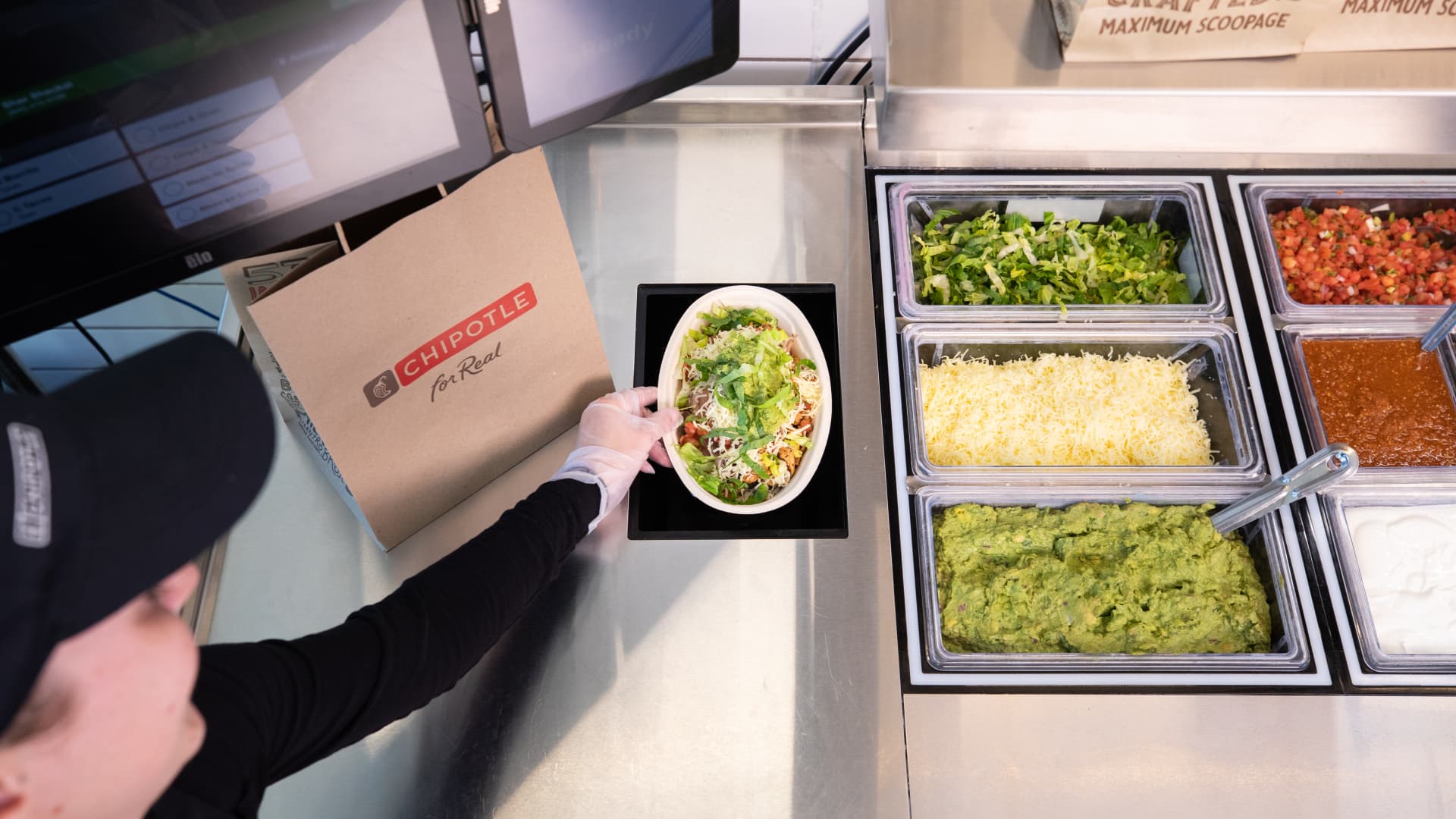
A completed burrito bowl assembled by Chipotle and Hyphen’s automation know-how.
Supply: Chipotle Mexican Grill
Hyphen’s know-how solves for each a pace and labor problem, serving to to automate a part of the service course of that may be repetitive and difficult to fill.
“You’ll be able to have, any person is promoting substances on prime, whereas the remainder of these things is going on beneath,” he mentioned of the makeline, which depends on a sequence of robotic arms to prep salads and bowls below an extended desk, out of public view, sending them down the row.
The makelines price between $50,000 and $100,000 to buy, and restaurant clients are sometimes getting a return on funding in below a yr, Klein mentioned. They function 95% of the time, however through the uncommon moments they’re down, staff can leap in to finish orders, the way in which an escalator would flip into stairs, he mentioned.
One other key characteristic is reducing down on meals waste. The know-how tracks substances “right down to the gram,” Klein mentioned.
“We’re completely portioning each ingredient, we’re in a position to assist them save on meals prices, or at the very least cut back meals prices not directly,” he mentioned.
The thought of the corporate started when Klein and his co-founder Daniel Fukuba constructed a totally robotic meals truck, which launched in Los Angeles three months earlier than the pandemic began. They modified gears to launch Hyphen quickly after that.
“When the pandemic occurred, we sort of simply needed to share that into one other route. We had fortunately been speaking to different restaurant companions about licensing our know-how for them, and we determined … it simply made much more sense to assist eating places which can be already round at this time,” Klein mentioned.
Know-how innovation will possible proceed to be a key development within the restaurant sector after a brutal yr for lots of the trade’s leaders. Shares of Cava and Chipotle are down practically 50% and 40% year-to-date, respectively, after pullbacks from key demographics together with youthful shoppers. Sweetgreen, one other competitor within the wholesome salad and bowl area, is down practically 80% on the yr.
Sweetgreen offered its robotics unit, Spyce, to mealtime platform Surprise earlier this yr for $186.4 million. Sweetgreen had acquired Spyce to construct its automated Infinite Kitchens, and it’ll proceed to make use of the know-how.
Klein mentioned Hyphen is speaking to main manufacturers and meals service suppliers for faculty campuses and workplace parks because it seems to not solely evolve the makeline, but additionally present information that comes from the meals prep and distribution. The corporate goals to develop extra software program sooner or later, together with instruments for meals prep scheduling for use behind the home.
One space that is not on the menu, at the very least for now, is the quick meals sector.
“We’re actually making an attempt to assist those who have actually a excessive combine or excessive customization when it comes to what their friends are ordering, in addition to excessive quantity. In order that’s sort of our strike zone,” he mentioned.

[ad_2]