
[ad_1]
Enhanced tax credit which have helped cut back the price of medical insurance for the overwhelming majority of Inexpensive Care Act enrollees expired in a single day as 2026 arrived, cementing larger well being prices for thousands and thousands of People at the beginning of the brand new 12 months.
Democrats compelled a 43-day authorities shutdown over the difficulty. Average Republicans known as for an answer to avoid wasting their 2026 political aspirations. President Trump floated a manner out, solely to again off after conservative backlash.
Ultimately, nobody’s efforts have been sufficient to avoid wasting the subsidies earlier than their expiration date. A Home vote anticipated in January may provide one other likelihood, however success is way from assured.
The change impacts a various cross-section of People who do not get their medical insurance from an employer and do not qualify for Medicaid or Medicare — a bunch that features many self-employed staff, small enterprise house owners, farmers and ranchers.
It comes at the beginning of a high-stakes midterm election 12 months, with affordability — together with the price of well being care — topping the listing of voters’ considerations.
“It actually bothers me that the center class has moved from a squeeze to a full suffocation, they usually proceed to only pile on and go away it as much as us,” stated 37-year-old single mother Katelin Provost, whose well being care prices are set to leap. “I am extremely dissatisfied that there hasn’t been extra motion.”
Subsidies helped cut back prices since pandemic
The expired subsidies have been first given to Inexpensive Care Act enrollees in 2021 as a brief measure to assist People get by means of the COVID-19 pandemic. Democrats in energy on the time prolonged them, transferring the expiration date to the beginning of 2026.
With the expanded subsidies, some lower-income enrollees acquired well being care with no premiums, and excessive earners paid not more than 8.5% of their revenue. Eligibility for middle-class earners was additionally expanded.
On common, the greater than 20 million sponsored enrollees within the Inexpensive Care Act program are seeing their premium prices rise by 114% in 2026, based on an evaluation by the well being care analysis nonprofit KFF.
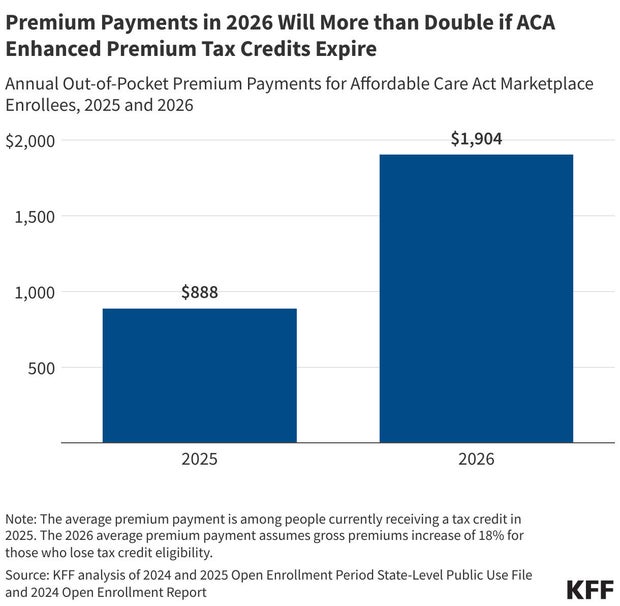
These surging costs come alongside an general enhance in well being prices within the U.S., that are additional driving up out-of-pocket prices in lots of plans.
Some enrollees, like Salt Lake Metropolis freelance filmmaker and adjunct professor Stan Clawson, have absorbed the additional expense. Clawson stated he was paying slightly below $350 a month for his premiums final 12 months, a quantity that may soar to just about $500 a month this 12 months. It is a pressure for the 49-year-old however one he is keen to tackle as a result of he wants medical insurance as somebody who lives with paralysis from a spinal wire harm.
Others, like Provost, are coping with steeper hikes. The social employee’s month-to-month premium fee is rising from $85 a month to just about $750.
Lori Hunt of Des Moines, Iowa, spoke with CBS Information throughout the congressional stalemate in October and stated she “could not afford” medical insurance with out the subsidies.
“I might need to cancel my insurance coverage,” Hunt stated, joking that her insurance coverage would encompass “ideas and prayers.”
Hunt survived breast most cancers three years in the past and was laid off from her job in 2025. With out the subsidies, she anticipated her ACA premium would soar to about $700 per thirty days. “It might be greater than my mortgage fee,” Hunt stated.
Many anticipated to go with out protection
Well being analysts have predicted the expiration of the subsidies will drive lots of the 24 million whole Inexpensive Care Act enrollees — particularly youthful and more healthy People — to forgo medical insurance protection altogether.
Over time, that would make this system costlier for the older, sicker inhabitants that is still.
An evaluation carried out final September by the City Institute and Commonwealth Fund projected the upper premiums from expiring subsidies would immediate some 4.8 million People to drop protection in 2026.
The impression may very well be best in Florida, which has the biggest variety of ACA enrollees of any state — greater than 4.7 million, based on KFF information. Texas is subsequent, with greater than 3.9 million, adopted by California, Georgia and North Carolina.
KFF Information/CBS Information 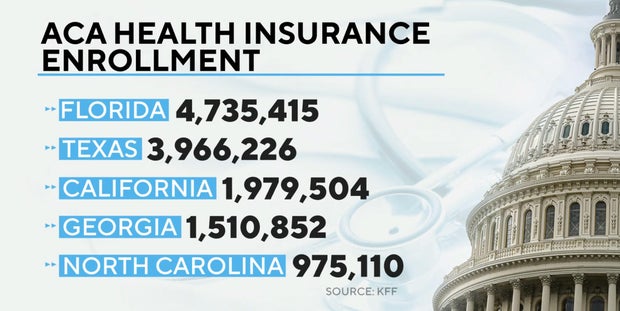
Kylie Barrios, a 30-year-old Florida resident, stated she anticipated to be amongst these dropping protection.
“Our medical insurance premium is successfully tripling from 2025 to 2026,” she advised CBS Information in December, saying it might rise from about $900 to $2,500.
Provost, the only mom, stated she is holding out hope that Congress finds a strategy to revive the subsidies early within the 12 months — but when not, she’ll drop herself off the insurance coverage and hold it just for her 4-year-old daughter. She will’t afford to pay for each of their protection on the present worth.
However with the window to pick and alter plans nonetheless ongoing till Jan. 15 in most states, the ultimate impact on enrollment is but to be decided.
Final 12 months, after Republicans reduce greater than $1 trillion in federal well being care and meals help with Mr. Trump’s large tax and spending cuts invoice, Democrats repeatedly known as for the subsidies to be prolonged. However whereas some Republicans in energy acknowledged the difficulty wanted to be addressed, they refused to place it to a vote till late within the 12 months.
In December, the Senate rejected two partisan well being care payments — a Democratic pitch to increase the subsidies for 3 extra years and a Republican various that may as an alternative present People with well being financial savings accounts.
Within the Home, 4 centrist Republicans broke with GOP management and joined forces with Democrats to pressure a vote that would come as quickly as January on a three-year extension of the tax credit. However with the Senate already having rejected such a plan, it is unclear whether or not it may get sufficient momentum to move.
In the meantime, People whose premiums are skyrocketing say lawmakers do not perceive what it is actually wish to wrestle to get by as well being prices ratchet up with no aid.
Many say they need the subsidies restored alongside broader reforms to make well being care extra reasonably priced for all People.
“Each Republicans and Democrats have been saying for years, oh, we have to repair it. Then do it,” stated Chad Bruns, a 58-year-old Inexpensive Care Act enrollee in Wisconsin. “They should get to the basis trigger, and no political occasion ever does that.”
Barrios, who stated she has typically voted Republican, stated she would love politicians to “act on these values that they … declare to guard.”
“The entire system feels as if it is failed and is not advocating for me as a small enterprise proprietor, as any person who needs to turn into a mother and have a household,” she stated.
[ad_2]