[ad_1]
Erbil, Iraq — The U.S. army is within the means of transferring almost 7,000 ISIS suspects from prisons and jails in northeast Syria to detention amenities throughout the border into Iraq. The operation comes amid issues over safety, following a mass escape from no less than one jail in Syria, however it’s also elevating concern over the detainees’ destiny.
An Iraqi safety supply instructed CBS Information that as of Thursday, almost 2,000 detainees had been transferred into the nation.
Iraq has vowed to place the prisoners on trial, and plenty of may face terrorism expenses in an opaque justice system that, simply seven years in the past, noticed alleged ISIS militants, together with European nationals, convicted and sentenced to demise.
On the finish of January, Syria’s Ministry of Protection introduced a 15 day extension of a ceasefire that largely ended clashes between authorities troops and Kurdish forces within the nation’s northeast. These clashes had led to chaos round prisons holding ISIS detainees within the area lengthy managed by the U.S.-allied Kurdish Syrian Democratic Forces (SDF).
AFP through Getty 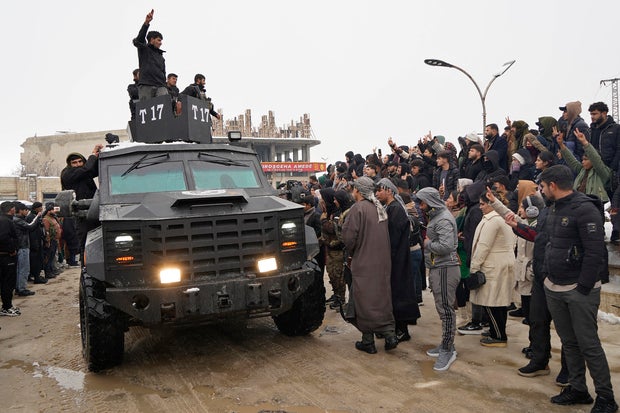
The mayhem included a Jan. 20 mass-escape from one facility.
The protection ministry mentioned the ceasefire extension was supposed to allow the U.S.-led army coalition to finish the switch of the ISIS suspects to Iraq.
From the beginning of the U.S.-led battle towards ISIS in 2014, the SDF performed a decisive position in defeating the terrorist group and forcing it to desert its self-declared Islamic caliphate in 2019. ISIS, whereas now not holding vital territory, nonetheless poses a risk, and the SDF has continued working alongside coalition forces to hold out joint operations aimed toward stopping its reemergence.
Because of the preliminary offensive and the continued operations, hundreds of ISIS suspects had been detained in prisons and detention facilities guarded by the SDF and coalition troops in northeast Syria.
However a deep lack of belief between the SDF and Syria’s new, post-dictatorial authorities, which can also be backed by the U.S., led to the clashes that weakened safety on the prisons holding the ISIS detainees — lots of them hardened militants.
The uncertainty over safety on the detention amenities alarmed not solely the SDF and leaders in Damascus, however neighboring international locations and the U.S., and Washington agreed to relocate the roughly 7,000 ISIS suspects to safer detention amenities in Iraq.
U.S. Secretary of State Marco Rubio confirmed the plan, saying the prisoners would “be in Iraq briefly,” and urging the detainees’ residence international locations to repatriate their nationals.
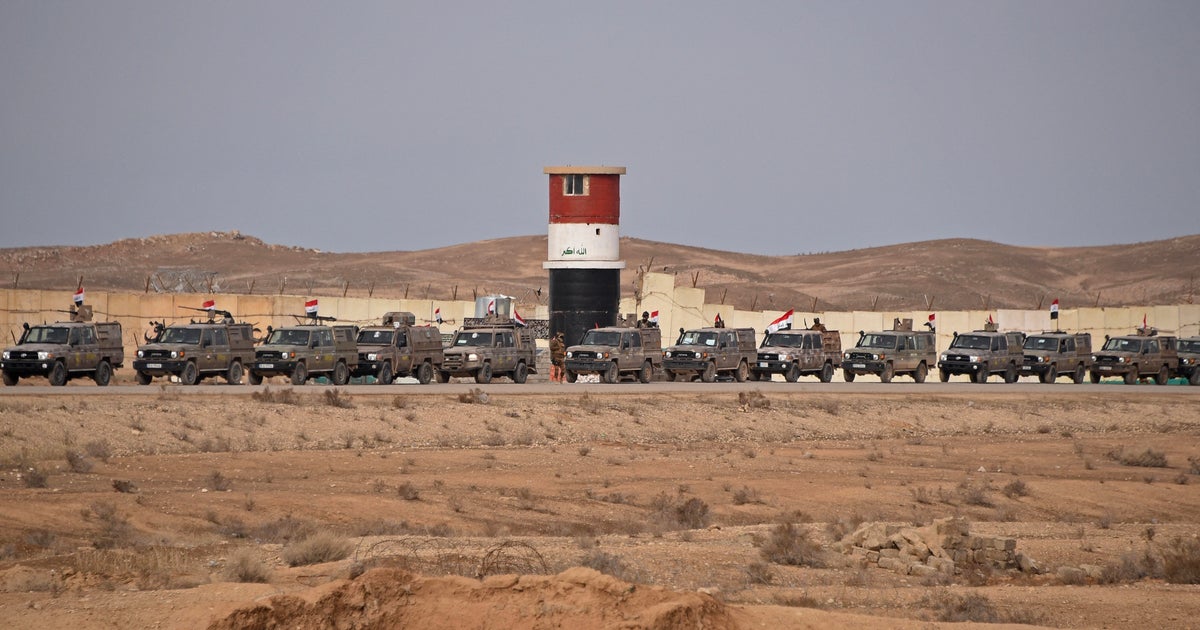
In Iraq, officers cautious of additional mass escapes moved shortly to tighten safety alongside the border with Syria whereas providing safe amenities to carry transferred detainees.
Zaid AL-OBEIDI/AFP/Getty 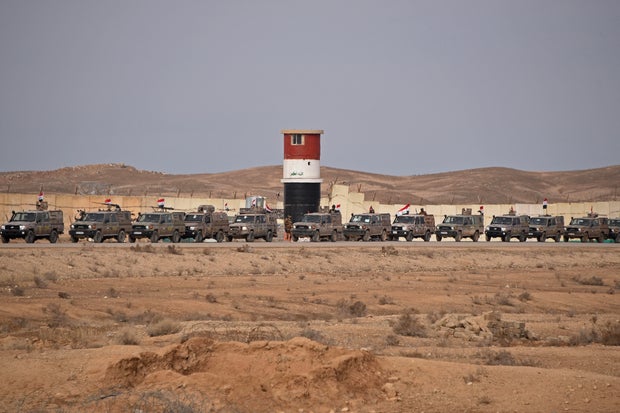
“It’s higher to have them imprisoned and secured in Iraq than fear about their escapes and releases in Syria,” one Iraqi safety supply, who was not approved to talk on the matter, instructed CBS Information.
However whereas Rubio mentioned the ISIS suspects would solely be held briefly in Iraq, the federal government in Baghdad has gone additional, saying it is able to put them on trial.
Iraq says it could supply ISIS suspects “truthful and decisive trials.” Can it?
Iraq’s prime authorized official, the President of the Supreme Judicial Council, Decide Dr. Faiq Zidan, mentioned in a televised handle on Jan. 23 that his nation was totally ready to deal with the instances of ISIS suspects, international and home.
“Whereas some international locations refuse to obtain their nationals concerned in terrorist crimes, the Iraqi judiciary confirms its full readiness to attempt terrorists detained in camps inside Syrian territory, in accordance with nationwide legal guidelines and worldwide obligations, guaranteeing truthful and decisive trials, reaching justice for the victims of terrorism, and preserving safety in Iraq and different international locations,” Zidan mentioned.
However Sarah Sanbar, a researcher with the New York-based Human Rights Watch group, questioned Iraq’s skill to hold out so many trials pretty, telling CBS Information that the final time such numerous individuals had been put earlier than courts within the nation, the “system was fully overwhelmed.”
Following the defeat of ISIS in Iraq on the finish of 2017, the nation put hundreds of ISIS suspects on trial. In response to the United Nations mission in Iraq, between January 2018 and October 2019, the Iraqi judiciary processed greater than 20,000 terrorism-related instances.
Iraqi officers haven’t confirmed how many individuals convicted of terrorism offenses had been sentenced to demise throughout that interval, however Human Rights Watch and Amnesty Worldwide have mentioned round 8,000 persons are on demise row within the nation, together with non-Iraqi residents.
A number of information shops, together with The Wall Road Journal, reported in 2019 that seven French nationals had been among the many tons of of individuals sentenced to demise. A CBS Information workforce attended one of many trials in Baghdad.
“They had been completely sham trials,” Sanbar instructed CBS Information. “Confessions obtained beneath torture, individuals being tortured in detention facilities, trials that lasted 10 minutes and not using a lawyer current, the place they had been sentenced to demise, on the idea of an nameless informant and no corroborating proof.”
Maya Alleruzzo/AP 
Responding to questions despatched by CBS Information through electronic mail, an official with Iraq’s Nationwide Heart of Justice and Worldwide Judicial Collaboration rejected Sanbar’s accusations, saying the “Iraqi judiciary categorically rejects torture” and noting that “extracting confessions by means of coercion is against the law punishable beneath Iraqi legislation.”
“Terrorism trials in Iraq are performed in accordance with present legal guidelines and inside a constitutional framework that ensures the proper to a good trial, the defendant’s proper to a protection, and the eligibility of rulings for authorized attraction,” the official on the heart mentioned, including that every one such proceedings had been “overseen by specialised judges working beneath extraordinary circumstances imposed by the dimensions and nature of those crimes.”
Sanbar mentioned Iraq’s justice system “has come a great distance” for the reason that trials in 2019, because the nation itself has continued to stabilize, “however that being mentioned, a number of these core systemic points nonetheless persist.”
Requires Iraq and the U.S. to say “who’s even there”
“We do not know who’s there,” Sanbar instructed CBS Information of the detainees being moved into Iraq by the U.S. “And a part of what we’d name on authorities to do in Iraq, and the coalition, is to be very clear about who they’re transferring, inform the households, give them entry to authorized illustration, in order that at first, we all know who’s even there.”
On a go to to an enormous jail housing ISIS suspects in Hasaka, northeast Syria, in 2019, CBS Information discovered that almost all of them had been Iraqis or Syrians, however there have been additionally many Europeans, Asians, Turks and residents of different Arab international locations. There was additionally one American man, however CBS Information discovered later that he had been repatriated.
CBS Information 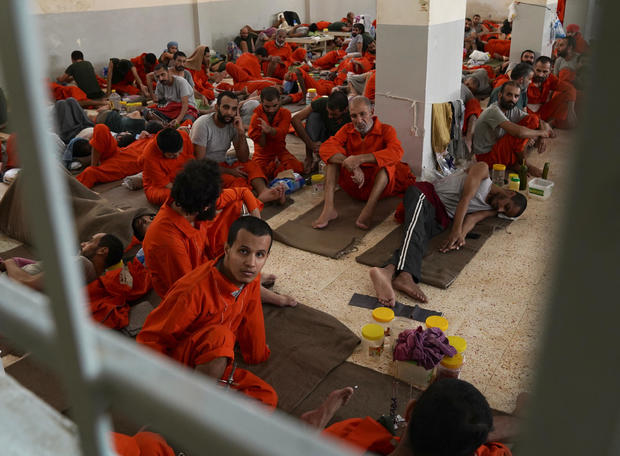
Thus far, no third nation has commented on the switch of any international nationals to Iraq or the potential of them being placed on trial within the nation. That has not come as a shock to Sanbar.
“We have seen these international locations whose residents left to hitch ISIS fully washing their fingers of any form of accountability. They’ve allow them to languish there for the final 10 years,” mentioned Sanbar. “We might hope that now they’d take them residence, and we name on them to take action.”
The Iraqi Nationwide Heart of Justice and Worldwide Judicial Collaboration instructed CBS Information it was in communication with various international locations concerning the matter, although it didn’t establish them.
When CBS Information spoke with Iraq’s justice chief Zaidan in 2019 about criticism over the earlier convictions and demise sentences, together with of seven French nationals, his stance was clear: Different international locations ought to both deal with it themselves, or let Iraq do it Iraq’s approach.
“My message to the international governments,” Zaidan mentioned: “Please respect the Iraqi court docket and the Iraqi legislation. If you need our court docket to make a trial for all of the fighters, you have to respect our determination. You should respect our legislation. In case you do not settle for what we’re doing in our court docket, please take your detainee for you, take your suspect in your nation, and make a trial in your nation.”
[ad_2]