[ad_1]
Newly launched paperwork present the FBI’s scramble to elucidate final 12 months why it launched a display screen recording with a lacking minute from the evening Jeffrey Epstein died, as a substitute of the unique footage.
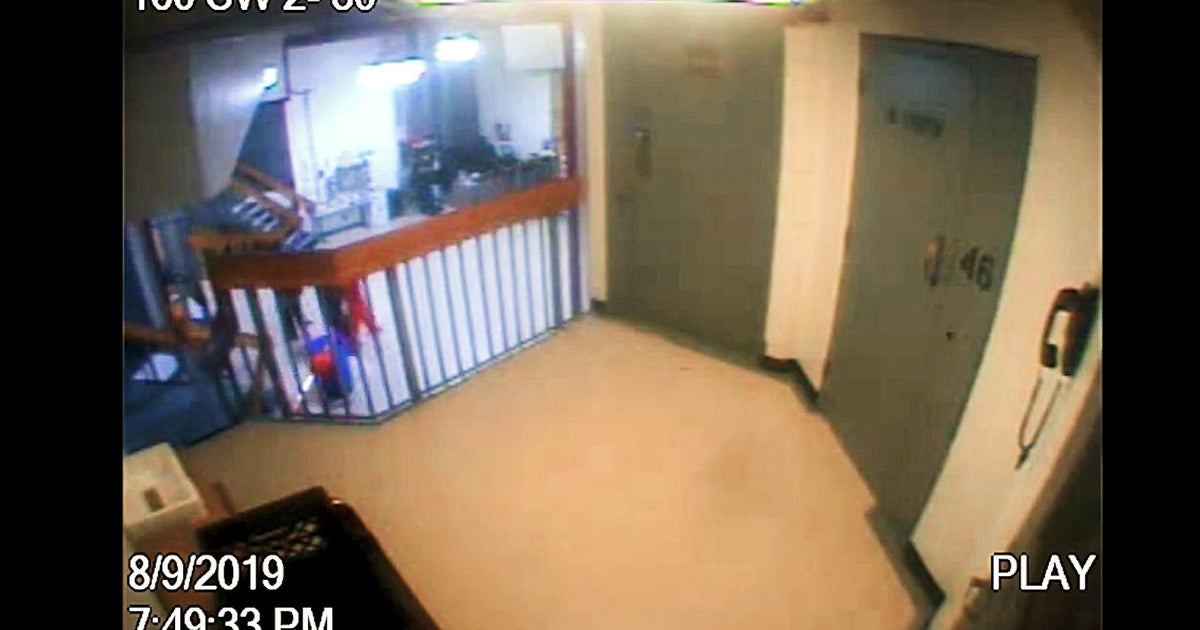
The discrepancy fueled conspiracy theories a few cover-up after then-Deputy FBI Director Dan Bongino promised the company would launch the unique surveillance footage from Epstein’s Manhattan jail “so you do not suppose there are any shenanigans.” The FBI has by no means provided a public rationalization of the way it ended up releasing a video with a spot in footage.
Final Might, as a groundswell constructed demanding public scrutiny of the Justice Division’s data on Epstein, the company bumped into an issue: it had already destroyed its grasp copy of surveillance video from Epstein’s closing hours within the Metropolitan Correctional Middle.
An FBI agent sought and was granted in June 2024 authorization to destroy an proof merchandise labeled 1B60, describing it as an exhibit “not pertinent” to the case.
That merchandise, in line with a doc among the many Epstein information, was the grasp recording of “tapes containing the archive of [Manhattan Correctional Center] video pictures.” It had been saved in a Bronx warehouse.
In February 2025, an agent defined in a special doc the justification for destroying the video.
“As this case was already closed and [redacted prosecutor’s name] concurred on 08/26/2024 with company proof dealing with procedures, authorization was granted to destroy Merchandise 1B60,” the agent wrote. “Per FBI coverage, if an proof merchandise stays undisposed, the investigative case file should stay open.”
However by mid-2025, the Justice Division wanted the destroyed proof reconstructed. That launched a sophisticated scramble to rebuild the video information, in line with paperwork included among the many hundreds of thousands launched up to now in what have change into often known as the Epstein information.
A “high-level overview” of the steps taken to take action was compiled in July by an FBI digital forensics and analytics part chief.
The trouble concerned acquiring one other copy of the footage that remained saved throughout two information on a NiceVision digital video recorder, the system used within the jail. One of many video information began at 7:40 p.m. The opposite began at 12 a.m. and ended at 6:40 a.m. On Might 21, 2025, an agent used a display screen seize device to re-record the footage from NiceVision.
However 62 seconds of footage could not be captured, leaving a spot from 11:58 and 58 seconds, to 12:00.
Quickly after the video was launched in July, members of the general public seen it jumped from about 11:59 to midnight. Slightly than clarify that the footage had been pieced collectively from a duplicate, Lawyer Basic Pam Bondi introduced that the explanation for the hole was that the jail recording system had a nightly reset leading to a misplaced minute each evening.
“There was a minute that was off that counter, and what we discovered from Bureau of Prisons was yearly, each evening, they redo that video,” Bondi mentioned on July 8, noting that the system was outdated. “Each evening is reset, so each evening ought to have that very same lacking minute. So we’re searching for that video as effectively, to indicate it is lacking each evening.”
It seems Bondi had accepted a speculative conclusion summarized by the part chief, that the system reset nightly, dropping that minute. It is a concept that seems to have been unverified.
“The Video Specialist theorized the NiceVision methods presently required time to write down information and precipitated an actual time delay in what’s recorded leading to a spot of time not recorded proper earlier than midnight,” the part chief wrote. “The Video Specialist was unable to check the accuracy of his concept.”
Specialists informed CBS Information in July that the time delay concept was implausible. Not one of the safety system specialists CBS Information spoke with had heard of a system that had that problem.
The Justice Division has not replied to questions in regards to the video information.
An FBI specialist tried to merge the display screen recordings utilizing the video enhancing software program Adobe Premiere, however “Adobe Premiere didn’t work with the video file format the display screen seize was created in,” the part chief wrote.
The specialist then used software program referred to as Quick Ahead Transferring Image Skilled Group “to transform the information to a format succesful to ingest into Adobe Premiere.”
That stage led to at least one extra obvious discrepancy found final 12 months by Wired, which “discovered that one of many supply clips was roughly 2 minutes and 53 seconds longer than the section included within the closing video, indicating that footage seems to have been trimmed earlier than launch.”
The Wired evaluation was appropriate. The part chief referred to as it “commonplace observe” when doing a display screen seize to incorporate “padding” to the tip, additional recording time that may be pared again.
“When the display screen recording was introduced into Adobe Premiere the padding was trimmed,” the part chief wrote. Wired identified that the primary video file used within the display screen seize was the one with “padding.” It ended at 11:58:58, “which suggests the 2 (clips) would overlap.”
A CBS Information investigation printed in July 2025 famous a shift within the video’s look, often known as its side ratio, after midnight.
The part chief defined “the side ratio of the file was additionally corrected to create a extra pure look.”
The complete footage, together with the lacking minute, was made public by Congress in September. It confirmed that nothing notable or uncommon appeared on the recording throughout that minute.
[ad_2]