[ad_1]
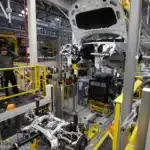
DHL Autonomous Robotic at work.
Supply: DHL
Staff at DHL Group used to stroll near a half marathon every day simply to categorise, choose and transfer gadgets throughout huge warehouses.
Now, their distance and efforts are vastly lowered by autonomous cellular robots that may unload containers for the package deal supply and provide chain administration firm with a pace of as much as 650 circumstances per hour.
“That’s what we look ahead to, and the place we have been profitable in deploying know-how at scale over the past 5 years, going from after we began in 2020 with 240 initiatives, and now we’re as much as 10,000 initiatives,” Tim Tetzlaff, DHL’s international head of digital transformation, advised CNBC.
The corporate’s autonomous improvements have accelerated processes at 95% of DHL’s international warehouses. Merchandise-picking robots in a single warehouse have elevated items picked per hour by 30%, whereas autonomous forklifts at that very same warehouse have contributed a 20% enhance in effectivity, the corporate mentioned.
Tetzlaff mentioned automation is vital for the corporate as a result of it is such a labor-intensive enterprise.
“We nonetheless have the ambition to develop our enterprise even additional, however in case you take a look at the place these distribution facilities needs to be situated … it is usually very powerful to search out further labor and even further areas simply to construct these warehouses there,” he mentioned.
DHL is one among a number of success corporations transferring towards automation and leveraging synthetic intelligence because the business works towards larger effectivity.
On an earnings name with analysts in late January, United Parcel Service CEO Carol Tomé mentioned the corporate deployed automation in 57 buildings within the fourth quarter, bringing its whole to 127 automated buildings, with plans for twenty-four extra in 2026.
“This yr, we plan to additional automate our community and consequently, we count on to extend the proportion of U.S. quantity we course of via automated amenities to 68% by the tip of the yr, up from 66.5% on the finish of 2025,” she mentioned.
Equally, FedEx has mentioned it sees automation as an alternative to boost its employees’ jobs, putting in robotic arms to assist course of small packages at its Memphis hub and dealing with AI firm Dexterity to leverage robots for loading containers into containers. Its “Community 2.0” initiative is working to extend the effectivity of its package deal processes.
The corporate not too long ago introduced a partnership with Berkshire Gray to launch a completely autonomous robotic to unload containers and optimize operations.
It estimates that the worldwide warehouse automation market is anticipated to exceed $51 billion by 2030.
“We now have about 24% of our eligible common day by day quantity flowing via 355 Community 2.0-optimized amenities,” CEO Raj Subramaniam mentioned on a name with analysts in December.
A human fleet
A employee unloads packages from a FedEx truck in San Francisco, California, US, on Wednesday, Dec. 17, 2025.
David Paul Morris | Bloomberg | Getty Pictures
With the rise of automation, corporations are weighing the steadiness between their human employees and their technological improvements.
UPS has introduced layoffs north of 75,000 over the previous yr as the corporate focuses on effectivity and cuts down its partnership with Amazon amid a multiyear turnaround plan.
The corporate additionally mentioned it closed 93 buildings in 2025 and plans to shutter at the least 24 buildings within the first half of 2026.
“What’s taking place is you are seeing a cascading impact of websites being closed which might be legacy standard amenities, plenty of labor required to run these amenities, to a way more nimble, faster, automated, consolidated facility,” Govt Vice President Nando Cesarone mentioned on the January name.
In a press release to CNBC, a UPS spokesperson mentioned the corporate is targeted on making jobs simpler for its staff and that the AI and robotics tackle repetitive duties that “make us extra environment friendly in different features.”
FedEx didn’t reply to requests for touch upon how the corporate is balancing its workforce and know-how. Subramaniam mentioned on the newest earnings name that the Community 2.0 initiative has resulted in “structural value reductions” however the firm has not publicly disclosed job minimize quantities.
Teamsters, the union representing employees from lots of the main packaging corporations, mentioned it’s going to stay centered on making certain its group members have a voice on the desk in relation to know-how.
“We by no means need to get in the way in which of know-how and its improvement, however all of that, it should assist employees, and it can not work towards them ever,” spokesperson Lena Melentijevic advised CNBC. “It is the employees who’re the spine of every one among these corporations and who’re important to their success, and we’re right here to advocate for them and maintain corporations accountable.”
DHL’s Tetzlaff mentioned the corporate needs its automation to enrich human labor as a substitute of changing it altogether. No matter how a lot DHL’s know-how improves, Tetzlaff mentioned the dexterous duties of packaging and delivery stay within the arms of the staff.
“Within the time the place we deployed 8,000 collaborative robotics into our operation worldwide, we nonetheless employed 40,000 folks,” he mentioned.
The most important space the place DHL has deployed its robotics is in merchandise choosing, with greater than 2,500 robots utilizing educated arms to pick gadgets for packages. This previous vacation season, to maintain up with the Black Friday and Christmas demand, the corporate added 30% capability to its robotic fleet.
“There’s a bonus for us as an organization, having an amazing human fleet of employees that’s motivated and likes the job, however complementing this with a robotic fleet that we are able to scale up and down and have that versatile stability to cope with change, the peaks all year long, be it greater adjustments like Covid, be it [customer] profile adjustments and so forth,” he mentioned.
The trail ahead for funding
DHL Autonomous Forklift at work.
Supply: DHL
Nonetheless, it is unlikely there will likely be a close to future wherein warehouses are filled with humanoid robots, based on provide chain professional and Accenture logistics and success lead Benjamin Reich.
Humanoid robots have been gaining intense recognition as tech corporations innovate human-like machines, with Nvidia CEO Jensen Huang saying he believes the innovation is fast-paced. On the January CES commerce present, Google introduced a partnership with Boston Dynamics, the identical firm working with DHL, to enhance the tech firm’s new robotic named Atlas.
However Reich mentioned amongst his purchasers, he is seeing that “people are nonetheless within the lead.”
“We’re additionally not seeing a alternative of jobs, however a shifting that you just’re extra searching for talent units in the marketplace to serve the hole between diploma of automation, operational duties in addition to organizational,” Reich advised CNBC.
The automation is angled towards particular jobs, he added, with robots taking on repetitive duties and corporations as a substitute “redirecting” their hiring towards technical roles as a substitute of eliminating job development altogether.
Reich mentioned the business is seeing rising investments into automation, with the most important good points coming not from changing folks, however via growing the effectivity of the provision chain and warehouse execution processes.
There are additionally components within the broader business which might be impacting the workforce, based on Ronny Horvath, the transportation and logistics lead at Accenture. There is a scarcity of expert employees who’ve each the guide abilities and the organizational abilities wanted for the sector, and there is additionally competitors amongst corporations for warehouse personnel based mostly on pay, advantages, way of life and extra.
“So automation also can assist, not changing however augmenting that hole, that void, that has been left by simply not getting the employees that you’ve got in the present day,” Horvath mentioned. “And we see plenty of purchasers, they’ve an automation or robotic technique … however they nonetheless have the plans to rent human employees as properly.”
Horvath added that the business is reaping the rewards of its new know-how. He is seen corporations in a position to regulate to ship on excessive demand, enhance effectivity and work towards extra automated processes to maintain up with warehousing.
In line with an Accenture research from March, 51% of factories globally count on to have totally automated warehouses by 2040, and 70% of transportation logistics executives deal with autonomous provide chains as a high funding precedence.
“There’s virtually no autonomous construction present in the mean time,” Horvath mentioned. “So most or a few of these purchasers are ranging from scratch, and this may take time till these investments are accomplished and till additionally they reap the advantages out of it for all these areas.”
[ad_2]