[ad_1]
by TeachThought Curricula
Curricula Format In case you’d wish to buy printable studying response playing cards to make use of within the classroom, you are able to do so at our TeachersPayTeachers Retailer. You will discover the useful resource present right here–> non-fiction studying responses.
Within the ELA classroom, literacy entails decoding a textual content after which analyzing it for which means, implicit and express themes. It additionally requires analyzing the connection of a textual content to a given perspective, writer’s goal, and associated textual content and media.
Which is the place these prompts are available in.
The next analytical responses are meant to common and common, helpful for utility for a spread of texts. Right here, essentially the most particular type is non-fiction texts, together with essays, articles, editorials, speeches, memoirs, biographies, and different informational texts.
How To Use These Prompts
Every immediate is designed to face alone, so lecturers can choose one or a number of based mostly on the textual content, the talent being emphasised, or the wants of particular person college students. A couple of approaches that work properly:
As studying response stations: Print the playing cards and place them at stations across the room. After studying a shared textual content — for instance, Martin Luther King Jr.’s “Letter from Birmingham Jail” — college students rotate and reply to 2 or three prompts of their alternative.
As differentiated journal prompts: Assign particular prompts based mostly on the place college students want follow. A pupil engaged on figuring out writer’s craft would possibly reply to: immediate 3 (“How does the writer set up and develop the theme all through the textual content? What instruments do they use?”), whereas a pupil prepared for extra complicated evaluation would possibly tackle immediate 9 (evaluating texts when it comes to theme, tone, writing fashion, and thought group).
As dialogue starters: Use a single immediate to border a Socratic seminar or small-group dialogue. Immediate 5 (“Who’s the viewers? How have you learnt?”) can generate productive debate when utilized to an editorial or political speech the place the meant viewers isn’t instantly apparent.
As evaluation preparation: As a result of the prompts mirror the sorts of analytical considering required on standardized assessments, common use builds familiarity with shut studying and evidence-based response with out requiring separate take a look at prep.
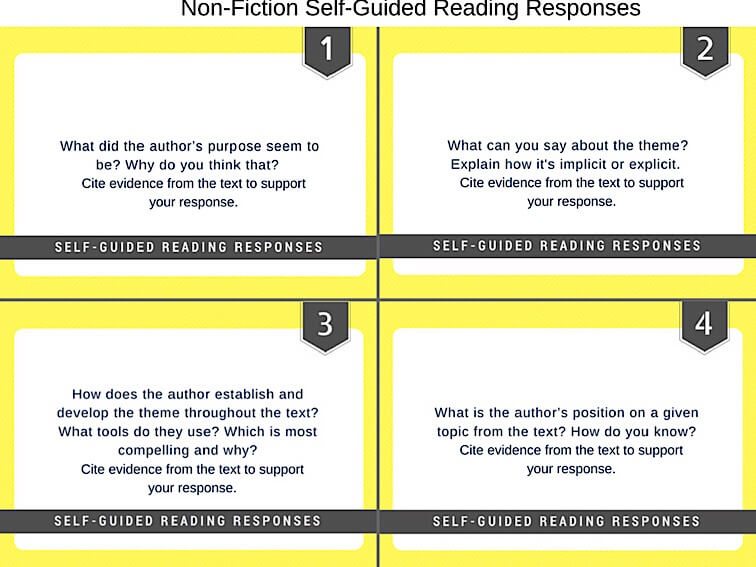
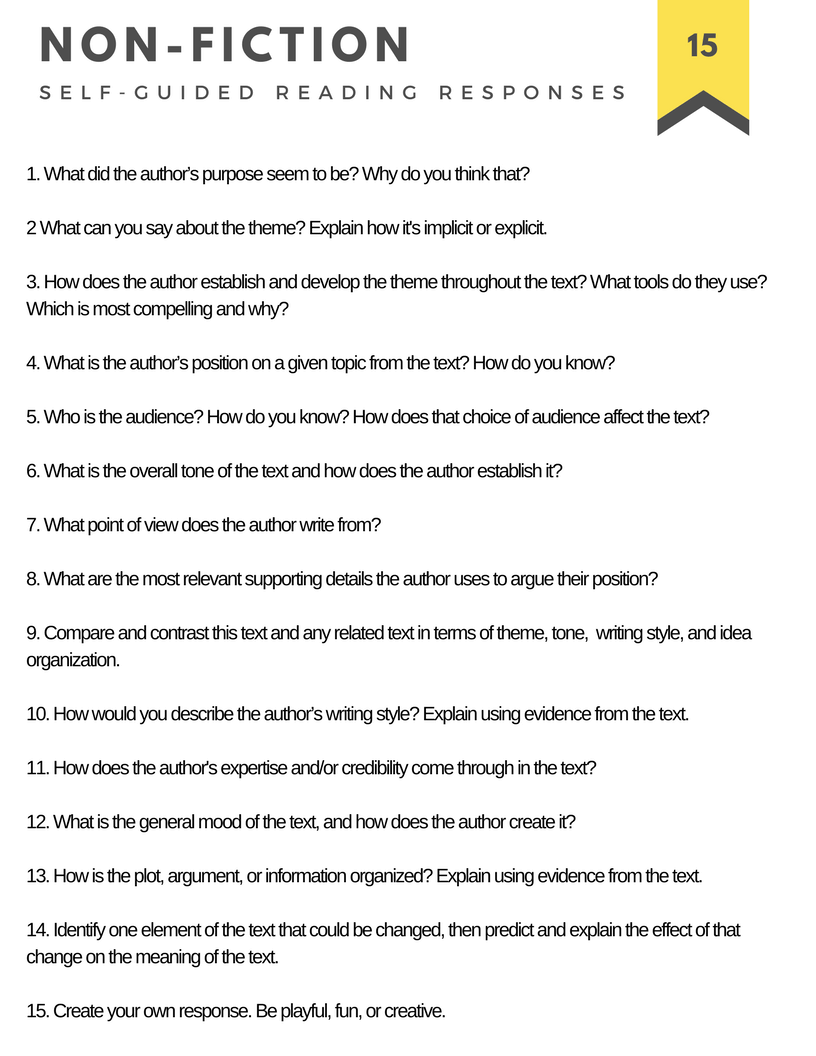
The prompts seem on the picture beneath. In case you’d wish to obtain precise playing cards to make use of within the classroom (see the picture above for an instance), we’ve created a curricula set you may obtain right here.
Content material Space: English-Language Arts, Literature, Writing
Grade Stage: Excessive Faculty/Grades 8-12
Non-Fiction
Self-Guided Studying Responses
15
- What did the writer’s goal appear to be? Why do you suppose that?
- What are you able to say concerning the theme? Clarify the way it’s implicit or express.
- How does the writer set up and develop the theme all through the textual content? What instruments do they use? Which is most compelling and why?
- What’s the writer’s place on a given matter from the textual content? How have you learnt?
- Who’s the viewers? How have you learnt? How does that alternative of viewers have an effect on the textual content?
- What’s the total tone of the textual content and the way does the writer set up it?
- What viewpoint does the writer write from?
- What are essentially the most related supporting particulars the writer makes use of to argue their place?
- Evaluate and distinction this textual content and any associated textual content when it comes to theme, tone, writing fashion, and thought group.
- How would you describe the writer’s writing fashion? Clarify utilizing proof from the textual content.
- How does the writer’s experience and/or credibility come by way of within the textual content?
- What’s the common temper of the textual content, and the way does the writer create it?
- How is the plot, argument, or data organized? Clarify utilizing proof from the textual content.
- Establish one component of the textual content that may very well be modified, then predict and clarify the impact of that change on the which means of the textual content.
- Create your personal response. Be playful, enjoyable, or inventive.
TeachThought: Analysis-Knowledgeable Methods for Educating and Studying
[ad_2]