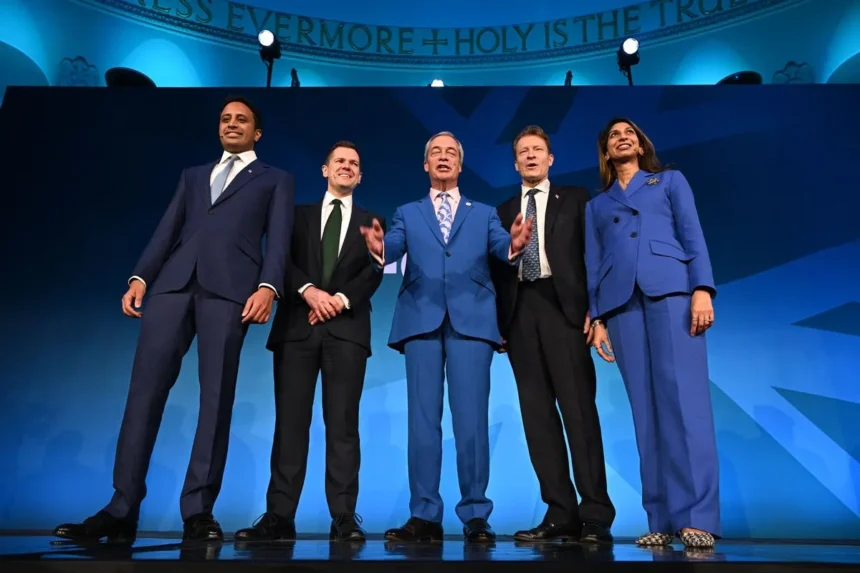
Nigel Farage, leader of Reform UK, announced the party’s inaugural front bench appointments on Tuesday. He asserted that the party now boasts its own distinct brand, identity, and senior leaders overseeing key departments, addressing criticisms that it relies solely on his leadership.
Key Appointments and Roles
Reform UK named four prominent spokespersons. Former Conservative ministers Robert Jenrick and Suella Braverman received roles. Jenrick serves as the party’s economics spokesperson, often called the shadow chancellor. Richard Tice, Farage’s deputy, takes on business, trade, and energy. Zia Yusuf handles home affairs, focusing on sharp reductions in legal and illegal migration.
Robert Jenrick’s Economics Role
Jenrick’s selection sparked internal competition from Yusuf and Tice. Sources indicate Farage promised him the position during defection talks earlier this year. At a London event, Jenrick vowed to challenge Chancellor Rachel Reeves, whom he labeled a “wrecking ball,” and criticized decades of economic mismanagement. This comes despite his prior ministerial roles, including at the Treasury, under the Conservative government.
In 2020, as housing secretary, Jenrick drew scrutiny for approving a Tory donor’s luxury housing project just before a new tax levy, potentially saving billionaire Richard Desmond £45 million.
Suella Braverman on Education and Equalities
Braverman, who recently joined after resigning and being sacked from Conservative home secretary positions, leads education, skills, and equalities. She declared that “diversity and equality policies are ripping Britain apart” and pledged to eliminate the minister for women and equalities role. If Reform gains power, she aims to repeal the Equality Act, which safeguards against discrimination.
Braverman also stated that “social and gender transitioning will be banned in all schools, no ifs no buts,” vowing to end “transgender chaos” where children learn more about gender ideology than biology. Equalities groups and legal experts condemned her remarks.
Jo Maugham KC, executive director of the Good Law Project, accused her of appealing to “misogynists, homophobes, racists and antisemites” by undermining discrimination protections. He warned that banning social transition equates to policing children’s appearances, calling it “unworkable” with a “North Korean flavour.”
Dr. Paul Martin OBE, chief executive of the LGBT Foundation, defended the Equality Act as part of the solution to Britain’s challenges, providing protections in work, healthcare, education, and services. A Stonewall spokesperson added that equality leaders must champion equal treatment for marginalized groups.
Zia Yusuf’s Home Affairs Focus
Yusuf, who briefly resigned as party chair last year before returning, targets migration cuts. He pledges to exit international treaties blocking mass deportations and deems it reasonable to pay the Taliban for repatriating illegal entrants. Critics highlight his rhetoric likening illegal migration to an invasion and noting more arrivals in eight years than D-Day troops.
Richard Tice’s Business Portfolio
Tice proposes a “super department” to boost GDP growth to 4 percent. He faces questions over tax arrangements, as partner Isabel Oakeshott resides in low-tax Dubai. Tice visits the UAE every six to eight weeks and splits time between Westminster and his Skegness constituency. Farage noted Tice will rarely appear centrally, focusing on sites like Aberdeen’s refineries and manufacturing hubs. Tice has praised Dubai’s safety, despite its human rights criticisms on speech, discrimination, and political detentions.