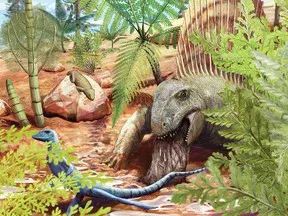
Scientists have uncovered the world’s oldest fossilized predator vomit, dating back nearly 290 million years. This remarkable find from the Bromacker excavation site in Germany sheds light on feeding behaviors in ancient land ecosystems, long before dinosaurs roamed the Earth.
The Rare Regurgitalite Discovery
The fossil, classified as regurgitalite—scientifically termed fossilized vomit—marks the earliest confirmed instance from a fully terrestrial environment. Detailed in a study published in Scientific Reports, it captures direct evidence of predator-prey dynamics in a prehistoric ecosystem.
Mark MacDougall, a paleontologist and assistant professor at Brandon University in Manitoba, co-authored the research. “This fossil is extremely important for understanding how early land ecosystems worked,” MacDougall stated. “It’s rare to get such direct evidence of who was eating whom nearly 300 million years ago. In this case, the predator clearly bit off more than it could stomach.”
Advanced Analysis Reveals Prey Details
Researchers employed CT scanning and chemical analysis to examine the specimen. The vomit contains bones from at least three distinct animals: a small reptile, a swift lizard-like creature, and remains of a larger herbivore.
Unlike coprolites, which are fossilized feces with fully digested contents, regurgitalites preserve partially intact skeletons expelled before complete breakdown. Evidence points to a large predator, possibly an early mammal relative like the sail-backed Dimetrodon, which predates dinosaurs by about 40 million years.
“These animals lived together, died together, and ended up in the same regurgitated pile, probably within days of each other,” MacDougall noted. “That kind of detail is incredibly rare in the fossil record.”
Insights into Early Land Predation
The discovery offers the first direct proof of opportunistic feeding among terrestrial predators. Modern analogs, such as owls and wolves regurgitating indigestible parts, highlight similar behaviors preserved across eons.
The international team, led by experts from Germany’s Museum für Naturkunde in Berlin and France’s CNRS, relied on Brandon University’s expertise for ecological interpretation. This regurgitalite illuminates the structure of pre-dinosaur land communities.