[ad_1]
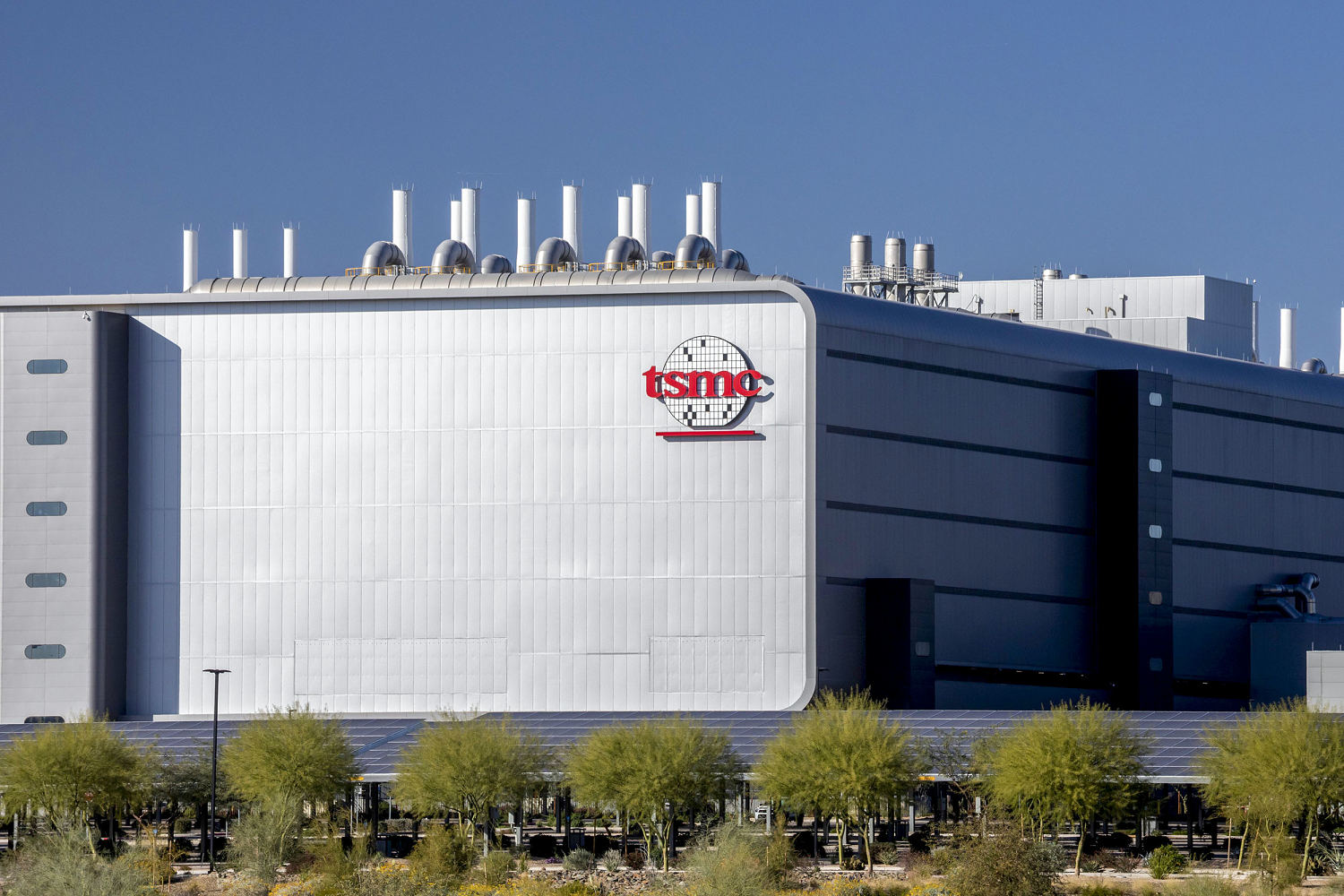
Key parts produced by a number one Taiwanese chipmaker have been present in a robust AI chip from a Chinese language firm, in keeping with an preliminary report from a semiconductor analysis agency, which consultants say might violate U.S. export controls.
U.S. officers have been briefed on the analysis, in keeping with a supply conversant in the problem who requested anonymity to debate personal issues. The analysis particulars a breakdown of an AI chip produced for the Chinese language firm Enflame. After it took the Enflame processor aside, the analysis agency TechInsights stated on its web site, it discovered that key chip parts had been manufactured by Taiwan Semiconductor Manufacturing Co. (TSMC).
Over the previous a number of years, the U.S. has imposed tight restrictions on what AI-related merchandise might be bought to Chinese language corporations or corporations working in China, a transfer supposed to keep up America’s lead in AI growth. Chips present the computing energy essential to create and run AI programs, and their restricted provide has acted as a bottleneck for China’s AI business.
The commerce guidelines, established by the Commerce Division, decide the place and the way a chip might be exported based mostly on such metrics because the variety of computing calculations it will probably carry out per second and its computing energy relative to its measurement.
The Enflame S60 chip can be highly effective sufficient to be topic to these export restrictions, TechInsights appeared to conclude, based mostly on its preliminary evaluation. The export management classification probably makes the chip’s sale to Chinese language AI corporations unlawful from late 2022 onward, consultants say. In line with a number of Chinese language newspapers, a minimum of one in all which is state-affiliated, Enflame S60 chips have been manufactured in 2024.
TechInsights says it classifies export management particulars, additionally known as ECCNs, based mostly on data from producers or third-party suppliers or on “data out there on the time of research.” Within the identical disclaimer, TechInsights notes that its inferences and conclusions aren’t remaining regulatory choices.
Shortly after NBC Information despatched its request for remark to TechInsights, the publicly viewable classification was modified to “TBD” earlier than it was faraway from the web site fully.
“The technical evaluation of the Enflame S60 are ongoing and never full,” TechInsights spokesperson Graham Butler wrote in response to a request for remark. “We are going to briefly place an ECCN based mostly on the preliminary report findings. These are topic to alter as reviews are finalised.” TechInsights declined to supply the total report back to NBC Information. TSMC advised NBC Information that the classification initially utilized by TechInsights was incorrect.
Since 2022, the U.S. has asserted that its export controls apply to sure AI-related “objects made with using U.S. expertise, software program, or instruments” destined for China, even when the objects themselves are manufactured exterior the U.S. That dedication contains basically all AI chips, provided that American expertise is used within the machines that manufacture chips.
Beneath the U.S. export guidelines, which have been expanded to use to chips which might be destined for nations past China to deal with smuggling fears, TSMC has been banned from delivery cutting-edge chips meant for AI functions to Chinese language corporations with out particular export licenses.
TSMC fabricates the vast majority of the world’s AI chips due to its experience with the distinctive and complicated manufacturing strategies required to create semiconductor-dense chips.
“We’ve reviewed a sure third-party evaluation report claiming a specific chip manufactured by TSMC is assessed as a managed AI chip,” a TSMC spokesperson wrote in reply to a request for remark in regards to the new analysis relating to the Enflame S60.
“Based mostly on its technical options and purposes, this chip doesn’t meet the standards for classification as a managed AI chip and the report has since been corrected, and the inaccurate declare has been eliminated. TSMC is a law-abiding firm, and we’re dedicated to complying with all relevant guidelines and rules, together with relevant export controls.”
Requested about TSMC’s declare that TechInsights’ classification for the Enflame chip was inaccurate, a TechInsights spokesperson merely reiterated that the technical evaluation was “ongoing and never full.”
Enflame didn’t reply to requests for remark.
TSMC has beforehand been accused of violating export controls associated to manufacturing a chip present in AI processors from the main Chinese language tech firm Huawei, in keeping with Reuters.
In April, Reuters reported that the Commerce Division opened an investigation into TSMC over how its chips made for an organization known as Sophgo wound up in Huawei’s processors, which was already prohibited by export controls from receiving TSMC-made AI chips, and stated TSMC might face a penalty of $1 billion or extra. On the time, a TSMC spokesperson stated that the corporate was dedicated to complying with the regulation and that it was cooperating with the Commerce Division.
When requested in regards to the existence and standing of the Huawei investigation, Commerce Division spokesperson Lauren Weber Holley wrote in an electronic mail: “The Division of Commerce doesn’t touch upon lively enforcement issues or verify or deny the existence of any pending investigations.”
Requested about any potential investigation relating to the Enflame chip, Holley wrote: “The Division of Commerce doesn’t touch upon lively enforcement issues or verify or deny the existence of any pending investigations.”
Measures launched in November 2023 additional restricted the kinds of chips and nations to which semiconductor manufacturing corporations utilizing American expertise can export chips meant for AI functions. The Enflame S60 chip, manufactured by TSMC, is sufficiently highly effective to make it topic to those tighter rules, in keeping with particulars beforehand viewable on TechInsight’s web site.
Jacob Feldgoise, a senior knowledge analysis analyst at Georgetown College’s Heart for Safety and Rising Expertise who had entry to separate knowledge in regards to the chip, stated he was inclined to belief TechInsights’ preliminary dedication that the chip is highly effective sufficient to be topic to the foundations.
Due to intense international AI competitors and fears that Chinese language corporations may divert superior chips to the Chinese language navy, the Commerce Division not often grants such licenses. In line with a senior Commerce Division official, Enflame didn’t obtain a license in 2023, 2024, or 2025.
“If this can be a massive AI chip designed for knowledge middle use and produced at TSMC, that’s seemingly an export management violation just like the Huawei-Sophgo incident,” stated Lennart Heim, a number one semiconductor knowledgeable, specifying that he had not seen the chip and would wish extra particulars to succeed in a agency conclusion. The Commerce Division didn’t touch upon the existence or standing of the Huawei-related investigation or verify whether or not that incident was an export management violation.
“Enflame is principally Tencent’s outsourced AI chip designer. It’s not some random unbiased startup — it’s intently tied to one in all China’s largest tech corporations,” Heim advised NBC Information in written feedback. “That is in all probability a considerably smaller incident than Huawei-Sophgo by way of what number of chips have been produced — nevertheless it exhibits the sample of chips getting via TSMC that shouldn’t have.”
In line with the reviews from Chinese language newspapers, Enflame has deployed tens of hundreds of S60 chips in knowledge facilities and related infrastructure essential for AI growth and utilization.
In latest months, the Trump administration has accredited the sale of high-powered chips far exceeding the efficiency capabilities of the Enflame S60 chip to China. Nevertheless, the State Division has reportedly slowed the approval course of because it pushes for tighter guidelines on how the chips, like Nvidia’s H200 sequence, are used given nationwide safety concerns.
[ad_2]