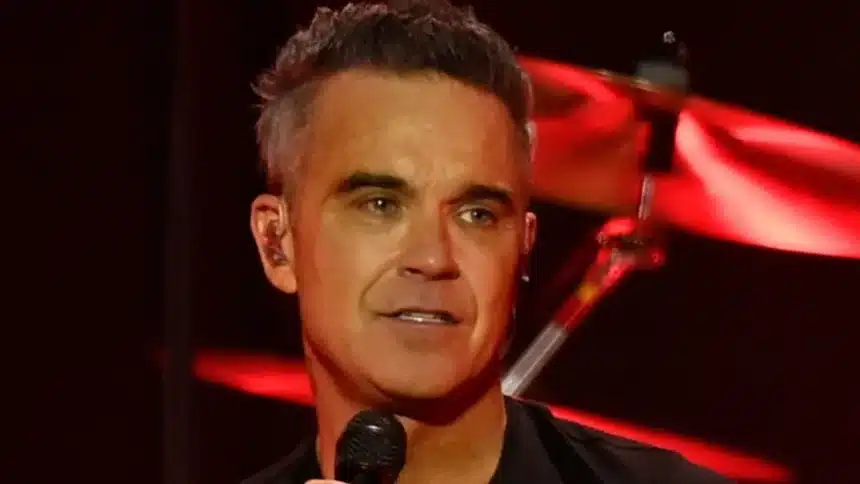
Robbie Williams publicly apologizes to former Take That bandmate Gary Barlow during a War Child concert at Manchester’s Aviva Studios, marking the end of their long-standing rivalry.
Reflection During Intimate Gig
At the intimate performance, Williams pauses to address the recent Take That Netflix documentary. He reflects on his departure from the band in 1995 amid frustrations over playing second fiddle to Barlow, the group’s leader. Years of public jabs followed, primarily from Williams, deeply affecting Barlow’s confidence.
Despite a 2010 reunion tour and album that temporarily resolved tensions, uncertainties about their true reconciliation persisted. Williams now seeks to fully mend past wrongs, admitting his behavior toward Barlow, Howard Donald, and Mark Owen was unacceptable.
“Did anybody see the Take That documentary?” Williams asks the audience. “I have to say I was a bit of a ‘c***’ in the second episode. I don’t think anybody has seen a man smugger than Robbie Williams in the second episode.”
He expresses genuine remorse: “And you know what, I felt really bad. I felt f***ing horrible about it. I’d been horrible to Gary, horrible to Mark, horrible to Howard and I was genuinely thinking about it for days and days and days and I’d go to bed at night and I was thinking I’ve gotta apologise again.”
Williams clarifies his current feelings: “But just to clarify, I f**king love Gary Barlow now. And he loved me. There’s only so many times I can apologise now.”
Revisiting the 90s Track ‘Ego A Go Go’
Williams transitions into his 1990s song “Ego A Go Go,” originally written about Barlow, describing it as a “horrible song.” The chorus states: “Ego a go go now you’ve gone solo/Living on a memory/Now you’ve gone stately/And yes you do hate me/Could you offer an apology.”
During a rehearsal, Williams has an epiphany: “I was sat there thinking hang on no one has ever left a boyband and gone ‘they’re a c***, they’re a c*** except me’. But I’m a c***.”
Insights from the Netflix Docuseries
The three-part series details Barlow’s battle with bulimia, triggered after Take That’s 1996 breakup and intensified by his rivalry with Williams. Archival footage replays Williams admitting: “My problem always was with Gary, I wanted to crush him. I wanted to crush the memory of the band and I didn’t let go. Even when he was down I didn’t let go.”
At the Battersea Power Station premiere, Barlow shares the emotional toll: “It’s a narrative I haven’t thought about for years and years. When we had our reunion we spent a lot of time talking about it and I remember leaving on one particular day and we’d discussed everything. And I remember leaving and my shoulders were light. And I’d not thought about it since because I’d not needed to. And it brought it all back. Tricky times, they were.”
Healing During 2011 Reunion
The documentary also covers the group’s 2011 comeback with Williams. He explains the reconciliation process: “I needed Gary to listen to my truth.”
Barlow adds: “There were things around people not being supportive of his songwriting and his weight. I’d called him Blobby rather than Robbie one day, which I shouldn’t have done. Then I hit him with things he had done to me that I didn’t like. In about 25 minutes we’d put things to bed that had haunted us for years.”