[ad_1]
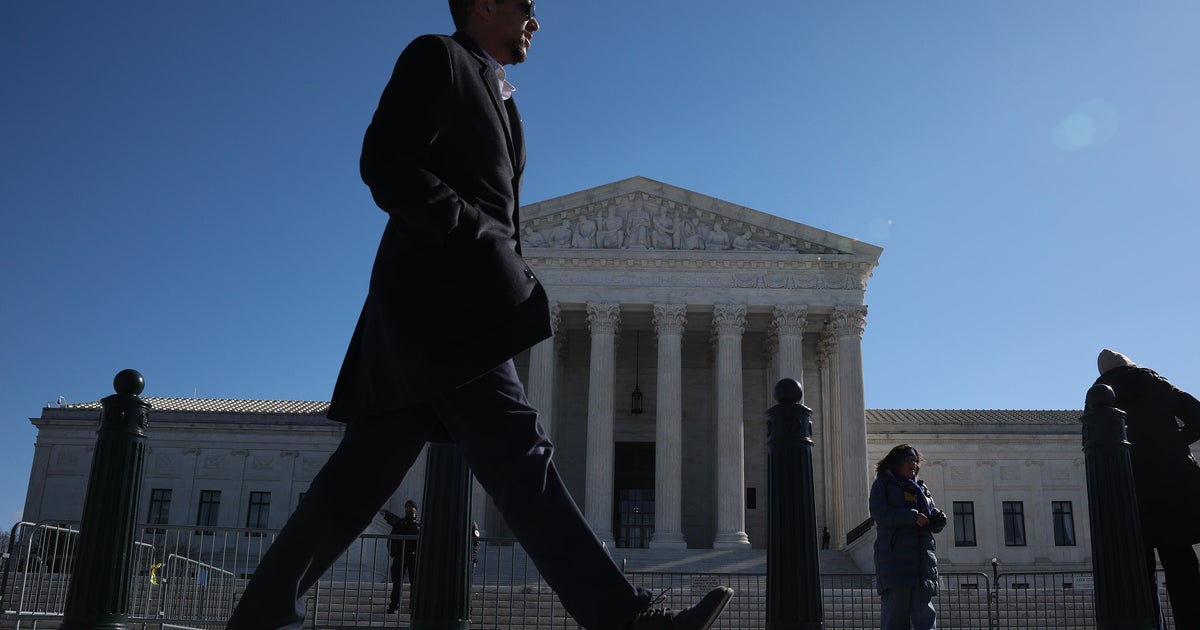
Washington — The Supreme Courtroom is about to listen to arguments Monday in a Second Modification dispute over a federal legislation that bars illegal drug customers from possessing firearms.
The case, United States v. Hemani, is the second involving gun rights that the excessive courtroom is listening to in its present time period, becoming a member of a authorized battle over a Hawaii legislation that restricts the place concealed-carry license holders can deliver their firearms. The Supreme Courtroom heard arguments in that case in January and appeared skeptical concerning the constitutionality of the measure.
However the courtroom struggle can be the newest to land earlier than the Supreme Courtroom within the wake of its landmark 2022 determination that acknowledged the precise to hold weapons in public and laid out a brand new check for figuring out whether or not a firearms restriction violates the Second Modification. Underneath that framework, the federal government should present {that a} gun legislation is in keeping with the nation’s historic custom of firearm regulation.
The gun legislation
The statute at difficulty was enacted by Congress in 1968 as a part of the Gun Management Act and forbids an illegal drug consumer from having a firearm. A violation of the legislation is a felony punishable by as much as 15 years in jail. The Justice Division estimates roughly 300 persons are charged with the offense annually.
Maybe probably the most high-profile offender was Hunter Biden, the son of former President Joe Biden who was discovered responsible in 2024 of possessing a gun whereas he was hooked on crack cocaine. He was pardoned earlier than Biden’s presidency ended final January.
The defendant on this case, Ali Hemani, was charged with illegally possessing a firearm as an illegal drug consumer after the FBI discovered a Glock 9mm pistol, 60 grams of marijuana and a small quantity of cocaine throughout a search of his household’s dwelling in Texas. Hemani knowledgeable brokers of the gun and surrendered it to them, based on courtroom papers. He additionally admitted to utilizing marijuana a couple of instances per week.
The prosecution centered solely on his marijuana use. Hemani moved to dismiss the cost, arguing that the drug-user-in-possession legislation violates the Second Modification. His effort was profitable. The U.S. Courtroom of Appeals for the fifth Circuit dominated in comparable circumstances in 2023 and 2024 that the legislation is unconstitutional when utilized to a drug consumer who was not confirmed to be beneath the affect whereas he had the firearm.
The authorized arguments
President Trump has taken steps to shore up Second Modification rights, however on this case, the Justice Division is urging the Supreme Courtroom to uphold the legislation. In courtroom filings, Solicitor Normal D. John Sauer mentioned that the Second Modification permits Congress to limit gun possession by routine drug customers.
Hemani’s legal professionals, however, argue that the query earlier than the courtroom is a slim one: whether or not the federal government can deprive an occasional marijuana consumer of the precise to maintain a handgun within the dwelling.
“I feel what the courtroom is being requested to determine, and I’d think about the rationale it took the case, is to present some extra steering about what varieties of individuals could be disarmed with out violating the Second Modification,” Joseph Blocher, co-founder of the Duke Middle for Firearms Legislation, instructed CBS Information. “Basically, that is what this case is about.”
In filings, Sauer argued the legislation covers routine customers of managed substances like marijuana, and mentioned the restriction is “non permanent and restricted” since an individual regains the flexibility to have weapons as soon as he stops habitually utilizing unlawful medicine. He argued there may be sturdy proof within the nation’s historic report demonstrating that individuals who pose a transparent risk of violence to others could be disarmed, however solely quickly.
Sauer pointed to founding-era measures that restricted the rights of routine drunkards, which he mentioned are carefully analogous to routine drug customers. He argued that legislatures can prohibit gun possession by “unusually harmful individuals.” These limits, nonetheless, can’t be so broad that they cowl most strange residents, he mentioned.
“For so long as America has had a drug drawback, jurisdictions have restricted drug customers’ entry to firearms,” he wrote, including that Congress was justified in figuring out that armed routine drug customers jeopardize public security.
Sauer famous that 43 states and the District of Columbia all have legal guidelines that prohibit drug customers and addicts from having weapons, and warned that the fifth Circuit’s determination, if upheld, would throw these legal guidelines into query.
Nonetheless, if there are constitutional issues concerning the legislation in marginal circumstances, Sauer famous that the Justice Division beneath Mr. Trump has revived the course of for a disarmed particular person to petition the lawyer basic to have their gun rights restored.
The case is “important as a result of it is the primary actual check on the Supreme Courtroom of the legislature’s prerogative to disarm classes of individuals,” Blocher mentioned.
Historical past and custom
The Supreme Courtroom’s June 2022 determination within the case New York State Rifle and Pistol Affiliation v. Bruen was important in that it marked the primary enlargement of gun rights for the reason that excessive courtroom’s 2008 and 2010 rulings involving the person proper to gun possession. Nevertheless it additionally modified the best way courts consider the constitutionality of gun legal guidelines, putting the burden on the federal government to point out {that a} restriction is rooted within the nation’s historic custom of firearms regulation.
Since then, decrease courts have struggled to use that customary, and in some locations, longstanding federal firearms restrictions have been invalidated for failing the history-and-tradition check. In a 2024 determination within the case United States v. Rahimi, the Supreme Courtroom supplied some readability for the way courts ought to study gun laws beneath its new framework when it upheld a federal legislation that bars individuals topic to home violence restraining orders from having weapons.
However that case concerned a willpower by a courtroom that a person posed a risk to the security of others and subsequently might be disarmed quickly.
Blocher mentioned Hemani’s case is totally different in that it includes a willpower by Congress about which teams of persons are thought-about harmful and topic to disarmament.
“I wish to see an affirmation that legislatures have some energy to declare sure classes of individuals topic to disarmament,” he mentioned. “That does not imply that these determinations are unreviewable. It doesn’t suggest that the legislature simply will get to determine no matter it thinks by way of individuals being disarmed. There nonetheless must be, after Bruen and after Rahimi, a historic precept to underlie that willpower.”
The case has created some odd alliances, with gun violence prevention teams becoming a member of the Trump administration in urging the Supreme Courtroom to uphold the legislation. On the opposite aspect, the American Civil Liberties Union has signed on as co-counsel to characterize Hemani. The ACLU and gun rights teams just like the Nationwide Rifle Affiliation argue the restriction must be invalidated.
In a Supreme Courtroom transient, Hemani’s legal professionals argue that there isn’t any historic custom of stripping anybody who consumes an “intoxicant” a couple of instances per week of their gun rights. They argue the legislation is unconstitutional on two totally different grounds. First, they are saying it’s too obscure, since Congress did not outline “illegal consumer” or specify how frequent, current or substantial the drug use should be to ensure that somebody to be stripped of their gun rights. Second, they are saying the legislation violates the Second Modification.
“We see this as a important civil rights query,” Brandon Buskey, director of the ACLU’s Legal Legislation Reform Mission, instructed CBS Information. “As an preliminary matter, the center of the federal government’s case in opposition to our consumer, Mr. Hemani, is that he could be prosecuted and topic to a jail time period of as much as 15 years just by advantage of admitting to common marijuana use and having a gun that was safely secured in his dwelling. For us, that in and of itself constitutes a significant query of constitutional and in addition civil rights for all People.”
Buskey argued that as to the Second Modification query, historical past and custom don’t help treating leisure marijuana customers as categorically harmful.
Hemani’s legal professionals additionally reject the federal government’s try and liken legal guidelines disarming routine drunkards to the legislation disarming drug customers, arguing that these early restrictions lined solely individuals who usually abused alcohol, not all those that drink. They warned that if the Supreme Courtroom accepts the federal government’s place, tens of millions of People who use an “intoxicating substance” with some frequency might be disadvantaged of a constitutional proper.
Additionally they famous that 40 states have legalized marijuana use to some extent in recent times, so the federal ban poses a “fixed risk” to a portion of the inhabitants who lives in these states and owns weapons.
“It is not our place that marijuana is a very innocuous and innocent substance. We additionally wish to clarify that we predict there are real issues on this nation with gun violence,” Buskey mentioned. “Our place is merely that this legislation doesn’t serve public security and that there are lots of different and narrower methods for the federal government to deal with the very actual drawback of gun violence, past merely assuming that each particular person who makes use of marijuana on some foundation is a public-safety danger.”
The Supreme Courtroom has additionally been requested to weigh in on a unique provision of the Gun Management Act that prohibits individuals convicted of felonies from having firearms. Dozens of petitions have been filed with the courtroom asking it to determine whether or not the legislation violates the Second Modification as utilized to individuals convicted of nonviolent felonies.
Whereas the Supreme Courtroom turned away many of those appeals, it has not but acted on a petition filed by a Utah girl convicted of felony financial institution fraud for passing a fraudulent verify at a grocery retailer greater than 15 years in the past.
[ad_2]