[ad_1]
The assassination of Iran’s Supreme Chief Ayatollah Ali Khamenei within the early hours of the U.S. and Israel’s conflict on Iran has raised a easy however enormously consequential query: Who will change him?
For practically 4 a long time, Khamenei sat atop Iran’s advanced energy construction, serving not simply because the nation’s highest spiritual authority but additionally as its final political decision-maker. His killing on the sprawling advanced that housed his workplaces and residence in Tehran has created a vacuum in a system designed above all to stop precisely that form of instability.
Formally, the choice now rests with Iran’s Meeting of Specialists, the highly effective clerical physique tasked with choosing the nation’s supreme chief. In follow, nevertheless, the result will nearly actually emerge from a a lot smaller circle: senior clerics, the Islamic Revolutionary Guard Corps and the safety institution that has lengthy underpinned the Islamic Republic’s energy construction.
A number of names have already surfaced. However one stands out.
Mojtaba Khamenei
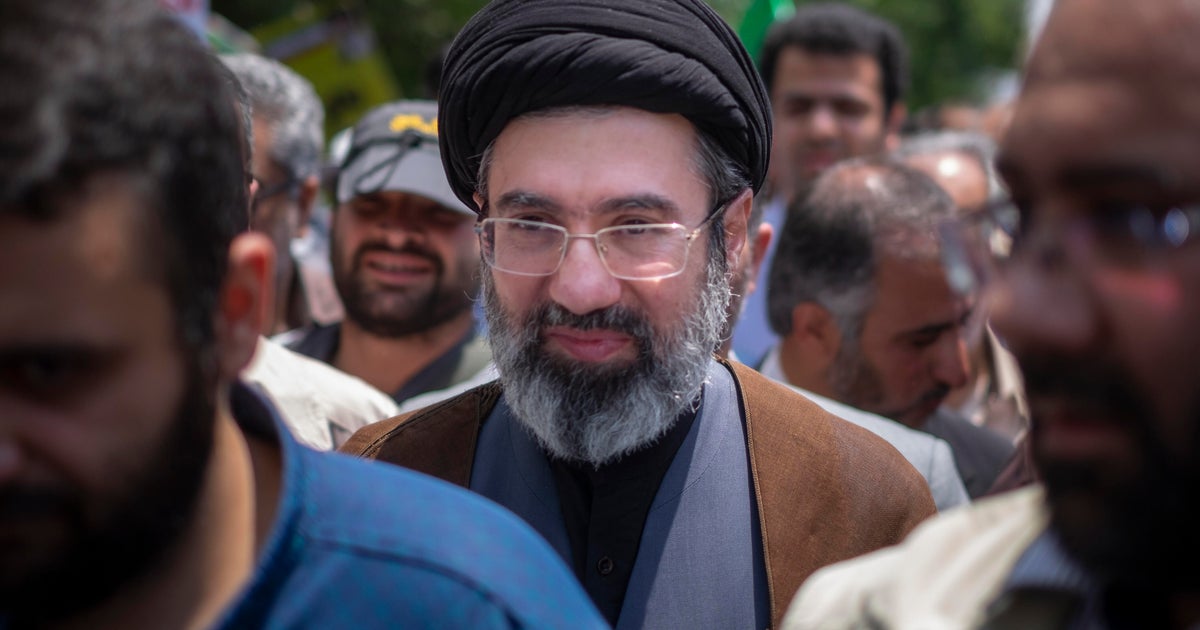
The main contender is Mojtaba Khamenei, the late chief’s second son.
In contrast to many figures in Iran’s hierarchy, Mojtaba has by no means held elected workplace. However for years he has operated quietly behind the scenes from inside his father’s workplace, cultivating affect throughout the safety institution, notably throughout the Islamic Revolutionary Guard Corps.
Morteza Nikoubazl/NurPhoto through Getty Pictures 
He studied theology in Qom and fought as a younger volunteer throughout the Iran-Iraq conflict within the Eighties, credentials that also carry weight throughout the revolutionary elite. But his authority has largely come from proximity to energy reasonably than his spiritual stature.
He’s believed to have deep relationships with senior figures within the Revolutionary Guard. That issues enormously in Iran’s political system, the place the Guards wield huge navy, financial and political energy.
Georgetown College professor and Iran skilled Mehran Kamrava, in Doha, stated a Mojtaba succession would doubtless mirror the system’s intuition for survival.
“The deep state within the Islamic Republic desires continuity,” Kamrava stated in an interview. “If Mojtaba certainly is chosen as his father’s successor, it will point out greater than anything that the Islamic Republic is attempting to make sure continuity.”
Throughout Ali Khamenei’s tenure, the supreme chief managed to keep up authority over the Revolutionary Guard regardless of the group’s huge energy contained in the state.
Kamrava believes Mojtaba is seen inside Iran’s energy construction as somebody able to preserving that steadiness.
“The idea inside Iran is that Mojtaba has a equally superior place in relation to the commanders of the Revolutionary Guards,” Kamrava stated.
If he’s in the end chosen, it will sign that Iran’s ruling elite has chosen stability over experimentation at a second of maximum stress.
It could additionally mark one thing unprecedented within the Islamic Republic: a management transition that successfully retains energy throughout the identical household.
And whereas Mojtaba will be the frontrunner, he’s not the one determine below dialogue.
Ali Reza Arafi
One other distinguished title is Ayatollah Alireza Arafi, a senior cleric deeply embedded inside Iran’s spiritual establishments. Arafi serves on each the Guardian Council and the Meeting of Specialists and has spent years overseeing Iran’s influential community of seminaries in Qom.
Following Khamenei’s assassination, Arafi was reportedly elevated to a brief management council tasked with guiding the nation throughout wartime and thru the succession course of.
Sadeq Larijani
Anther potential candidate is Ayatollah Sadeq Larijani, a former judiciary chief and member of certainly one of Iran’s strongest political households. Larijani has lengthy been seen as a believable successor due to his clerical credentials and deep ties to the nation’s political institution.
Hasan Khomeini
Some analysts have additionally pointed to Hassan Khomeini, the grandson of Islamic Republic founder Ayatollah Ruhollah Khomeini. Amongst clerics and reformist circles he instructions respect, although his comparatively reasonable repute may make him a troublesome alternative for Iran’s hardline institution.
Mohammad Mehdi Mirbagheri
Hardline cleric Mohammad Mehdi Mirbagheri has additionally been floated as a attainable contender attributable to his ideological alignment with essentially the most conservative factions inside Iran’s political system.
Unprecedented challenges forward
Whoever emerges as the following supreme chief, the circumstances surrounding this management transition are unprecedented.
Khamenei was killed throughout the opening part of a conflict that has already expanded past Iran’s borders, with missile and drone assaults rippling throughout the Gulf and the broader Center East.
A number of senior Iranian officers had been additionally reportedly killed within the early strikes, eliminating potential successors and additional narrowing the sector of candidates.
Management transitions contained in the Islamic Republic are usually rigorously choreographed affairs. The final one occurred in 1989 after the loss of life of Ayatollah Ruhollah Khomeini and concerned intense negotiations amongst clerical and political elites earlier than Khamenei in the end emerged because the compromise alternative.
This time the method is unfolding in the midst of an energetic conflict.
Kamrava believes one other issue shaping Iran’s future management is generational change contained in the Revolutionary Guard.
Most of the commanders who outlined Iran’s navy posture for many years had been veterans of the Iran-Iraq conflict. That have, he stated, usually made them extra pragmatic.
“The commanders of the Revolutionary Guards who had been killed had been those that had reduce their enamel within the Iran-Iraq conflict,” Kamrava stated. “That they had seen battle shut up and so they had moderated.”
Their replacements, nevertheless, symbolize a unique era.
“The youthful era… are much more radical, far much less pragmatic,” Kamrava added.
That shift might in the end form Iran’s route greater than the identification of the following supreme chief.
Regardless of the shock of Khamenei’s assassination, few analysts anticipate Iran’s political system to remodel in a single day. Kamrava was direct when requested whether or not a management transition may deliver vital change.
“I do not assume we’ll see radical shifts in the way in which the Islamic Republic conducts itself,” he stated.
The system might regulate tactically. Previously, Iranian leaders have loosened sure social restrictions after main crises to ease home stress.
However strategically, the construction of energy inside Iran stays intact. Clerics, Revolutionary Guard commanders and safety establishments nonetheless dominate the state. And their precedence, particularly in wartime, is stability.
Whoever emerges as Iran’s subsequent supreme chief will inherit a rustic below immense pressure: a widening regional conflict, a battered financial system and a inhabitants that has repeatedly taken to the streets in protest over the previous decade.
The Islamic Republic has survived crises earlier than. However this second is completely different. For the primary time because the 1979 revolution, Iran’s supreme chief has been killed throughout a conflict — and the system he helped form is now being examined in actual time.
[ad_2]