[ad_1]
by TeachThought Workers
In a single sentence, Bloom’s Taxonomy is a hierarchical ordering of cognitive abilities that may, amongst numerous different makes use of, assist academics educate, and college students study.
For instance, Bloom’s Taxonomy can be utilized to:
–create assessments
–body discussions
–plan classes (see 249 Bloom’s Taxonomy Verbs For Vital Pondering)
–consider the complexity of assignments
–design curriculum maps
–develop on-line programs project-based studying (typically via project-based studying concepts)
–self-assessment
See How To Educate With Bloom’s Taxonomy for extra studying.
How Bloom’s Taxonomy Is Helpful For Academics
We’ve checked out methods to make use of Bloom’s Taxonomy–and there are lots of causes for the recognition of Bloom’s Taxonomy (that probably deserve an article of their very own to discover). For now, it’s clear that many educators love Bloom’s as a result of, amongst different virtues, it provides them a manner to consider their educating—and the next studying of their college students.
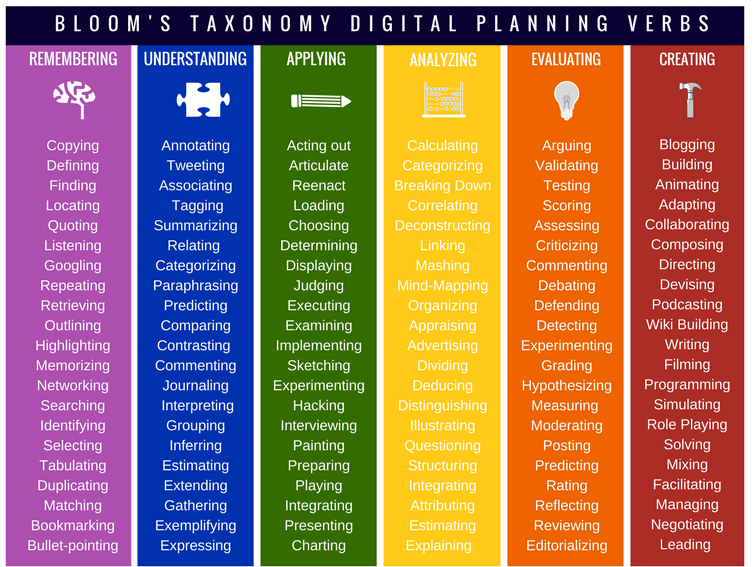
As talked about above, the framework can be utilized to create assessments, consider the complexity of assignments, improve the rigor of a lesson, simplify an exercise to assist personalize studying, design a summative evaluation, plan project-based studying, body a gaggle dialogue, and extra. As a result of it merely offers an order for cognitive behaviors, it may be utilized to nearly something. (You possibly can see one instance right here–Bloom’s Taxonomy digital verbs.)
The picture above visually demonstrates the degrees of Bloom’s Taxonomy as a spectrum quite than a hierarchy, permitting room for the ‘energy verbs’ that may act as synonyms (and thus exercise concepts) for academics planning classes and models.
There are six ranges in Bloom’s Taxonomy.
See additionally How To Write Lesson Aims Utilizing Bloom’s Taxonomy
The 6 Ranges of Bloom’s Taxonomy
1. The primary stage is to Bear in mind.
Instance actions on the Remembering stage: memorize a poem, recall state capitals, bear in mind math formulation
2. The second stage is to Perceive.
Instance actions on the Understanding stage: manage the animal kingdom based mostly on a given framework, illustrate the distinction between a rectangle and a sq., summarize the plot of a easy story
3. The third stage is to Apply.
Instance actions on the Utility stage: use a method to unravel an issue, choose a design to satisfy a function, reconstruct the passage of a brand new legislation via a given authorities/system
See additionally Examples Of Analogies For Vital Pondering
4. The fourth stage is to Analyze.
Instance actions on the Evaluation stage: determine the ‘elements of’ democracy, clarify how the steps of the scientific course of work collectively, determine why a machine isn’t working
5. The fifth stage is to Consider.
Instance actions on the Analysis stage: make a judgment relating to an moral dilemma, interpret the importance of a given legislation of physics, illustrate the relative worth of technological innovation in a selected setting—a instrument that helps recuperate topsoil farming, for instance.
6. The sixth and highest stage is to Create.
Instance actions on the Creation stage: design a brand new resolution to an ‘outdated’ downside that honors/acknowledges the earlier failures, delete the least helpful arguments in a persuasive essay, write a poem based mostly on a given theme and tone
A Transient Historical past Of Bloom’s Taxonomy Revisions
Bloom’s Taxonomy was created by Benjamin Bloom in 1956, printed as a type of classification of studying outcomes and targets which have, within the greater than half-century since, been used for the whole lot from framing digital duties and evaluating apps to writing questions and assessments.
The unique sequence of cognitive abilities was Data, Comprehension, Utility, Evaluation, Synthesis, and Analysis. The framework was revised in 2001 by Lorin Anderson and David Krathwohl, yielding the revised Bloom’s Taxonomy.
Probably the most important change to the Cognitive Area was the elimination of ‘Synthesis’ and the addition of ‘Creation’ as the very best stage of Bloom’s Taxonomy. And being on the highest stage, the implication is that it’s probably the most advanced or demanding cognitive talent–or no less than represents a type of pinnacle for cognitive duties.
[ad_2]