[ad_1]

For years, folks might largely belief, not less than instinctively, that seeing was believing. Now, what’s faux usually seems to be actual and what’s actual usually seems to be faux.
Throughout the first week of 2026, that has already develop into a conundrum many media consultants say might be arduous to maneuver previous, due to advances in synthetic intelligence.
President Donald Trump’s Venezuela operation virtually instantly spurred the unfold of AI-generated pictures, outdated movies and altered photographs throughout social media. On Wednesday, after an Immigration and Customs Enforcement officer fatally shot a girl in her automotive, many on-line circulated a faux, most probably AI-edited picture of the scene that seems to be based mostly on actual video. Others used AI in makes an attempt to digitally take away the masks of the ICE officer who shot her.
The confusion round AI content material comes as many social media platforms, which pay creators for engagement, have given customers incentives to recycle outdated photographs and movies to ramp up emotion round viral information moments. The amalgam of misinformation, consultants say, is making a heightened erosion of belief on-line — particularly when it mixes with genuine proof.
“As we begin to fear about AI, it’s going to seemingly, not less than within the quick time period, undermine our belief default — that’s, that we imagine communication till we’ve some motive to disbelieve,” stated Jeff Hancock, founding director of the Stanford Social Media Lab. “That’s going to be the massive problem, is that for some time individuals are actually going to not belief issues they see in digital areas.”
Although AI is the newest know-how to spark concern about surging misinformation, related belief breakdowns have cycled by means of historical past, from election misinformation in 2016 to the mass manufacturing of propaganda after the printing press was invented within the 1400s. Earlier than AI, there was Photoshop, and earlier than Photoshop, there have been analog picture manipulation strategies.
Quick-moving information occasions are the place manipulated media have the largest impact, as a result of they fill in for the broad lack of know-how, Hancock stated.
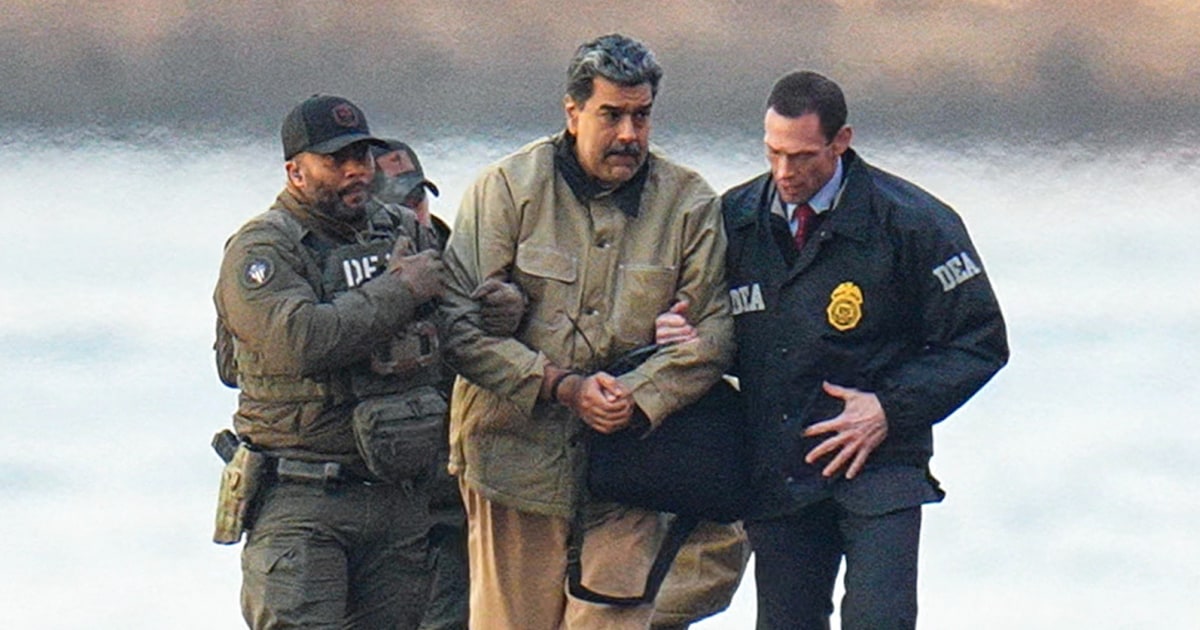
On Saturday, Trump shared a photograph on his verified Reality Social account of the deposed Venezuelan chief Nicolás Maduro blindfolded and handcuffed aboard a Navy assault ship. Shortly afterward, unverified pictures surrounding the seize — a few of which had been then become AI-generated movies — started to flood different social media platforms.
As actual celebrations unfolded, X proprietor Elon Musk was amongst these sharing what gave the impression to be an AI-generated video of Venezuelans thanking the U.S. for capturing Maduro.
AI-generated proof has already made its means into courtrooms. AI deepfakes have additionally fooled officers — late final yr, a flood of AI-generated movies on-line portrayed Ukrainian troopers apologizing to the Russian folks and surrendering to Russian forces en masse.
Hancock stated that whilst a lot of the misinformation on-line nonetheless comes by means of extra conventional avenues, resembling folks misappropriating actual media to color false narratives, AI is quickly dumping extra gasoline on the hearth.
“By way of simply a picture or a video, it’s going to primarily develop into inconceivable to detect if it’s faux. I believe that we’re getting near that time, if we’re not already there,” he stated. “The outdated kind of AI literacy concepts of ‘let’s simply have a look at the variety of fingers’ and issues like which are prone to go away.”
Renee Hobbs, a professor of communication research on the College of Rhode Island, stated the principle battle for researchers who examine AI is that individuals face cognitive exhaustion as they attempt to navigate the sheer quantity of actual and artificial content material on-line. That makes it more durable for them to sift by means of what’s actual and what’s not.
The outdated kind of AI literacy concepts of ‘let’s simply have a look at the variety of fingers’ and issues like which are prone to go away
Jeff Hancock, founding director of the Stanford Social Media Lab
“If fixed doubt and anxiousness about what to belief is the norm, then truly, disengagement is a logical response. It’s a coping mechanism,” Hobbs stated. “After which when folks cease caring about whether or not one thing’s true or not, then the hazard isn’t just deception, however truly it’s worse than that. It’s the entire collapse of even being motivated to hunt reality.”
She and different consultants are working to determine the right way to incorporate generative AI into media literacy training. The Group for Financial Co-operation and Improvement, an intergovernmental physique of democratic nations that collaborate to develop coverage requirements, is scheduled to launch a world Media & Synthetic Intelligence Literacy evaluation for 15-year-olds in 2029, for instance.
Even some social media giants which have embraced generative AI seem cautious of its infiltration into folks’s algorithms.
In a current publish on Threads, the top of Instagram, Adam Mosseri, touched on his considerations surrounding AI misinformation’s changing into extra frequent throughout platforms.
“For many of my life I might safely assume that the overwhelming majority of pictures or movies that I see are largely correct captures of moments that occurred in actual life,” he wrote. “That is clearly now not the case and it’s going to take us, as folks, years to adapt.”
Mosseri predicted that web customers will “transfer from assuming what we see is actual by default, to beginning with skepticism once we see media, and paying far more consideration to who’s sharing one thing and why they is likely to be sharing it. That is going to be extremely uncomfortable for all of us as a result of we’re genetically predisposed to believing our eyes.”
Hany Farid, a professor of laptop science on the UC Berkeley College of Info, stated his current analysis on deepfake detection has discovered that individuals are simply as prone to say one thing actual is faux as they’re to say one thing faux is actual. The accuracy charge worsens considerably when individuals are proven content material with political undertones — as a result of then affirmation bias kicks in.
“Once I ship you one thing that conforms to your worldview, you need to imagine it. You’re incentivized to imagine it,” Farid stated. “And if it’s one thing that contradicts your worldview, you’re extremely incentivized to say, ‘Oh, that’s faux.’ And so whenever you add that partisanship onto it, it blows the whole lot out of the water.”
Individuals are additionally likelier to right away belief these they’re acquainted with — resembling celebrities, politicians, members of the family and mates — so AI likenesses of such figures might be even likelier to dupe folks as they get extra lifelike, stated Siwei Lyu, a professor of laptop science on the College at Buffalo.
Lyu, who helps preserve an open-source AI detection platform known as DeepFake-o-meter, stated on a regular basis web customers can enhance their AI detection expertise just by paying consideration. Even when they don’t have the flexibility to research each little bit of media they arrive throughout, he stated, folks ought to not less than ask themselves why they belief or mistrust what they see.
“In lots of instances, it might not be the media itself that has something improper, nevertheless it’s put up within the improper context or by someone we can’t completely belief,” Lyu stated. “So I believe, all in all, frequent consciousness and customary sense are crucial safety measures we’ve, and they don’t want particular coaching.”
[ad_2]