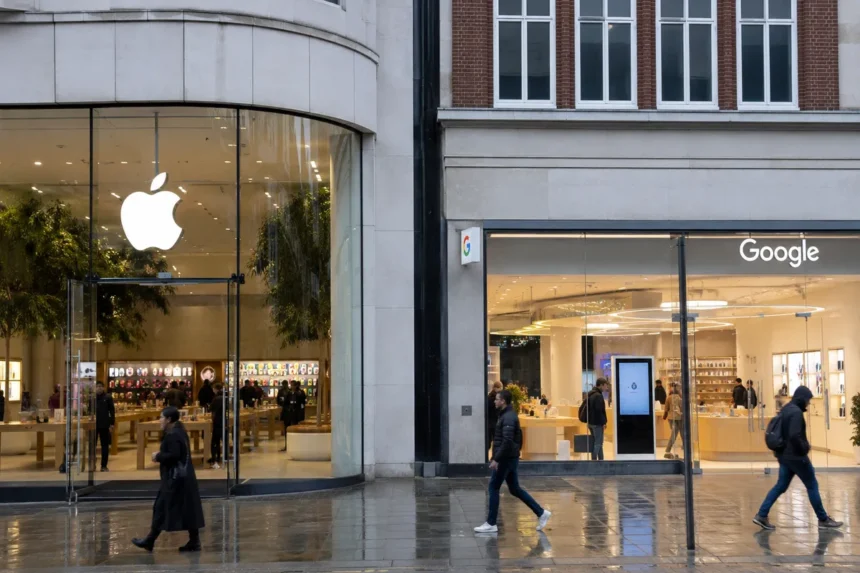
Apple stock (NASDAQ:AAPL) could be poised for a significant upward movement, potentially reaching around $400 per share, representing an approximate 30% increase from its current valuation. This optimistic outlook is largely driven by a new thesis from Rothschild & Co Redburn, which suggests Apple can reclaim its leadership in artificial intelligence not by developing cutting-edge models itself, but by strategically integrating third-party, potentially Nvidia-powered, open-source AI solutions. This approach could reframe Apple’s AI strategy from a perceived weakness to a strength in smart integration, with the anticipated launch of a foldable iPhone serving as a key catalyst.
Redburn’s AI Strategy for Apple: Leveraging Open Models
Analysts at Rothschild & Co Redburn, led by Timm Schulze-Melander, have upgraded Apple shares to a ‘Buy’ rating and set a price target of $400, a substantial increase from their previous $260 target. Their core argument posits that Apple’s current AI efforts, including its partnership with Google’s Gemini models for Apple Intelligence, have not yet matched the performance of frontier models. Instead of engaging in a costly race to build the most advanced proprietary AI, Redburn proposes a “Fast Follower 2.0” strategy.
This strategy involves Apple leveraging robust, open-source AI models developed by external entities. This is where Nvidia comes into play. While no formal partnership has been announced, Redburn highlights Nvidia’s technology, such as its Nemotron models, as an example of the kind of high-performing, adaptable AI that Apple could integrate. Such a move would allow Apple to enhance its AI capabilities more rapidly than through internal development alone and reduce its reliance on competitors like Google.
The Power of Distribution and Integration
The central tenet of Redburn’s thesis is that Apple’s immense distribution network—its base of billions of active devices—is its ultimate competitive advantage. By integrating leading third-party AI models, Apple could become the primary gateway for consumers to access advanced AI functionalities, even if the underlying models are developed elsewhere. This shifts the focus from owning the AI model to mastering its integration and user experience across Apple’s ecosystem.
This perspective aligns with observations from other financial institutions. HSBC analyst Nicolas Cote-Colisson, who also holds a ‘Buy’ rating on Apple with a $366 target, has previously suggested that Apple’s comparatively modest AI spending could be an advantage. He argues that focusing on AI integration into devices, software, and services, rather than on expensive model development, could prove more effective as AI capabilities mature and become commoditized. In such a scenario, controlling the consumer relationship becomes paramount.
Nvidia’s Potential Role and Market Implications
Should Apple indeed lean towards integrating open-source AI models, Nvidia stands to benefit indirectly. As a provider of powerful AI hardware and increasingly sophisticated model technologies, Nvidia could supply the foundational components that enable these third-party models. The trend toward more device manufacturers utilizing Nvidia’s ecosystem for on-device or near-device AI experiences suggests a broader market shift that Apple could tap into.
However, this strategic direction is not without its risks. A key concern is that Apple might opt to deepen its reliance on closed AI ecosystems, such as continuing its strong partnership with Google, or forge a different strategic alliance. Such decisions could limit the incremental demand for Nvidia’s technologies within Apple’s product lines.
Foldable iPhone: A Secondary Catalyst
Beyond the AI strategy, Redburn’s $400 price target also factors in the potential success of Apple’s anticipated foldable iPhone. The firm forecasts significant sales for a premium foldable model, potentially named iPhone Ultra, projecting 14 million units by fiscal year 2027 with an estimated average selling price of $2,199. This device, if successful, could substantially increase Apple’s overall iPhone average selling prices and revenue.
Risks and Skepticism in the Market
Despite the optimistic outlook from Redburn, significant risks and skepticism remain. Jefferies analyst Edison Lee, for instance, has expressed concerns, downgrading Apple to ‘Underperform’ with a price target of $263.66. Lee’s assessment highlights potential execution risks in both Apple’s AI development and its premium hardware strategy. He views the high cost of a foldable iPhone as a potential barrier, suggesting it might remain a niche product rather than a mainstream driver of sales.
The debate surrounding Apple’s future hinges on these contrasting views: Redburn sees an opportunity for Apple to innovate through strategic integration and leverage its existing user base, while Jefferies points to potential pitfalls in executing ambitious AI and hardware plans. The market’s ultimate decision will depend on Apple’s ability to effectively navigate the complexities of AI development, strategic partnerships, and the introduction of innovative, high-priced hardware.
Conclusion: A Strategic Pivot or Continued Challenges?
The possibility of Apple stock reaching $400 hinges on a strategic pivot towards leveraging external AI advancements, particularly through open-source models potentially supplied or enabled by Nvidia, combined with the successful launch of premium hardware like a foldable iPhone. This approach could transform perceived AI limitations into distribution strengths. However, the path forward is fraught with challenges, including competitive pressures, execution risks, and market acceptance of new product categories. Investors will be closely watching Apple’s next moves to see if this bold vision can materialize into significant shareholder value.