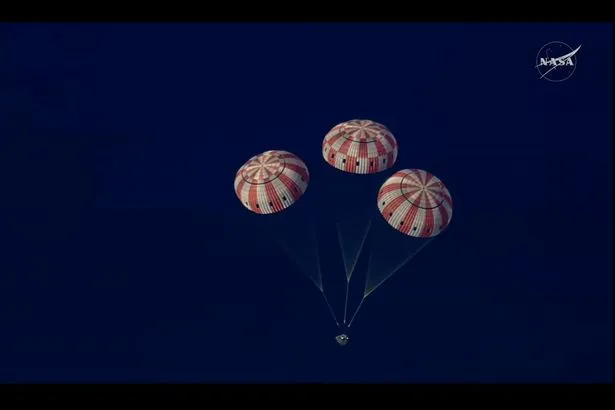
NASA’s Artemis II crew safely splashed down in the Pacific Ocean early Saturday, April 11, concluding their groundbreaking nearly 10-day mission.
Flawless Re-Entry Triumph
Mission control steered the Orion capsule through intense re-entry, where the heat shield endured thousands of degrees to shield astronauts Christina Koch, Reid Wiseman, Victor Glover, and Canadian Space Agency astronaut Jeremy Hansen.
Officials described the landing as a ‘perfect bullseye splashdown,’ executed without complications. The heat shield had raised concerns after charring during the 2022 uncrewed test flight.
This event represents the first crewed lunar re-entry for NASA since Apollo 17 in 1972, in collaboration with the Defense Department.
The capsule hurtled back at 34,965 feet per second—or 23,840 mph—before decelerating to roughly 19 mph on impact.
Key Mission Milestones
The crew launched from Florida on April 1, achieving vital successes in NASA’s Artemis initiative to build a lasting Moon presence.
Without landing or orbiting the Moon, they shattered Apollo 13’s distance record by traveling 252,756 miles from Earth.
In a moving highlight, the emotional astronauts secured approval to name two craters after their Orion spacecraft and Commander Wiseman’s late wife, Carroll.
They captured fresh naked-eye views of the lunar far side, enjoyed a total solar eclipse aligned with their launch timing, and recorded an ‘Earthset’ echoing Apollo 8’s famed 1968 Earthrise photo.
Insights Amid Technical Hurdles
A NASA official remarked on the eve of splashdown: “It just makes you want to continue to go back. It’s the first of many trips and we just need to continue on because there’s so much more to learn about the Moon.”
The flight delivered substantial scientific gains despite valve malfunctions in the drinking water and propellant systems.
Upcoming Artemis Steps
Artemis III next year will test capsule docking with lunar landers in Earth orbit.
Artemis IV targets a crewed landing near the Moon’s south pole in 2028.