[ad_1]

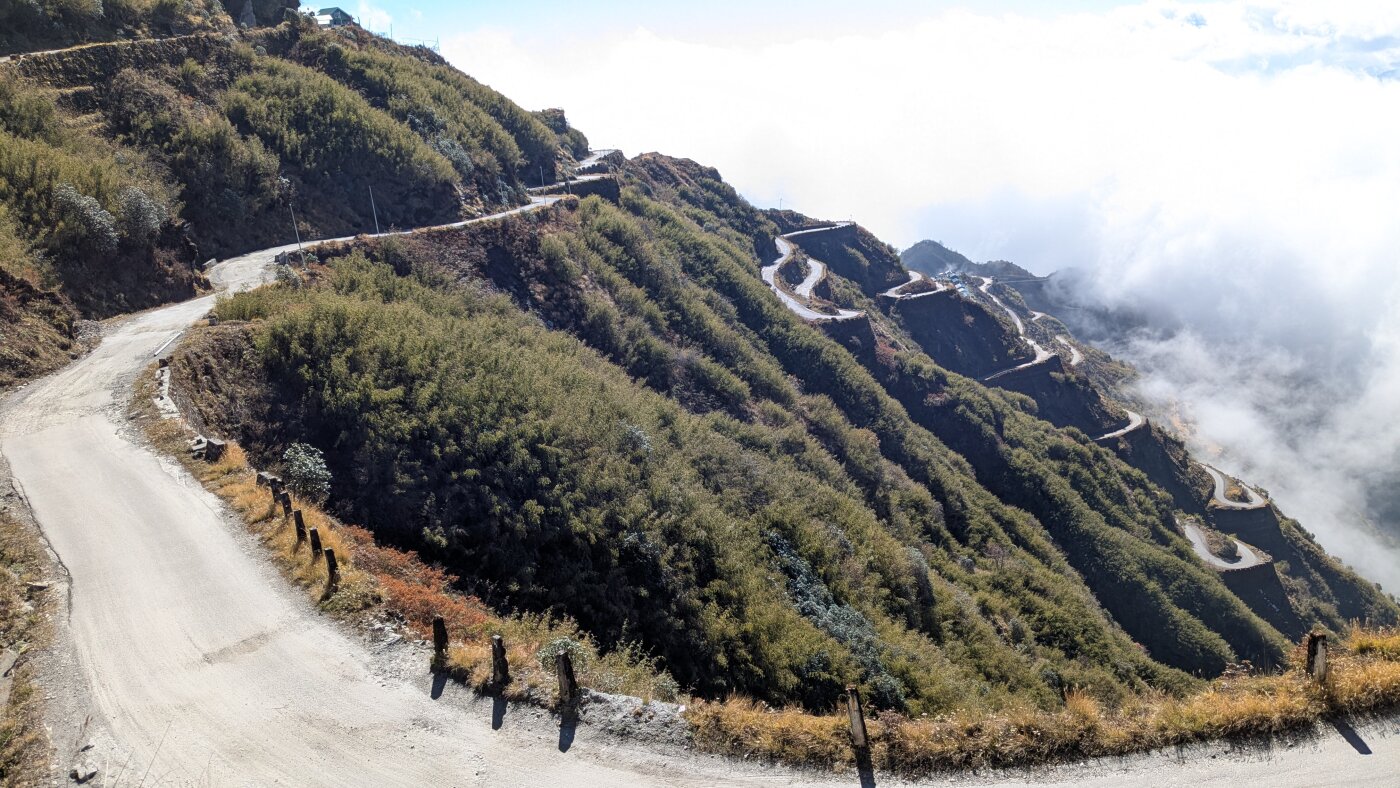
A street curves across the mountains close to Zuluk village within the Indian state of Sikkim. Lately, the Indian authorities has labored to spice up street connectivity in such villages close to its border with China.
Omkar Khandekar/NPR
disguise caption
toggle caption
Omkar Khandekar/NPR
GANGTOK, India — Practically 4 years in the past, Indian Finance Minister Nirmala Sitharaman informed the Parliament she had large plans for India’s border villages.
“Border villages with sparse inhabitants, restricted connectivity and infrastructure typically get ignored from developmental beneficial properties,” she mentioned, whereas saying the federal government’s spending finances for 2022-2023.
She unveiled the Vibrant Villages Programme, aiming to undo the neglect of hundreds of communities on the border. Its first part began with greater than 600 villages alongside India’s 2,100-mile-long border with China, many excessive up within the forbidding Himalayan plateau.
The finance minister did not say it, however India’s initiative seemed to be a response to China’s decade-long buildup of troops and army and civilian infrastructure alongside their shared border.
Immediately, there is a story of two borderlands within the Himalayas. China has systematically fortified its borders with India, in addition to neighboring Nepal and Bhutan, creating lots of of villages subsequent to those South Asian nations alongside Chinese language-controlled Tibet, and transferring tens of hundreds of civilians there. Analysts say the authorities in Beijing hope they may act because the state’s “eyes and ears” alongside the disputed border, and that lots of the villages double as army bases.
In the meantime, lots of India’s improvement tasks on the border sputter alongside with out a deadline, typically stymied by its slow-moving forms. In consequence, youth are transferring away from the villages to cities and cities downhill for jobs and training.

An indication in India’s Sikkim state bordering China reads “Warning: You might be beneath Chinese language remark.” In jap components of the state, Indian safety forces have put up such indicators to warn folks of surveillance.
Omkar Khandekar/NPR
disguise caption
toggle caption
Omkar Khandekar/NPR
For years, analysts have accused the Chinese language military of “salami slicing.” It is a tactic by which one nation occupies its rival’s areas by chipping away at its borders. The emptying out of India’s border villages, they are saying, might additional embolden China to enter areas that India calls its personal.
That is already began occurring, says researcher Vinayak Bhat, who labored as a satellite tv for pc analyst with the Indian military till 2015. Of greater than 600 Chinese language villages constructed close to its border with India to date, he says at the least 10 are situated in disputed areas.
In 2021, India’s International Ministry accused China of “enterprise development actions” alongside the border and “in areas it has illegally occupied” in Arunachal Pradesh state. China denied this, saying the development was “by itself territory.”
India’s Vibrant Villages initiative was meant to bolster civilian presence alongside the disputed border. However NPR’s current go to to 1 such area and interviews with residents in different areas reveal a large hole between the federal government’s plans and their execution.
Unkept guarantees, bureaucratic bottleneck

A string of flags welcomes guests to the village of Zuluk within the Indian state of Sikkim. India goals to spice up tourism to those border villages, hoping to create jobs for locals and stop younger folks from migrating to faraway cities for work.
Omkar Khandekar/NPR
disguise caption
toggle caption
Omkar Khandekar/NPR
The border village of Gnathang, in India’s far-flung state of Sikkim, sits in a scenic valley of glacial lakes and grazing yaks, surrounded by the snow-capped Himalayas. A few of its roads run so near China and Bhutan that mobile networks throughout the mountain ridges ship texts to “welcome” customers to their nations.
It is also a spot the place Indian and Chinese language troopers have locked horns prior to now, most lately in 2017. Quite a few Indian military camps thus dot these mountains, the place slogans of weapons and glory are scrawled on their partitions. The ghost of Baba Harbhajan Singh, an Indian soldier who died in 1968, is believed to regulate the patrolmen. Legend has it, in the event that they get drowsy on the job, Baba smacks them awake.
However for a lot of residents, the larger battle is usually with nature. In winter, eggs and onions flip rock-solid. There isn’t any operating water. The ability and web go off for days. Folks largely hibernate of their wood-and-tin homes, burning firewood to courageous the freezing chilly.

Indian Union Railways Minister Ashwini Vaishnaw briefs the media on Union Cupboard choices on the Nationwide Media Centre on April 4, 2025, in New Delhi. Chaired by Prime Minister Narendra Modi, the Cupboard authorized the Vibrant Villages Programme II to develop villages situated alongside the nation’s worldwide borders to reinforce nationwide safety.
Sanjeev Verma/Hindustan Instances by way of Getty Photos
disguise caption
toggle caption
Sanjeev Verma/Hindustan Instances by way of Getty Photos
Below the Vibrant Villages Programme, the finance minister mentioned, the federal government would remodel such locations. She promised to construct roads and homes, promote tourism, prolong welfare tasks and create jobs.
That was in 2022.
“Since then, all we have now acquired is one solar-powered lamp in our village,” says Sonam Bhutia, the village chief of Gnathang. The streetlamp broke down in a month — however they’d nobody to show to.
“Our legislators solely go to twice in a five-year time period: whereas campaigning for elections and for a victory lap,” Bhutia says.
He says it is why solely 750 folks reside there now, after greater than 1,500 residents have left through the years. A whole lot of Indian border villages have emptied out as residents transfer to cities and cities in different components of the nation.
Within the week NPR spent in Sikkim, extra residents shared tales of unkept guarantees. Roads and cellphone connectivity did enhance, serving to draw extra vacationers. However energy and web have been erratic, and locals needed to transfer out for faculties and medical therapy, they mentioned.

Sonam Bhutia, chief of Gnathang village within the Indian state of Sikkim, accuses the Indian authorities of neglecting improvement works inside border villages.
Omkar Khandekar/NPR
disguise caption
toggle caption
Omkar Khandekar/NPR
Some blame the forms. Sherpa Sangpo Bhutia, the chief of Zuluk village, says he participated in a number of conferences with state officers over the previous two years. The officers then submitted proposals to construct a sports activities floor and cultural heart within the village that has but to materialize.
“I am positive they’re attempting from their finish,” he says, “nevertheless it have to be getting caught someplace.”
The chasm between the federal government’s guarantees and outcomes worries researchers who examine safety on this space, as a lot of the border between India and China is disputed. And whereas India’s development lags, China has been aggressively constructing villages within the area and subsidizing new residents to maneuver in.
China has steadily constructed up Himalayan villages alongside Tibet’s southern borders with India, Nepal and close by Bhutan since 2016. The distant villages are normally accessible solely from the Chinese language facet, by freshly constructed roads linking them to larger Chinese language cities close by.
China has additionally constructed villages in areas claimed by Bhutan, though China considers them a part of its territory and populated them with Chinese language residents, in accordance with analysis by China scholar Robert Barnett. His report in late 2024 documented 22 such villages.
Want for velocity

An Indian military convoy strikes alongside the Srinagar-Leh Nationwide Freeway towards Ladakh on June 17, 2020. Not less than 20 Indian troopers have been killed in a violent conflict with Chinese language forces in a disputed border space.
Faisal Khan/Anadolu Company by way of Getty Photos
disguise caption
toggle caption
Faisal Khan/Anadolu Company by way of Getty Photos
During the last decade, India and China have had a number of confrontations over the buildup of roads and infrastructure close to the border. Tensions peaked in 2020, as a brawl within the high-altitude area of Ladakh killed at the least 20 Indian troopers, in addition to an unconfirmed variety of Chinese language troops, and led to a two-year army standoff.
Retired Col. Vinayak Bhat labored as a satellite tv for pc analyst with the Indian Military till 2015. He says many new Chinese language villages have the potential to be army launchpads — although the Chinese language authorities painting them primarily as civilian settlements.


“China retains claiming these are civilians who’ve are available in and occupied these areas,” says Bhat. “So what does one do? You possibly can’t kill them. You must have talks. And that they are profiting from.”
Whereas India won’t have the sources to construct new villages to claim its territorial claims, Bhat says, it will possibly management migration out of ones that exist already — by correct implementation of tasks like Vibrant Villages.
For this report, NPR requested the Earth imaging firm Planet Labs to share satellite tv for pc pictures alongside India’s border with China. These included practically a dozen villages from the western area of Ladakh and the northeastern states of Sikkim and Arunachal Pradesh in India. The photographs have been from November 2022 and October-November 2025. NPR requested Bhat and Matthew Akestar, a Tibet scholar and researcher, to research them.
Each Bhat and Akestar say the pictures counsel India is prioritizing the development of roads within the mountains. Additionally they level to the elevated development alongside the roads, however say it is not clear what the character of the buildup is.
The general progress, says Bhat, is “a lot slower. However I am positive there are constraints and the persons are practical in taking choices.”
Konchok Stanzin, a former Indian legislator from the Himalayan territory of Ladakh, concurs that it isn’t simple to construct within the Himalayan highlands. “Given the low temperatures, folks can work solely between April and October,” he says.

Staff with India’s Border Street Organisation assemble a street close to Demchok, in Ladakh, on Could 19, 2024.
Tauseef Mustafa/AFP by way of Getty Photos
disguise caption
toggle caption
Tauseef Mustafa/AFP by way of Getty Photos
However Stanzin observes that the velocity and planning in infrastructure tasks in India are in sharp distinction to these seen in Chinese language villages throughout the border. He noticed it himself just a few years in the past, whereas visiting Demchok village on the frontier.
“Indian officers typically solely approve work in September,” he says, when a biting chilly is nearly to set in. And when work does begin, it drags on indefinitely.
“When Chinese language authorities construct a street, they carry alongside energy strains too,” Stanzin says. “However in India, they construct a street, then dig it up for cables, then dig it up once more for plumbing works. … Within the time it takes India to put the muse for a constructing, China completes the constructing.”
On the different finish of the border, the agricultural works minister of Arunachal Pradesh, Pasang Dorjee Sona, says central authorities officers in New Delhi typically determine what they want with out consulting native leaders. Their “desktop work,” he says, has meant a number of border villages have been ignored of welfare actions.

“A number of villages that are precisely on the border have been missed out” of the primary part of the Vibrant Villages Programme, he says. “And plenty of villages, the place there was no habitation for years, have made it to the record.”
Sona provides that Indian bureaucrats typically deal with constructing infrastructure however not making the amenities useful: Faculties lack academics; hospitals lack well being care staff; mobile towers lack a secure community.

Folks watch and journey India’s new Nationwide Freeway route connecting the border state of Sikkim with West Bengal state and the remainder of the nation, in Bagrakote, West Bengal, India, on Jan. 6, 2025.
Diptendu Dutta/NurPhoto by way of Getty Photos
disguise caption
toggle caption
Diptendu Dutta/NurPhoto by way of Getty Photos
“Roads are developing,” he says, “however different sectors additionally have to be taken up in the identical spirit.”
India’s inside ministry didn’t reply to NPR’s requests for an interview. However Indra Grasp Subba, a parliamentary legislator from Sikkim, says such delays are inherent to India’s democratic system.
“If China needs to do one factor, they may do it,” he says. “However in India, we do issues with the consensus of the folks. The tempo could be a bit of slower, however the improvement can be equitable.”
It is why, he says, it took two years to place collectively an inventory of tasks price $50 million in his Sikkim constituency. For the previous few months, he is been ready for approval from Prime Minister Narendra Modi’s authorities.
Residents who’ve returned to Indian border villages want the officers would hurry up.

Pema Sherpa, who runs a café within the Indian village of Kupup, says unreliable energy, web and cell connectivity in border areas like hers make life troublesome for residents and guests.
Omkar Khandekar/NPR
disguise caption
toggle caption
Omkar Khandekar/NPR
Three years in the past, Pema Sherpa stop her job in Delhi and returned to her hometown Kupup, in Sikkim state. She now takes care of a grocery and snack store alongside together with her mom, serving rice, noodles and meat curries to vacationers.
She says the brand new roads have introduced in additional clients — however the insufficient infrastructure makes on a regular basis life a battle.
“I’ve heard the Vibrant Village marketing campaign is about reversing migration,” she says. “However in order for you folks to return and set up themselves, primary companies are wanted. Even my siblings do not favor staying right here due to points round energy, cell connectivity and web.”
For residents like Sherpa, the principle problem for many residents of India’s border villages is just not China. It is getting their very own authorities to control.
Omkar Khandekar and Pankaj Dhungel reported from Gangtok, India. Emily Feng reported from Washington, D.C. Aowen Cao contributed analysis.
[ad_2]