Stories of finding unexpected treasures in everyday pocket change frequently capture public attention. The latest coin to generate significant online discussion is the 2016 Battle of Hastings 50p piece. An extraordinary eBay listing recently surfaced, asking a staggering £37,358.40 for one of these coins, prompting questions about its true market value. While such figures sound life-changing, understanding the actual worth of a Battle of Hastings 50p coin requires looking beyond inflated online asking prices.
The Real Value of a Battle of Hastings 50p Coin
For a standard Battle of Hastings 50p coin that has been circulated and found in everyday change, its value typically ranges between £1.50 and £3.00. These figures represent a modest but respectable return, often up to six times its face value. For collectors or those seeking coins in superior condition, the value can increase. A coin in “Brilliant Uncirculated” (BU) condition, meaning it shows no signs of wear and tear, or one that remains sealed in its original Royal Mint presentation pack, can command a higher price, generally between £5.00 and £10.00.
While achieving twenty times the face value is a good outcome for a 50p coin, it falls significantly short of the tens of thousands of pounds seen in some online listings. This discrepancy highlights the difference between asking prices and actual market value.
Understanding eBay Listings and Coin Valuation
The wide range of prices for the Battle of Hastings 50p on online marketplaces like eBay, from a few pounds to hundreds of thousands, stems from the platform’s open listing system. Anyone can set an asking price for an item, regardless of its actual market worth. A listing price of £37,000 does not automatically equate to the coin’s value, nor does it guarantee a sale at that price.
Sellers often list common coins at exceptionally high figures for several reasons. This can be an attempt to capitalize on buyers who are less informed about coin values, or it can be a strategy to generate publicity and attract attention to their listings. To ascertain a coin’s genuine worth, it is crucial to consult completed sales rather than active asking prices. On auction sites, utilizing the “Sold Items” filter provides a realistic view of what buyers have actually paid for similar coins.
Rarity and Mintage of the Battle of Hastings 50p
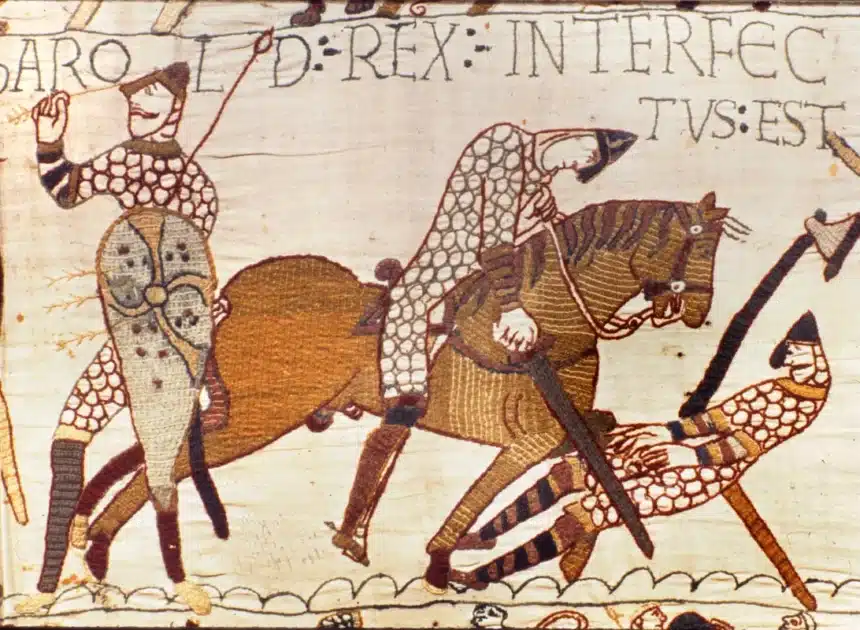
The Royal Mint issued the Battle of Hastings 50p coin in 2016 to commemorate the 950th anniversary of the pivotal 1066 event. The design famously depicts King Harold’s demise, with an arrow striking his eye, a scene inspired by the historical Bayeux Tapestry. While it serves as an interesting numismatic piece celebrating a significant historical milestone, the coin is not considered particularly rare.
A substantial 6.7 million Battle of Hastings 50p coins were released into general circulation. This mintage figure places it in the mid-range for rarity among commemorative 50p coins. To provide context, other notable 50p coins have significantly lower mintages. For instance, the highly sought-after 2009 Kew Gardens 50p had a mintage of only 210,000, and the 2023 Atlantic Salmon 50p saw just 200,000 enter circulation. Given the large number of Battle of Hastings coins minted, it is highly probable that millions of individuals have encountered or possessed one since its release.
Identifying Collectible Coins with Higher Value
For those looking to identify coins that might hold significant monetary value beyond their face amount, several factors are key. Coins exhibiting clear production errors, such as missing design elements, incorrect metal compositions, or significant striking flaws, can attract interest from specialist collectors and potentially fetch hundreds of pounds.
Furthermore, special editions produced by The Royal Mint for collectors, often made from precious metals and presented in protective cases, can be worth considerably more. These collector’s items can range in value from £50 to upwards of £500, depending on the metal, rarity, and condition.
The fundamental principle driving coin value is scarcity. Coins with lower mintages, like the aforementioned Kew Gardens 50p (which can be valued between £150–£200) or the Atlantic Salmon 50p (typically £50–£100+), command higher prices due to their limited availability. While the Battle of Hastings 50p is an interesting piece of British history and worth keeping as a memento, it is unlikely to provide a substantial financial windfall.
Conclusion: A Historical Keepsake, Not a Fortune
In summary, while the 2016 Battle of Hastings 50p coin holds historical significance and commemorates a key event in British history, its monetary value in general circulation is modest. Most circulated coins are worth a few pounds at most. Even those in pristine condition or in presentation packs typically only reach around £10. The exorbitant prices seen on auction sites are usually aspirational asking prices, not reflective of the coin’s true market value. For collectors, focusing on coins with demonstrably low mintages or significant production errors is a more reliable strategy for finding pieces with higher potential worth. The Battle of Hastings 50p remains a fascinating historical keepsake, but it’s advisable not to rely on it for significant financial gain.