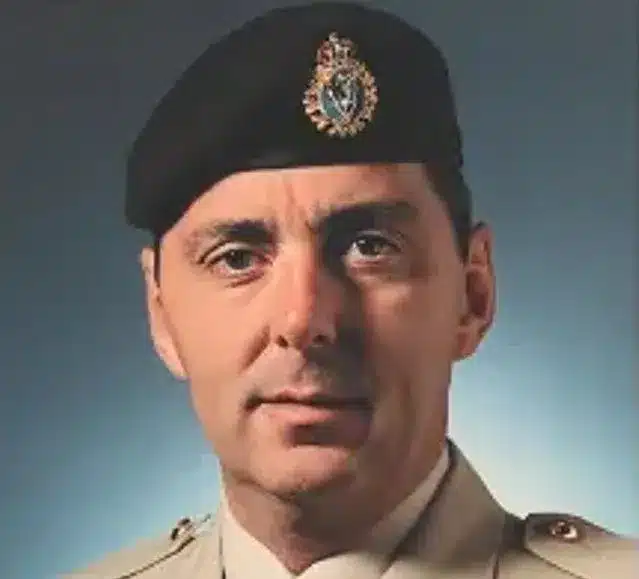
Retired Brigadier-General William Shane “Bill” Richard, a former commander of CFB Kingston, is being remembered as a pivotal community builder whose leadership significantly shaped modern Kingston. Richard, who passed away on July 7 at the age of 77, dedicated nearly four decades to the Canadian Armed Forces before channeling his considerable energy into healthcare, education, and community service in his adopted hometown.
A Transformative Military Career
Born in Charlottetown, P.E.I., on July 19, 1948, Richard’s connection with Kingston began in 1969 when he arrived as an officer cadet for signals officer training at the Canadian Forces School of Communications and Electronics. After a brief return as a young lieutenant in 1973 and subsequent United Nations peacekeeping deployments to the Golan Heights and Sinai Peninsula, he returned to Kingston in a significant leadership role as commandant of the communications and electronics school. With the exception of postings in Ottawa and London, England, Kingston became his enduring home.
Military colleagues recall Richard as a thoughtful leader who adeptly combined extensive operational experience with a keen interest in education and public policy. His academic pursuits included master’s degrees in mathematics and public administration, complemented by an executive fellowship at Queen’s University. This blend of practical experience and intellectual depth informed his approach to leadership.
Saving CFB Kingston
Richard’s tenure as commander of CFB Kingston, beginning in 1993, coincided with a period of significant defense budget reductions following the end of the Cold War. According to his son, Chad Richard, CFB Kingston was among the installations facing potential closure as the federal government reviewed its defense spending.
“My father assumed command at a time when the base was slated to be closed as part of a nationwide program to reduce defence spending,” Chad Richard explained. Rather than viewing this solely as a military challenge, Bill Richard adopted a broader, outward-looking strategy.
He actively worked to forge stronger connections between the military and the wider Kingston community. This involved cultivating relationships with Queen’s University, Kingston General Hospital, and municipal leaders. Furthermore, he helped establish partnerships linking the base with local economic development organizations. These initiatives were instrumental in demonstrating the strategic and economic importance of the installation, solidifying Kingston’s role as a vital center for military education and training.
His efforts to preserve the base’s future were recognized by the Greater Kingston Chamber of Commerce, which honored him with its President’s Award in 1996. Today, CFB Kingston remains a crucial training hub for the Canadian Armed Forces, hosting several key military schools and organizations, including the Canadian Forces School of Communications and Electronics.
A Legacy Beyond the Military
Richard’s influence extended significantly beyond his military career. After retiring from the Armed Forces with 37 years of service and achieving the rank of brigadier-general, he dedicated himself to public service within Kingston. He joined the board of Kingston General Hospital, eventually serving as its chair, where he guided the major healthcare institution through a period of substantial change.
At Queen’s University, Richard contributed his expertise by teaching in the School of Policy Studies and helping to lead an executive master’s program in public administration designed to cultivate future public-sector leaders. His son noted that Richard held a strong conviction in the power of collaboration, believing that bringing institutions together was key to solving complex problems.
Founding the Canadian Institute for Military and Veteran Health Research
This collaborative philosophy was central to one of his proudest post-military achievements: the establishment of the Canadian Institute for Military and Veteran Health Research (CIMVHR). “In this capacity, he sought to bring the Canadian Forces, KGH and RMC together for the establishment of the Canadian Institute for Military and Veteran Health Research,” Chad Richard stated.
The CIMVHR was founded to advance research supporting the health and well-being of military personnel, veterans, and their families. This initiative gained particular importance as Canada addressed the long-term effects of deployments, including those in Afghanistan, and increased awareness of post-traumatic stress injuries among returning service members.
Preserving Military Heritage
Richard also maintained a deep commitment to preserving military history. During his time as commandant of the communications and electronics school, he was a driving force behind the creation of Kingston’s Communications and Electronics Museum. This museum chronicles the history of Canada’s Signals branch and pays tribute to generations of military communicators whose vital work often went unnoticed by the public.
Colleagues observed that Richard believed understanding an institution’s history was fundamental to its future progress. This perspective underscored his dedication to preserving and celebrating military heritage.
A Life of Service and Connection
Throughout his life, Richard received numerous accolades acknowledging both his military service and his extensive community contributions. His obituary highlighted distinctions such as the King Charles III Coronation Medal, the Queen Elizabeth II Diamond Jubilee Medal, the Paul Henderson Award for Community Service, and the Community Foundation for Kingston & Area’s Community Builder Award.
For his son, Chad, these awards represented only a part of his father’s story. He emphasized that his father viewed leadership as a form of service, dedicating much of his life to fostering connections between individuals and organizations that might otherwise have operated in isolation. Whether leading soldiers, supporting local hospitals, educating future public servants, or advocating for veterans, his consistent focus was on building partnerships that strengthened the community fabric.
“He sought to bring people together,” Chad Richard reflected. “I believe he succeeded.” Richard’s enduring legacy is evident across Kingston today, from the continued vitality of CFB Kingston to the numerous institutions and organizations he helped to shape and strengthen.
He is survived by his wife, Shirlene, their children, Shane, Chad, and Candice, and three grandchildren. A funeral mass was held at St. Mary’s Cathedral, followed by a reception at the Communications and Electronics Museum.