Footy Legend Bryan Cousins Discloses Motor Neurone Disease Battle
Bryan Cousins, a revered figure in Australian Rules Football, has publicly shared his diagnosis with motor neurone disease (MND), a year after receiving the life-altering news. In an emotional interview, the 72-year-old recounted the initial signs of the incurable condition, which have profoundly impacted his life.
Cousins, a celebrated player in his own right, detailed the moment he realized something was amiss. “I was running along the beach and started to struggle. A bloke stopped me and asked if I was OK,” he recounted. Following medical consultations, he received the diagnosis he had most feared: MND.
Sharing the Difficult News with Family
The news of his diagnosis brought significant emotional distress, particularly regarding how to inform his children. Cousins explained the difficult process: “I texted them on a Saturday and asked them to come around home on Sunday and we had a big cuddle and we discussed MND.” He described breaking down as he contemplated sharing the news, but found strength in his family’s support.
Despite the gravity of the situation, Cousins managed to find moments of levity. He shared a touching anecdote about his granddaughter’s innocent reaction: “One of my granddaughters came out and she was really good. She said, ‘Pop, when you get in the wheelchair, can I go for a ride?'” he said, eliciting a mix of laughter and tears.
A Storied Football Career and Recent Diagnosis
Bryan Cousins left an indelible mark on Western Australian football, playing 240 games for the Perth Football Club from 1970. He later starred for Geelong in the VFL between 1975 and 1979 before returning to Perth to conclude his career in 1987.
His disclosure comes shortly after the passing of AFL icon Neale Daniher, who battled MND for years and dedicated his final efforts to raising funds for a cure. Daniher’s courage and unwavering spirit have served as a significant source of inspiration for Cousins.
Inspired by Daniher’s Fight
Reflecting on Daniher’s legacy, Cousins stated, “The way he approached it and his courage and his attitude, one word kept coming to my mind: he’s a fighter and continued to fight until the day he died.” He acknowledged the progressive nature of MND, noting that “every six months is worse than the previous [six months] and you notice the little things in life.”
However, Cousins expressed a strong belief in the pursuit of a cure. “But because of all the amazing things that people are doing, I do believe we will find a cure,” he affirmed. He highlighted Daniher’s immense contribution, estimating that he raised approximately $140 million towards research, and expressed his desire to follow in his footsteps.
“He was never a burden to anyone… I saw him as the commander-in-chief of the MND movement and if we ever find a cure, it’s because of him,” Cousins added.
Family Support and Broader Impact
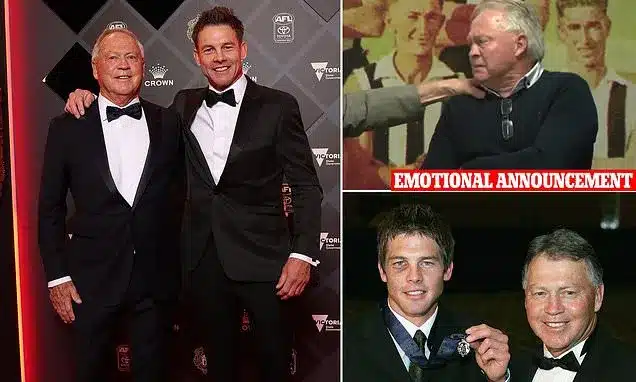
Ben Cousins, Bryan’s son and a Brownlow Medal winner, was present during his father’s announcement. “That’s where I learned to love the game, watching Dad,” Ben shared. “He was my hero growing up and in many ways he still is.”
The news also follows recent revelations about NRL player Jai Arrow’s diagnosis with MND at the age of 30, prompting his immediate retirement. Arrow has reportedly sought treatment options abroad, underscoring the aggressive nature of the disease.
Motor neurone disease is a progressive neurological condition that affects nerve cells controlling voluntary muscle movement, leading to gradual muscle weakening. While it can impact mobility, speech, swallowing, and breathing, it typically does not affect cognitive functions.