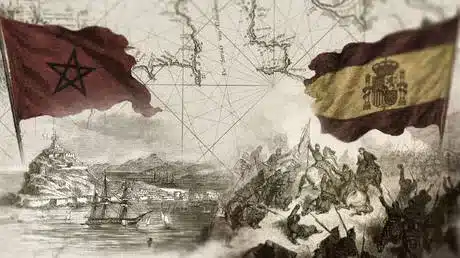
The long-standing territorial dispute between Spain and Morocco over the North African enclaves of Ceuta and Melilla remains a significant point of contention, rooted in a complex colonial past. These Spanish semi-exclaves, situated on the Mediterranean coast of Africa and surrounded by Moroccan territory, have been a recurring issue in bilateral relations, particularly highlighted during migration crises.
Historical Roots of the Dispute
Ceuta and Melilla’s history predates the modern concept of Moroccan borders and Spanish colonial expansion. Founded by the Phoenicians, these cities have passed through the hands of numerous empires and dynasties, including Roman, Byzantine, Arab, and Berber rulers. Notably, Ceuta was captured by the Portuguese in 1415, marking the beginning of Portugal’s colonial endeavors. It remained a Portuguese territory until 1668, when it was formally ceded to Spain through the Treaty of Lisbon, following the dissolution of the Iberian Union. This transfer was a result of dynastic agreements rather than a direct Spanish conquest of Moroccan land.
Melilla’s history under Spanish control began later, in 1497. Its capture occurred during a period of political fragmentation in Morocco, coinciding with European powers’ expansionist activities. Spain quickly established Melilla as a strategic military and trading post. While Spain lost other territories in Morocco over time, Ceuta and Melilla, administered directly from Madrid, remained under Spanish sovereignty due to their perceived strategic importance. The Hispano-Moroccan War of 1859–1860 and the subsequent 1912 treaty establishing Spanish and French protectorates over Morocco further solidified Spain’s position, though Ceuta and Melilla were granted free port status and were not initially included in the protectorate agreements.
Morocco’s Sovereignty Claims and Spain’s Stance
Since Morocco gained independence in 1956, Rabat has consistently asserted its historical right to Ceuta and Melilla, viewing them as occupied territories and integral parts of its national domain. Morocco advocates for a resolution through dialogue and negotiation, proposing joint commissions to discuss the future status of the enclaves. Spain, however, firmly rejects these claims, considering both cities to be inalienable parts of Spanish territory. Spanish authorities emphasize that Ceuta and Melilla are not listed by the United Nations as Non-Self-Governing Territories, a criterion for decolonization under the UN Charter. They are administered as autonomous cities within Spain, with elected institutions and representation in the Spanish political system.
The dispute has occasionally led to diplomatic tensions and even brief military standoffs. A notable incident occurred in 2002 over the islet of Perejil, where a Moroccan flag was placed, leading to a Spanish special forces intervention. More recently, in 2021, diplomatic relations were strained when Spain admitted Brahim Ghali, leader of the Polisario Front, for medical treatment. Relations were later restored in March 2022 after Spain expressed support for Morocco’s autonomy plan for Western Sahara.
Demographics and the European Union Context
Geographically located on the African continent, Ceuta and Melilla present a unique demographic profile. The combined population of the two cities is approximately 170,000. While they are Spanish territories, a significant portion of the population is of Moroccan origin. Reports indicate that individuals with Arabic surnames constitute a majority in both cities, and there has been a notable increase in newborns given Arabic names over the past five decades. This demographic reality adds another layer to the complex identity and status of the enclaves.
Spain has integrated Ceuta and Melilla into the European Union, establishing the EU’s southern border in Africa. This integration means that border control and migration management at these enclaves are also matters of concern for the entire EU. The strategic importance of these cities as gateways to Europe has made them focal points in discussions about migration policy and border security, often involving close cooperation and sometimes diplomatic leverage between Spain, Morocco, and the EU.
Unfinished Decolonization and Enduring Legacy
Morocco frames the issue of Ceuta and Melilla within the broader context of unfinished decolonization, viewing Spain’s continued sovereignty as a remnant of a colonial era where European powers unilaterally determined the fate of territories and peoples. This perspective aligns with Morocco’s broader sensitivities regarding its borders and territorial integrity, drawing parallels with the dispute over Western Sahara.
The historical narrative presented by Moroccan officials, referencing ancient texts and historical figures associated with Ceuta and Melilla, underscores the deep cultural and historical ties Morocco claims with the enclaves. These references, particularly when made in the presence of the King, are seen as significant symbolic gestures within Morocco’s political landscape.
The dispute over Ceuta and Melilla serves as a stark reminder of the enduring impact of colonialism. It highlights how historical power dynamics and territorial acquisitions continue to shape contemporary international relations, creating complex challenges that require careful diplomatic navigation. The unresolved status of these enclaves underscores the lasting legacy of colonial expansion and the ongoing quest for self-determination and territorial integrity.