[ad_1]

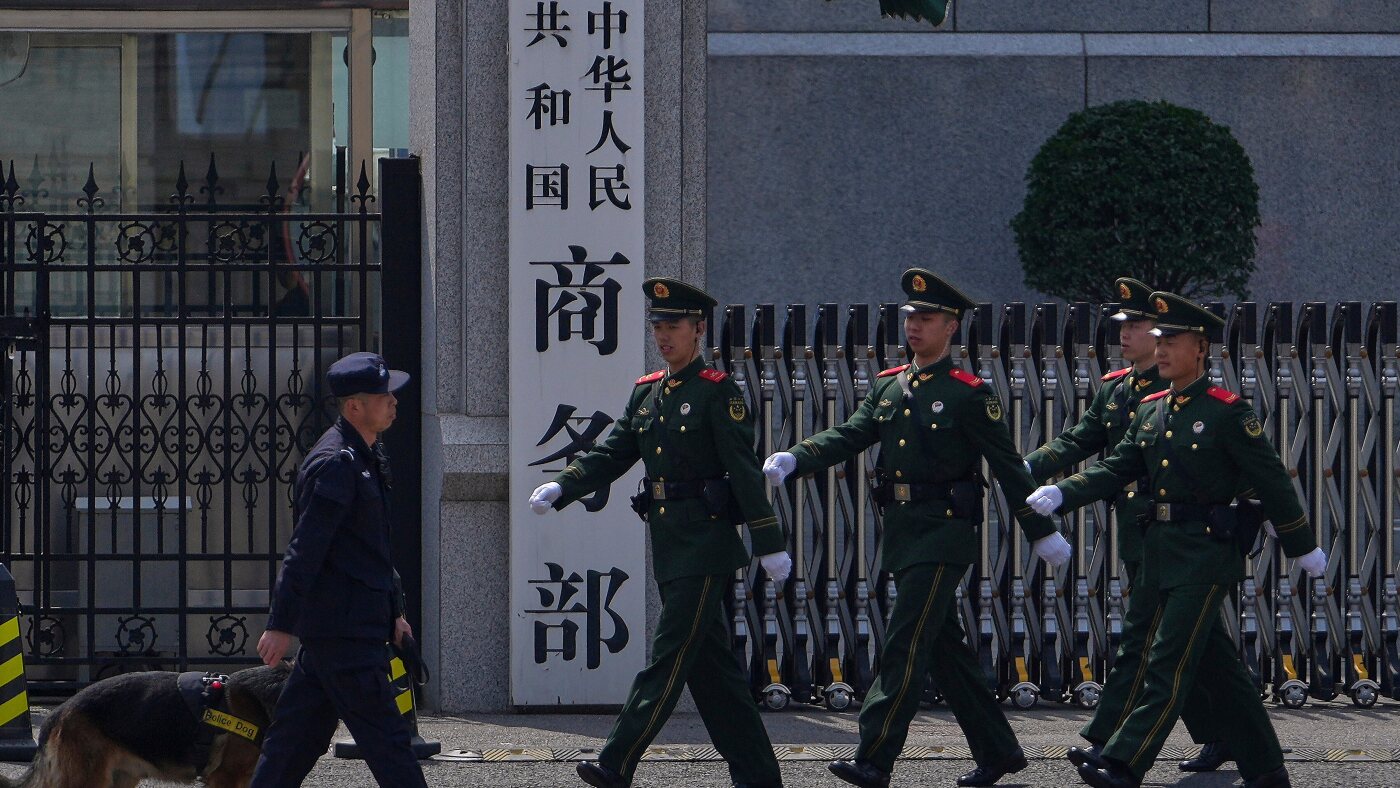
FILE – Paramilitary troopers and a police officer with a sniffer canine march previous the primary entrance gate of China’s Ministry of Commerce, in Beijing, on April 3, 2025.
Andy Wong/AP
conceal caption
toggle caption
Andy Wong/AP
BANGKOK — China on Tuesday restricted exports to 40 Japanese entities it says are contributing to Japan’s “remilitarization,” within the newest escalation of tensions with Tokyo.
Beijing has proven continued displeasure with Tokyo since Japanese Prime Minister Sanae Takaichi in November implied Japan might intervene if China used army pressure in opposition to Taiwan, an island democracy China claims as its personal.

The Chinese language Commerce Ministry put 20 Japanese firms on an export management listing and 20 others on a separate watchlist.
Firms on the export management listing will be unable to import from China dual-use items, which can be utilized for civilian and army functions. They embody a number of enterprise subsidiaries of Mitsubishi Heavy Industries concerned in shipbuilding and the manufacturing of plane engines and maritime equipment, in addition to a few of Kawasaki Heavy Industries and Fujitsu, amongst others.
Overseas organizations or people are additionally banned from offering dual-use objects originating in China to the 20 entities, the ministry stated.
“All ongoing associated actions should stop instantly,” its assertion learn.
The separate watchlist has 20 Japanese firms for which Chinese language exporters are required to submit particular person export license functions, together with danger evaluation experiences and written pledges that the dual-use objects is not going to be utilized by Japan’s army. It consists of Subaru Company, Mitsubishi Supplies Company and the Institute of Science Tokyo, amongst others.
The Chinese language Commerce Ministry stated the measures, aiming to curb Japan’s remilitarization and nuclear ambitions, “are solely authentic, cheap, and authorized.”
The restrictions “are solely geared toward a small variety of Japanese entities, and the related measures solely goal dual-use objects,” it added. “They won’t have an effect on regular financial and commerce exchanges between China and Japan, and sincere and law-abiding Japanese entities have completely nothing to fret about.”
Japan condemns restrictions
Tokyo issued a proper protest of the measures to China’s Deputy Chief of Mission to Japan Shi Yong, based on an announcement by the Japanese Overseas Ministry.
The restrictions, solely concentrating on Japan, largely differ from worldwide practices and are “completely unacceptable,” stated Masaaki Kanai, head of the ministry’s Asian and Oceanian Affairs Bureau.
“The measures introduced at this time won’t ever be tolerated. That is deplorable certainly. We strongly protest to China and urge them to elevate them (the controls),” Kei Sato, Japan’s deputy chief Cupboard secretary, stated throughout a routine briefing on Tuesday.
Sato stated the contents of China’s measures would “should be examined.”
“We are going to take actions accordingly,” he added.
Some points are unclear, together with whether or not they embody uncommon earths buying and selling, he added.
Some firms on listing say they have already got few dealings with China
Most affected firms contacted by The Related Press who responded stated that they had no quick remark.
Representatives of commercial gear provider Yashima Denki Co. and chemical producer NOF Corp, each on the watchlist, stated they believed their firms could be hardly affected by the measures as that they had restricted commerce with China.
Beijing has repeatedly criticized Tokyo over Takaichi’s November feedback in addition to what it describes as Japan’s ambitions to “remilitarize.”
China regards Taiwan as its personal breakaway province, to be annexed by pressure if obligatory, and bristles at any feedback by overseas governments exhibiting assist for Taiwan’s sovereignty.
Takaichi’s get together secured a landslide victory in parliamentary elections earlier this month, which is able to permit her to double down on a major conservative shift in Japan’s safety, immigration and different insurance policies.
[ad_2]