[ad_1]
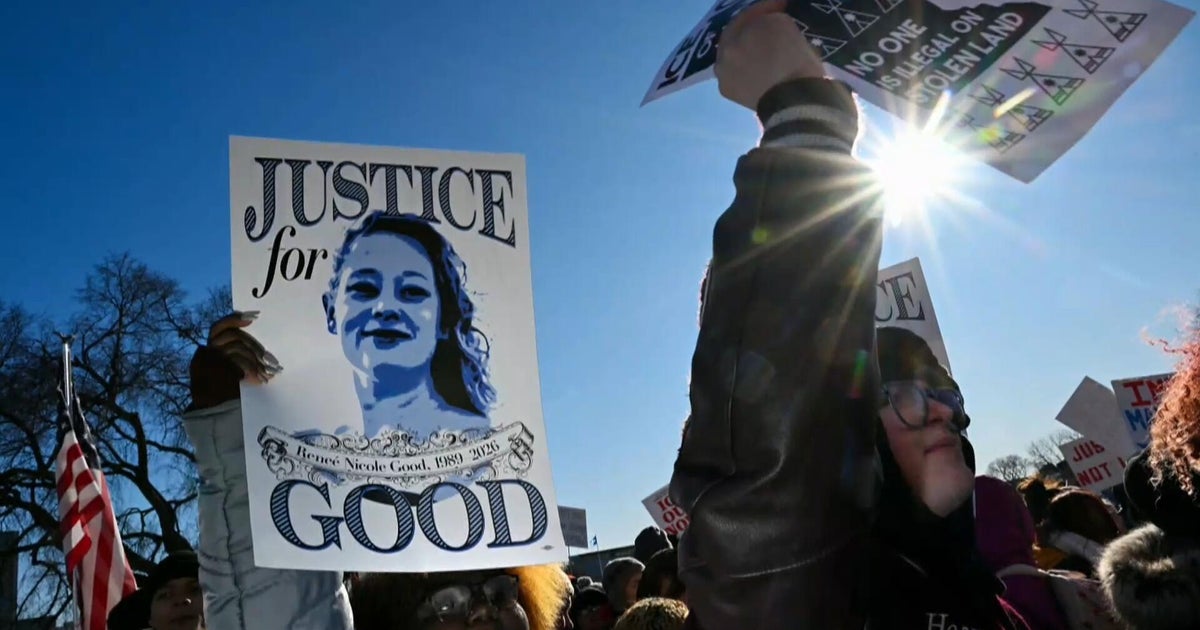
The deadly taking pictures of Renee Good by an Immigration and Customs Enforcement agent in Minneapolis final week units up a possible authorized showdown between the state and federal authorities.
If the state had been to indict the ICE agent, Jonathan Ross, on legal expenses, he might attempt to declare a type of immunity conferred by the Structure. Vice President JD Vance raised this the day after the taking pictures, asserting that the officer was immune from prosecution as a result of he is a federal agent.
“That man is protected by absolute immunity. He was doing his job,” Vance mentioned. The Division of Homeland Safety alleged that Good weaponized her car, and mentioned the officer acted in self-defense. Nevertheless, native officers pointed to video of the taking pictures and raised doubts.
The FBI and Justice Division are main the investigation into the taking pictures after the Minnesota Bureau of Felony Apprehension withdrew from the federal probe, saying it did not have “full entry” to the case proof.
Homeland Safety Secretary Kristi Noem mentioned Minnesota officers “have no jurisdiction on this investigation.”
However Carolyn Shapiro, a legislation professor and co-director of the Institute on the Supreme Court docket of the US at Chicago-Kent School of Legislation, advised CBS Information it is “merely false” that the state lacks jurisdiction.
Shapiro, who beforehand served as Illinois’ solicitor common, mentioned Minnesota has the authority to research and prosecute crimes dedicated within the state.
However any try to convey state legal expenses over Good’s demise is more likely to face authorized obstacles arising from a declare of immunity beneath the Structure’s Supremacy Clause.
What’s Supremacy Clause immunity?
The Supremacy Clause, in Article VI of the Structure, establishes federal legislation as supreme, superseding state legislation. It limits the power of states to intrude with federal legislation by means of legal prosecution. States could maintain federal officers accountable for violating state legislation, until state legislation conflicts with federal legislation; if there’s a battle, federal legislation prevails. But when state prosecutors have proof federal officers acted in methods not associated to their job duties or work insurance policies, then state legislation prevails.
Federal officers could also be prosecuted in the event that they “acted past the scope of their duties, violated federal legislation, or behaved in an egregious or unwarranted method,” Bryna Godar, an legal professional on the State Democracy Analysis Institute on the College of Wisconsin Legislation Faculty, wrote in a short explainer.
The state is independently gathering its personal proof within the Good case. Hennepin County Lawyer Mary Moriarty’s workplace has arrange an proof portal that has obtained a “substantial” variety of submissions, she mentioned in an interview Monday with CBS Minnesota.
Moriarty additionally mentioned after the FBI took over sole authority of the investigation that her workplace has jurisdiction to assessment proof and decide about expenses as a result of the taking pictures occurred in Hennepin County.
If a state prosecutor obtains an indictment or recordsdata legal expenses in opposition to a federal officer, the officer has the precise to have any potential state expenses within the case heard in federal courtroom. It is at this level the officer may invoke immunity beneath the Supremacy Clause, says Robert McNamara, deputy litigation director for the Institute for Justice, a public curiosity legislation agency that litigates “to finish widespread abuse of presidency powers.”
How might the Supremacy Clause immunity be used?
If expenses had been filed, Ross would probably seem earlier than a federal choose and assert that he was invoking the doctrine, and that the actions he took in taking pictures Good had been cheap and vital to satisfy his federal duties — a separate query from whether or not the taking pictures constituted a criminal offense.
“That is the doctrine that is going to be on the middle of the struggle,” McNamara mentioned.
The federal authorities wouldn’t be a celebration on this struggle. The immunity battle can be waged between the agent, on this case Ross, and the state of Minnesota, though the feds might present assist by hiring a protection legal professional or submitting an amicus temporary.
The courtroom must reply two questions at that time, Seth W. Stoughton, a legislation professor at South Carolina Faculty of Legislation, defined in an electronic mail to CBS Information. First, was Ross appearing throughout the scope of his duties, approved by federal legislation? Second, was he performing his duties in a “vital and correct” approach?”
If the courtroom decided the reply was “sure” to those questions, Ross may very well be granted immunity from the state prosecution, Stoughton mentioned.
The case might then be dismissed.
If, nevertheless, the choose allowed the prosecution to proceed, it might stay in federal courtroom with state legal guidelines utilized.
Federal courts “have permitted state authorities to prosecute federal officers for utilizing lethal power once they conclude that the power might have been unreasonable or extreme,” Stoughon mentioned.
He cited a case from the early Nineties when an FBI sniper killed an unarmed lady through the standoff close to Ruby Ridge. Idaho prosecutors charged the agent with involuntary manslaughter, and a federal courtroom allowed it to proceed. (The case was later dropped by state prosecutors.)
States have criminally prosecuted federal officers because the early Eighteen Eighties, with blended outcomes. Consultants say Supremacy Clause immunity is a fancy authorized course of most frequently used throughout occasions of heightened tensions between the states and the federal authorities.
If Ross was ultimately convicted on state expenses, he couldn’t be pardoned by President Trump, Shapiro famous. The president has the ability to pardon folks just for federal offenses, not for state crimes.
[ad_2]