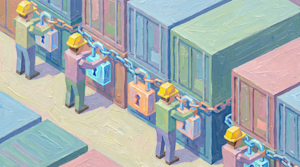
As enterprises speed up the deployment of LLMs and agentic workflows, they’re hitting a crucial infrastructure bottleneck: the container base photographs powering these functions are riddled with inherited safety debt.
Echo, an Israeli startup, is asserting a $35 million in Collection A funding at this time (bringing its to-date complete to $50 million in funding) to repair this by essentially reimagining how cloud infrastructure is constructed.
The spherical was led by N47, with participation from Notable Capital, Hyperwise Ventures, and SentinelOne. However the actual story isn't the capital—it's the corporate’s bold objective to switch the chaotic open-source provide chain with a managed, "secure-by-design" working system.
The Hidden Working System of the Cloud
To grasp why Echo issues, you first have to grasp the invisible basis of the trendy web: container base photographs.
Consider a "container" like a delivery field for software program. It holds the appliance code (what the builders write) and all the pieces that code must run (the "base picture"). For a non-technical viewers, the easiest way to grasp a base picture is to check it to a brand-new laptop computer. While you purchase a pc, it comes with an Working System (OS) like Home windows or macOS pre-installed to deal with the fundamentals—speaking to the exhausting drive, connecting to Wi-Fi, and operating applications. With out it, the pc is ineffective.
Within the cloud, the bottom picture is that Working System. Whether or not an organization like Netflix or Uber is constructing a easy net app or a fancy community of autonomous AI brokers, they depend on these pre-built layers (like Alpine, Python, or Node.js) to outline the underlying runtimes and dependencies.
Right here is the place the chance begins. In contrast to Home windows or macOS, that are maintained by tech giants, most base photographs are open-source and created by communities of volunteers. As a result of they’re designed to be helpful to everybody, they’re typically full of "bloat"—a whole lot of additional instruments and settings that the majority firms don't really want.
Eylam Milner, Echo’s CTO, makes use of a stark analogy to clarify why that is harmful: "Taking software program simply from the open supply world, it's like taking a pc discovered on the sidewalk and plugging it into your [network]."
Historically, firms attempt to repair this by downloading the picture, scanning it for bugs, and trying to "patch" the holes. However it’s a shedding battle. Echo’s analysis signifies that official Docker photographs typically comprise over 1,000 recognized vulnerabilities (CVEs) the second they’re downloaded. For enterprise safety groups, this creates an unimaginable sport of "whac-a-mole," inheriting infrastructure debt earlier than their engineers write a single line of code.
The "Enterprise Linux" Second for AI
For Eilon Elhadad, Echo’s co-founder and CEO, the trade is repeating historical past. "Precisely what's occurred up to now… all people run with Linux, after which they transfer to Enterprise Linux," Elhadad instructed VentureBeat. Simply as Crimson Hat professionalized open-source Linux for the company world, Echo goals to be the "enterprise AI native OS"—a hardened, curated basis for the AI period.
"We see ourselves within the AI native period, the muse of all the pieces," says Elhadad.
The Tech: A "Software program Compilation Manufacturing unit"
Echo just isn’t a scanning device. It doesn’t search for vulnerabilities after the actual fact. As a substitute, it operates as a "software program compilation manufacturing unit" that rebuilds photographs from scratch.
Based on Milner, Echo’s strategy to eliminating vulnerabilities depends on a rigorous, two-step engineering course of for each workload:
Compilation from Supply: Echo begins with an empty canvas. It doesn’t patch current bloated photographs; it compiles binaries and libraries instantly from supply code. This ensures that solely important elements are included, drastically lowering the assault floor.
Hardening & Provenance (SLSA Degree 3): The ensuing photographs are hardened with aggressive safety configurations to make exploitation troublesome. Crucially, the construct pipeline adheres to SLSA Degree 3 requirements (Provide-chain Ranges for Software program Artifacts), making certain that each artifact is signed, examined, and verifiable.
The result’s a "drop-in substitute." A developer merely modifications one line of their Dockerfile to level to Echo’s registry. The applying runs identically, however the underlying OS layer is mathematically cleaner and freed from recognized CVEs.
AI Defending In opposition to AI
The necessity for this degree of hygiene is being pushed by the "AI vs. AI" safety arms race. Unhealthy actors are more and more utilizing AI to compress exploit home windows from weeks all the way down to days. Concurrently, "coding brokers"—AI instruments that autonomously write software program—have gotten the primary turbines of code, typically statistically choosing outdated or susceptible libraries from open supply.
To counter this, Echo has constructed a proprietary infrastructure of AI brokers that autonomously handle vulnerability analysis.
Steady Monitoring: Echo’s brokers monitor the 4,000+ new CVEs added to the Nationwide Vulnerability Database (NVD) month-to-month.
Unstructured Analysis: Past official databases, these brokers scour unstructured sources like GitHub feedback and developer boards to determine patches earlier than they’re extensively revealed.
Self-Therapeutic: When a vulnerability is confirmed, the brokers determine affected photographs, apply the repair, run compatibility exams, and generate a pull request for human evaluate.
This automation permits Echo’s engineering staff to take care of over 600 safe photographs—a scale that will historically require a whole lot of safety researchers.
Why It Issues to the CISO
For technical decision-makers, Echo represents a shift from "imply time to remediation" to "zero vulnerabilities by default."
Dan Garcia, CISO of EDB, famous in a press launch that the platform "saves a minimum of 235 developer hours per launch" by eliminating the necessity for engineers to analyze false positives or patch base photographs manually.
Echo is already securing manufacturing workloads for main enterprises like UiPath, EDB, and Varonis. As enterprises transfer from containers to agentic workflows, the power to belief the underlying infrastructure—with out managing it—will be the defining attribute of the following technology of DevSecOps.
Pricing for Echo's resolution just isn’t publicly listed, however the firm says on its web site it costs "based mostly on picture consumption, to make sure it scales with the way you really construct and ship software program."