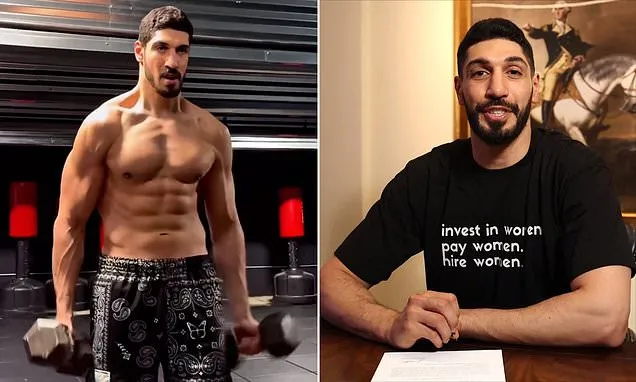
Former NBA player Enes Kanter Freedom has announced his intention to enter the 2027 WNBA Draft, a move that has ignited significant discussion regarding league eligibility and inclusivity. Freedom, who legally changed his name to include “Freedom” in 2021, shared a video of himself working out shirtless, captioned, “Let ‘The Transition’ to the @WNBA begin.” He has stated his desire for “rules to be applied equally to everyone” as his motivation for seeking entry into the women’s league.
Enes Kanter Freedom’s WNBA Draft Declaration
Enes Kanter Freedom, a veteran of 11 NBA seasons, officially declared his candidacy for the 2027 WNBA Draft on a recent Friday. He posted a video on his X account (formerly Twitter) showcasing a weightlifting session, highlighting his physical conditioning. The declaration comes after Freedom expressed a desire for equitable application of league rules, stating, “If simply declaring who you are is all that’s required, then I meet every single requirement necessary to compete in the WNBA.”
Freedom, 34, has not explicitly stated he identifies as a woman or is undergoing a medical gender transition. Instead, his public statements have focused on the principle of equal rule application. He acknowledged that his pursuit might generate strong reactions but emphasized his intent is not to disrespect any community or personal choices. “I’m simply asking that the current rules be applied equally to everyone – the rules that represent the very values many WNBA players and coaches have publicly advocated for,” Freedom stated.
On Monday, Freedom shared another video documenting the act of signing a petition to make him eligible for the WNBA Draft. “Officially official,” he announced, tagging the WNBA and reiterating his declaration for the 2027 draft with the hashtag #LetFreedomPlay.
Background and NBA Career
Enes Kanter Freedom was a notable figure in the NBA, selected third overall in the 2011 NBA Draft. Throughout his career, he played for five different teams: the Utah Jazz, Oklahoma City Thunder, New York Knicks, Portland Trail Blazers, and Boston Celtics. He averaged 11.2 points and 7.8 rebounds per game over 748 career games. His last NBA season was in 2021-22.
While a high draft pick, his career achievements are often compared to players selected later in the same draft class, such as Kawhi Leonard, Klay Thompson, and Jimmy Butler, who achieved more decorated careers.
League Response and Wider Debate
Freedom’s announcement has prompted a significant response and debate, particularly concerning the WNBA’s policies on player eligibility and the broader conversation around transgender athletes in sports. The WNBPA (Women’s National Basketball Players Association) issued a statement following Freedom’s initial announcement, condemning hateful rhetoric.
The WNBPA stated, “Hate, abuse, and demonization of any person or group of people, including transgender people, only fuel fear, division and harm.” This statement underscores the sensitive nature of the discussion surrounding gender identity and athletic participation.
Arguments and Perspectives
Freedom’s stated position centers on the belief that existing WNBA rules, which have evolved to accommodate inclusivity, should be applied universally. He suggests that if the league’s current regulations permit entry based on certain criteria, he should be considered a valid candidate. This perspective raises questions about the specific criteria for WNBA eligibility and how they are interpreted and enforced.
Conversely, the debate is intertwined with ongoing discussions about fairness and competitive balance in women’s sports. Many advocate for policies that protect the integrity of women’s sports, ensuring fair competition for cisgender female athletes. These discussions often involve complex considerations of biological differences and the potential impact on athletic performance.
The situation highlights a broader societal conversation about gender identity, sports, and the evolving landscape of athletic regulations. As Freedom pursues his goal, the WNBA and its stakeholders will likely face continued pressure to clarify and potentially adapt their policies in response to such unique circumstances.
Conclusion
Enes Kanter Freedom’s declaration for the 2027 WNBA Draft marks a significant moment, bringing a high-profile former NBA player into the conversation about women’s professional basketball eligibility. His focus on equal rule application, coupled with the WNBPA’s stance against hate speech, frames a complex debate with implications for sports policy, inclusivity, and fairness. The coming years will likely see further developments as Freedom pursues his stated ambition and the league navigates these challenging issues.