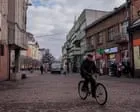
While most Ukrainians hope Viktor Orbán loses Hungary’s parliamentary election after 16 years in power due to his pro-Kremlin positions and opposition to Kyiv, sentiments differ in Berehove. This town of about 30,000 in the Zakarpattia region’s hills hosts a majority of ethnic Hungarians, where Hungarian language echoes alongside Ukrainian in daily life, schools, and homes.
Local Support for Orbán Persists
Some residents quietly back Orbán’s Fidesz party. “Orbán is not perfect, but he cares about Hungarians everywhere,” said László outside the Hungarian consulate while collecting voting documents. He requested anonymity due to discomfort discussing the topic publicly.
László expressed frustration over strained Hungary-Ukraine relations but commended Orbán for issuing passports to ethnic Hungarians, providing financial aid, and defending language rights. Many in Berehove hold dual Hungarian citizenship despite Ukrainian laws, with Budapest establishing voting stations at local consulates.
Orbán positions himself as a protector of the roughly 60,000 ethnic Hungarians in Zakarpattia, alleging discrimination and forced assimilation in Ukraine. Critics argue he amplifies these issues to fuel hostility toward Kyiv and its Western partners.
“Hungarian voters are sensitive to the issue of ethnic Hungarians living beyond Hungary’s borders,” noted András Rácz, a senior research fellow at the German Council on Foreign Relations. “Orbán’s rhetoric made the situation seem much worse, and with that, he turned domestic Hungarians against Ukraine.”
Escalating Diplomatic Tensions
Hungary blocks a €90 billion EU aid package for Ukraine, delaying vital war funding. Budapest also leverages ethnic Hungarian concerns to obstruct Kyiv’s EU membership push. In a leaked phone call this week, Hungary’s Foreign Minister Péter Szijjártó informed Russian counterpart Sergei Lavrov that rights issues for Hungarians significantly influence Budapest’s stance against Ukraine’s EU accession.
Nuanced Views from Berehove Residents
Locals describe a more balanced reality. Some highlight Ukraine’s language policies, including a now-suspended 2023 law phasing out minority languages in schools. Yet many report no daily discrimination.
“We live alongside Ukrainians like brothers and sisters,” said Erika, an employee at the town’s Hungarian theatre, where clocks show both Hungarian and Ukrainian times. “There is no discrimination here at all.” She follows the election closely but holds only Ukrainian President Volodymyr Zelenskyy as her leader and did not vote.
Near a Catholic church with a Hungarian flag, where services occur in Hungarian, Nátália emerged from mass. “Hungarians and Ukrainians live together and pray together,” she stated. “We celebrate both Orthodox and Catholic Easter, and we like it this way.” She lamented Ukraine’s role as a Hungarian political flashpoint, emphasizing local harmony amid heated politics.
Artúr compared Berehove’s divisions to Hungary’s own. “Just like over there, you have people who want Orbán to win and people who want the opposition to replace him,” he said, favoring Orbán’s defeat over corruption and Ukraine policy.
Historical Roots and Orbán’s Influence
Berehove, known historically as Beregszász, has shifted between empires—from Hungary, to Czechoslovakia post-World War I, briefly back to Hungary, then Soviet and independent Ukraine since 1991. Poverty persists despite changes.
Orbán’s administration funds schools, community centers, and farmers. “People see tangible results from him, and that’s why they tell me he has their vote,” said Boris Vashkeba, a lawyer heading a Hungarian organization in nearby Vynohradiv. Initially supportive, Vashkeba now criticizes Orbán’s Moscow tilt.
Timbur Tomba, who leads Kyiv’s Hungarian community and opposes Budapest’s government, attributes support to state media. “Most Hungarians in Ukraine still watch state propaganda. These people are just being fed lies from the television. They get a distorted picture of reality,” he said.
Zakarpattia’s border location distances it from war impacts, with fewer front-line deployments and rare sirens. “The war feels distant in Zakarpattia, so people don’t always understand what the rest of Ukraine is going through,” Tomba added. Orbán has claimed Ukraine sends ethnic Hungarians to the front disproportionately, but leaders refute this, noting thousands serve and about 100 have died. A central memorial honors fallen soldiers.
Hopes for Reconciliation
Zelenskyy visited Zakarpattia this week, meeting Hungarian leaders and praising unity ahead of Hungary’s vote. Vashkeba calls for renewed ties: “We need a restart in relations; it can’t go on like this. When Ukraine and Hungary, two nations that have both suffered at the hands of Russia, are set against each other, it is Moscow that ultimately benefits.”