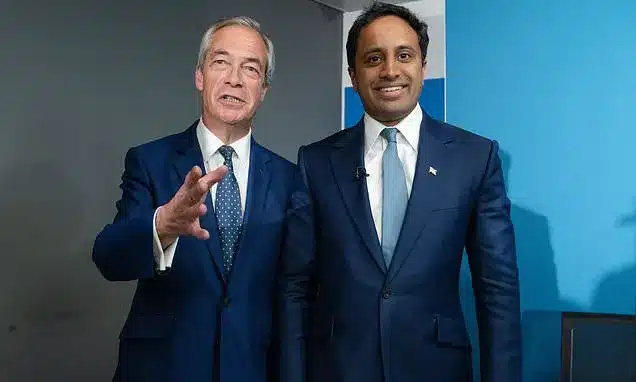
Nigel Farage’s leadership of the Reform UK party is reportedly facing an internal challenge, with accusations that a key figure, Zia Yusuf, is consolidating power and reshaping the party in his own image. This situation has drawn parallels to historical instances of internal power struggles within political movements, raising questions about Farage’s authority and the party’s future direction.
Internal Dissent and Suspension
The tensions within Reform UK became public when Tim Montgomerie, a former Downing Street adviser and recent defector to the party, publicly criticized Zia Yusuf, who holds the self-styled title of ‘Shadow Home Secretary.’ Montgomerie accused Yusuf of not being a “team player” and described his behavior as “childlike,” citing a three-month period where Yusuf allegedly refused to communicate with him following Montgomerie’s role in brokering Robert Jenrick’s defection to Reform. Despite Montgomerie’s lack of a formal leadership role, his criticisms resonated with other senior party members who reportedly shared similar sentiments.
However, Reform UK’s response was swift and controversial. Before Montgomerie’s full interview could be broadcast, he was suspended from the party. This action drew widespread condemnation, with critics labeling the party’s reaction as overly sensitive and akin to a “snowflake-like” response to dissent. The suspension occurred at a time when Reform UK was reportedly aiming to shift media focus towards its welfare policies and away from internal disputes and ongoing questions surrounding a significant financial gift to Nigel Farage.
Montgomerie, who co-founded the Centre for Social Justice think-tank and created the Conservative Home website, vowed to fight his suspension and expressed his desire to remain within Reform UK, emphasizing that his departure from the Conservative Party was not taken lightly. The internal division within Reform is evident, with some insiders supporting the suspension and others opposing it.
Farage’s Absence and Yusuf’s Growing Influence
Notably, Nigel Farage has remained conspicuously silent on the matter. The official explanation for his absence is a holiday following the Clacton by-election. However, the timing of his departure, which occurred before the election result was officially declared, has been questioned, particularly given the party’s previous criticism of other politicians taking summer breaks.
Despite Farage’s apparent detachment, evidence suggests Zia Yusuf is actively consolidating his influence. Recent appointments within the party have raised eyebrows, including the elevation of Jaymey McIvor to a senior role managing election candidates. McIvor, who denies allegations of sending inappropriate photos to a colleague that led to his expulsion from the Conservative Party, is reportedly a close ally of Yusuf. Insiders suggest that McIvor’s promotion to such a critical position, overseeing candidate selection, is unusual.
Yusuf’s Stance on Political Opponents
Yusuf’s confrontational approach extends to his dealings with political opponents, both external and internal. He was reportedly censured by Farage himself for calling former Tory defence secretary Ben Wallace a “traitor” for his role in facilitating the relocation of Afghans to Britain. Yusuf has also made thinly veiled criticisms of figures like Richard Tice, perceived as targeting individuals with “Right Honourable” titles and implying dishonor.
This antipathy towards traditional political figures appears to be shaping Reform UK’s strategic direction. While some party leaders have considered exploring potential alliances with the Conservative Party, particularly to counter the Labour Party, Yusuf is reportedly vehemently opposed. His strong anti-Tory sentiment, described as exceeding his dislike for Labour, is seen as a significant factor influencing the party’s stance.
Communication Strategy and Farage’s Diminishing Control
Furthermore, Yusuf seems to be exerting considerable influence over Reform UK’s communications strategy. The party’s tone has reportedly become more aggressive and hostile towards rivals in recent months, a shift that contrasts with Farage’s established public persona, often characterized as upbeat and optimistic. Sources within the party suggest that Yusuf is largely responsible for this change, operating independently and without broader consultation.
This apparent shift in control has led to speculation that Farage is gradually losing his grip on the party. Despite pledging to “give [Yusuf] a ticking-off” following the controversy over the Ben Wallace comments, there has been no discernible impact, with the offending tweets remaining online and no apology issued by Yusuf. Yusuf, a former investment banker who sold his luxury concierge company for a substantial sum in 2023, appears undeterred by Farage’s admonishment.
The Challenge to Farage’s Authority
Reports have emerged suggesting Farage is contemplating removing Yusuf, but some insiders question whether he possesses the necessary authority to do so. One perspective is that Yusuf holds significant leverage due to his knowledge of internal party affairs, making Farage hesitant to act against him. This reluctance, while perhaps understandable given the circumstances, places Farage in a difficult position.
The current internal chaos within Reform UK is described as unsustainable. With Yusuf reportedly installing his own leadership team, establishing an independent media operation, and pursuing his own political agenda, the party’s image as a potential government-in-waiting is being undermined, potentially resembling a disorganized group rather than a cohesive political force.
Conclusion: The Urgency for Action
The situation underscores the urgent need for Farage to reassert his authority. The narrative draws a parallel to the 1980s in Liverpool, where Derek Hatton, a deputy leader, effectively usurped power from the formal leader, John Hamilton. The article concludes that once a subordinate gains a taste for power, they are unlikely to relinquish it easily. Farage faces the critical task of addressing these internal challenges swiftly to prevent further erosion of his leadership and to maintain the party’s coherence and public image.