Explorers entering Foul Air Cave near Buchan in eastern Victoria immediately notice its grim reputation. Deep inside, bacteria deplete oxygen and release toxic gases, creating a pervasive stench. This natural pitfall, with its slippery entrance and steep drops, traps unwary animals, leaving traces of death amid the mud.
Megafauna Remains from the Pleistocene
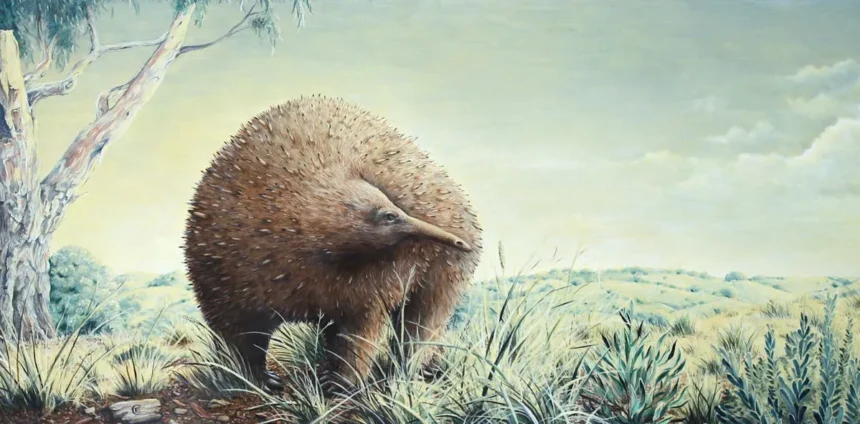
During the Pleistocene Epoch, tens to hundreds of thousands of years ago, the cave preserved bones from diverse megafauna. Among these, a fossil confirms the presence of the giant echidna Megalibgwilia owenii. This extinct monotreme, twice the size of today’s Australian echidnas, appears in a recent study in Alcheringa: An Australasian Journal of Palaeontology.
The specimen, collected nearly 120 years ago, verifies for the first time that this species inhabited Ice Age Victoria, filling a 1,000-kilometer gap in its known range.
Historical Expeditions Unearth Ancient Bones
In 1906–1907, early explorers including Frank Palmer Spry from Museums Victoria, local caves curator Francis Moon, and geologist Thomas Sergeant Hall first delved into the cave. They recovered numerous fossil bones, such as those from clawed mega-marsupials and predatory marsupial lions, now stored at Melbourne Museum.
These finds continue to reveal insights into prehistoric life. A seven-centimeter skull fragment, documented during routine collection reviews, matches M. owenii uniquely, confirmed through comparisons across Australian museum holdings. Historical records, maps, diaries, and newspapers link the fossil directly to Spry and Foul Air Cave.
Features of Owen’s Giant Echidna
Previously known from sparse fossils in Western Australia, South Australia, Tasmania, and New South Wales—including one skeleton and four partial skulls—this robust creature measured one meter long and weighed about 15 kilograms, comparable to a four-year-old child.
Its name blends the Greek “mega-” for large with “libgwil,” the Wemba Wemba term for echidna from northern Victoria and southeastern New South Wales, plus “owenii” honoring anatomist Sir Richard Owen. Known as Owen’s giant echidna, it closely resembled New Guinea’s long-beaked echidna (Zaglossus).
Broad limbs and shoulders showed heavy musculature, while its wide, straight, untoothed beak featured palate ridges. These traits suggest it ripped apart logs or dug hard soils for moth and beetle larvae, differing from modern echidnas’ termite and worm diets.
Modern Exploration Builds on the Past
Early cavers used basic gear like candles and ropes, yet succeeded through expertise and local knowledge. Today, advanced equipment—headlamps, protective suits, and sturdy ropes—enhances safety. Recent efforts, supported by Parks Victoria rangers and the Victorian Speleological Association, echo this collaborative spirit.
Collection-based research highlights how overlooked specimens yield discoveries. Sparse bones of similar large, slender echidnas from Victoria and South Australia deserve re-examination to explore variations or new species. Recent suggestions that Zaglossus lingered in northern Australia into the 20th century raise possibilities for further finds in landscapes or collections.