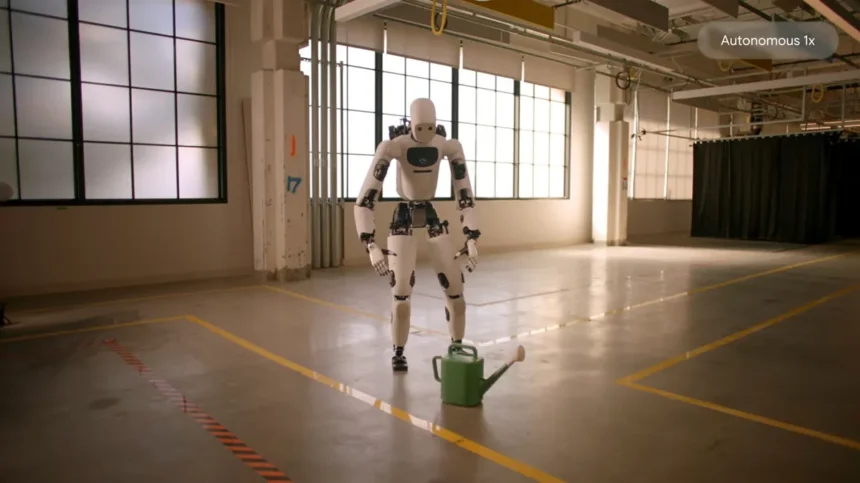
Google DeepMind has unveiled Gemini Robotics 2, an advanced artificial intelligence platform designed to provide robots with sophisticated, “intelligent whole-body control.” This new iteration of the AI model enables robots, including humanoid models, to perform a wider array of complex physical tasks with greater autonomy. The company showcased the platform’s capabilities through a video demonstrating robots engaging in activities such as cleaning up litter, handling watering cans, inserting a tape into a boombox, screwing in a lightbulb, and tying garbage bags.
Advancements Over Previous Systems
While the original Gemini Robotics system was capable of intricate manipulations like closing storage bags and folding origami, these actions were primarily executed through robotic arms and hands. Gemini Robotics 2 introduces a significant leap forward by integrating “intelligent whole-body control.” This allows robots to utilize their entire physical form for tasks, moving beyond the limitations of just articulated appendages. Google asserts that the demonstrations feature real-time footage of fully autonomous robots, distinguishing it from other high-profile robotic demonstrations that have reportedly relied on teleoperation.
Multimodal Understanding and Control Architecture
The enhanced capabilities of Gemini Robotics 2 stem from its architecture, which integrates multiple AI models to foster a multimodal understanding of the robot’s environment. Specifically, the platform incorporates:
- A vision-language model for comprehending visual and textual information.
- Two vision-language action models that govern both full-body movement and precise hand-and-arm actions.
This combination allows the robots to perceive their surroundings, interpret instructions, and execute coordinated physical responses using their entire bodies. This sophisticated integration is key to enabling more fluid and adaptable interactions with the physical world.
Task Specificity and Training Methodology
It is important to note that the robots powered by Gemini Robotics 2 are not yet general-purpose machines capable of performing any conceivable task. The models demonstrated were specifically trained for the activities shown in the accompanying video. Google DeepMind employed a diverse training methodology, combining human teleoperation, extensive video examples, and sophisticated simulations to teach the robots specific actions. This targeted training approach allows for high proficiency in demonstrated tasks but highlights the ongoing development required for broader applicability.
Towards Physical AGI
Google DeepMind views Gemini Robotics 2 as a significant milestone on the path toward what they term “physical AGI” – Artificial General Intelligence capable of performing any task a human can. This ambition involves creating robots that can seamlessly integrate into and interact with the physical world in ways previously only achievable by humans. The development represents a step towards robots that can understand and act within complex, real-world environments.
Safety Considerations and Future Development
The integration of advanced AI into physical robots, especially those capable of significant physical force, raises critical safety concerns. Google acknowledges this challenge and is implementing a multi-layered safety approach. Each layer of the AI model is equipped with guardrails designed to prevent harmful actions. Furthermore, the company has introduced a new benchmark called ASIMOV-Agentic, specifically developed to detect whether a given command could lead to a dangerous outcome.
Carolina Parada, head of robotics at Google DeepMind, emphasized the heightened importance of safety in these evolving applications. “The safety question is even more pressing because you’re putting them in a lot of other situations,” she stated. “There’s a lot of uncertainty that will show up, and so you want to be able to understand the safety question more deeply.” This focus on safety is paramount as the technology moves towards more unpredictable real-world scenarios.
Current Stage and Industry Context
Despite the impressive advancements, Gemini Robotics 2 is still in its early stages of development. Google has indicated that consumer-facing robots powered by this technology are not expected in the near future. This contrasts with the ambitious timelines set by some competitors, such as Elon Musk’s Tesla Optimus robots, which have been projected to become a major product with significant sales targets and deployment numbers in manufacturing facilities. However, past projections for Optimus robot deployment have not been met, underscoring the considerable challenges in bringing advanced robotics to widespread commercial reality.
The development of Gemini Robotics 2 signifies a notable progression in AI-driven robotics, focusing on intelligent control and a deeper understanding of physical tasks. While the path to general-purpose, autonomous robots is ongoing, Google DeepMind’s systematic approach to capability development and safety lays a foundation for future innovations in the field.